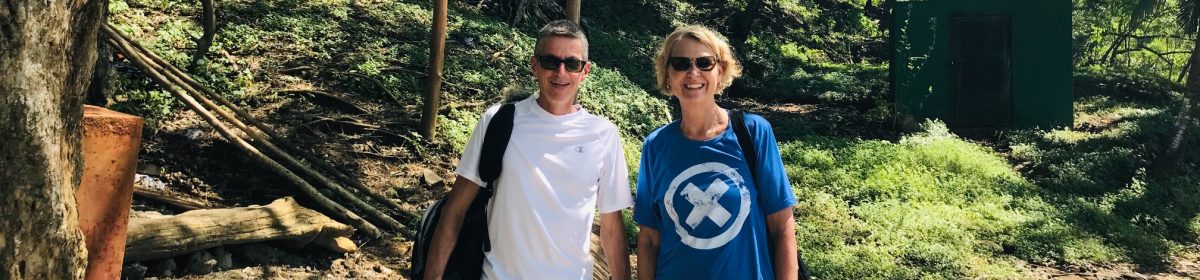
I’ve had multiple people back in the US ask me how we are enjoying the wonderful fruits and vegetables here in Costa Rica. They must imagine that we are able to stroll pleasantly through farmer’s markets with a wicker basket in hand, stop at stalls and chat amiably with the local vendors, discussing their wares, and then return home to prepare an authentic meal. This scene is a staple in House Hunter’s International, which would lead a person to believe that all expats are able to enjoy this romantic scenario. Our reality is different.
When we first moved to Costa Rica and lived in the Central Valley, there was a farmer’s market every Saturday in downtown Escazú. At that time, we didn’t have a car, so we walked everywhere. The farmer’s market was an hour’s walk away. Since it was such a far walk, we didn’t chance it if it looked like it was going to rain, which precluded us going during the six months of the rainy season. When we did visit, we didn’t take a wicker basket, which we still don’t own, instead opting for a couple of Costco bags.
Our purchase decisions were not based on cordial conversations with the local vendors. Instead, they were based first and foremost on what we could comfortably carry weight-wise on our hour walk back home. Obviously, we never bought watermelons at the farmer’s market! After an hour, though, all items felt very heavy, so John cut a couple of foam pool noodles to cushion the bag handles, so they didn’t cut into our fingers as we trudged home.
All transactions were in cash, and Costa Rican paper bills start with the 1000 value. It is not easy for us to understand high numbers in Spanish. (Actually, one of the many things it is not easy for us to understand in Spanish.) After we made a selection and asked for the price, we would struggle to understand the response. Eventually we would just show the vendor a Costa Rican bill, like the red 1000, and see if we were asked for more, or were given change. No amiable chatting during the transaction.
We went to the farmer’s market maybe twice. It was such an inconvenient way to purchase small, lightweight fruits and vegetables, that it was not worth the effort. And then along came COVID, which shut the farmer’s markets down, anyway.
It shouldn’t be surprising then, to learn that in Escazú, our fruit and vegetable purchases were primarily made at Walmart, which was right across the street, or PriceSmart (like Costco for Latin America), which was about a half hour walk away. We always carried our Costco bags, and brought along the pool noodle cushions for PriceSmart, or when we anticipated buying something heavy at Walmart. Again, the decision on where to purchase items often came down to weight. Not surprisingly, then, watermelons were always bought at Walmart.
I suppose that our purchase of fruits and vegetables primarily at Walmart and PriceSmart in Escazú would be disappointing to those who might have imagined us living out those scenes from the House Hunter’s International shows.
When we moved to the Playa Flamingo area, and bought our pickup, we thankfully no longer had to rely on slogging to and from stores with heavy bags in hand. But our primary stores were less convenient. So, unlike before, when we could walk across the street to Walmart, or a half hour to PriceSmart, we now face an hour’s drive to the closest Walmart and PriceSmart, in Liberia. Actually, PriceSmart is on the outskirts of Liberia, across from the airport, while Walmart is further into town. PriceSmart is fairly new, with ample parking. Walmart has been around for a while, and the store and its parking lot are usually very crowded. Because of the extra hassle, we avoid going to the Liberia Walmart unless it is absolutely necessary, a sentiment that we also had when we lived in the US.
We do go to PriceSmart a couple of times a month, and when we do, we buy some fresh fruits and vegetables. The problem with PriceSmart, like Costco, is that for many things, you must buy an ample supply, because they are packaged together in amounts that will feed armies. For example, if we wanted to buy bananas, we would have to buy several bunches. We can’t eat that many before they turn, so buying bananas there isn’t an option.
On a day-to-day basis, there are two places in Playa Flamingo that we drive to for our fruits and vegetables. The first is a small grocery type store, that many gringos usually refer to as Chinese stores. The second is a more local fruit and vegetable stand. The small grocery store is less than a 10-minute drive from our house and easy to get in and out of, which makes it our preferred source of staples in between PriceSmart trips. Pulling in and out of parking areas can be accident-ridden here. Our priority for stores to frequent changed from where we could easily walk to, in Escazú, to where we would be the least likely to be involved in an accident, in Playa Flamingo.
The small store has a tiny section in the back corner that houses their fruit and vegetable selections. We can purchase one type of lettuce, red/white/green onions, broccoli, carrots, zucchini, Costa Rican sweet peppers, and sometimes cauliflower, packages of mushrooms and green beans. There are also a few other fruits and vegetables squeezed in that we cannot recognize.
We do occasionally go to one of the local fruit and vegetable stands, that is a 15-minute drive, or longer, and requires us to go through the small, beachfront town of Brasilito. Brasilito is not charming and has only one road, technically “highway” 180, you must use to get through it. Just off the main grass square, which is primarily used for parking for the beach, is a one-lane bridge for the two-lane road. It is highly unusual that there is no one coming from the other direction, so you learn the unspoken etiquette for crossing a one-lane bridge. If you come upon the line of cars that is currently crossing the bridge, you speed up to make sure you cross before cars on the other side see an opening. If you are one of the unlucky ones, you must wait until all of the cars crossing in the other direction are through. One time we had to wait in line for 20 minutes because a parked truck along the side of the road blocked traffic, causing gridlock on the bridge.
The local fruit and vegetable stand was made from a large storage container. It is not air conditioned, although there are several refrigerated cases in it. They sell most of the same fruits and vegetables that the Chinese grocery does but have more on-hand. They also sell other items that we can’t get at the Chinese store, for example, sweet potatoes, mushrooms, different varieties of lettuce, apples, and spinach. On a few occasions, as we rummaged through one of the refrigerated cases, we discovered a few packages of Brussel sprouts! When they are unattainable, a recipe for bacon-roasted Brussel sprouts arriving in our email causes us to salivate excessively and unapologetically.
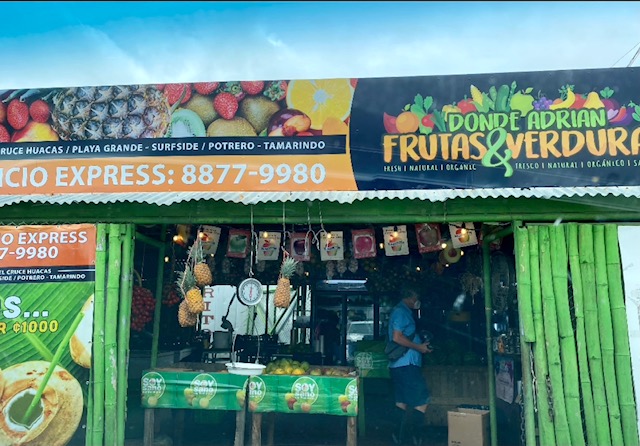
Of course, the fruit and vegetable stand carries locally grown fruits and vegetables that Costa Ricans are familiar with, and we are not. In the tradition of the House Hunter International market shopping scene, I would like to think that we are adventurously seeking out new fruits and vegetables, and happening upon one, excitedly holding it up to each other to see, exclaiming – “let’s try this!” Nope. We’ve had a few experiences with new fruits and vegetables, and although they have been adventurous, we are not anxious to repeat them.
Take, for example, our experience with one unknown fruit that we purchased from the stand. We were there to purchase some specific items, and as we worked our way through the two narrow aisles, I noticed a crate on the ground, with about four very large, greenish fruits. I had never seen these fruits for sale anywhere before, and even though we had our truck so could handle transporting one of these hefty items, I just stepped around the crate. As I made my way back to the same area, one of the local workers held up one of them and asked if I wanted to buy one. I poked it. It was so soft, seemingly too soft. My experience with fruits is that if they are that soft, they are over-ripe, so I thought he was just trying to get rid of old produce on an unsuspecting gringo.
At that moment, another gringo approached me.
I looked at him, and mentally categorized him. I am a gringo here in Costa Rica, but in my mind, there are different categories of gringos, and they each have their own look. John and I are in the “Retired gringo” category. People in my category look older, and wear vacation clothes. Women wear shorts, skorts and the occasional sundress, often with some bling. Men wear shorts and sleeveless shirts when they can get away with it, because it is so hot, otherwise t-shirts and the occasional button-down shirt for a nice dinner. Our preferred footwear is sandals or flipflops. Most of our group lives in tourist areas and speak little or no Spanish. Men get haircuts, and most women get their hair and nails done. And almost all of us have a protruding stomach – from a slight paunch to a full-on beer belly. We are in Costa Rica because of the weather and beaches, like other retirees who flock to Miami. But here you don’t have hurricanes.
The other gringo that approached me was in what I call the “Pura Vida” category. These are younger people that I imagine came to Costa Rica because of the Pura Vida lifestyle. They all have long hair – men and women alike. Men may pull their hair back into a ponytail or manbun, or let it flow. Men also usually have beards. Both the men and women are stick thin. The women wear long, flowing, clothes, with spaghetti straps that show off their model-like physique and the fact that they don’t have to worry about covering up bra straps. Men usually wear shorts and t-shirts, but the t-shirts are usually plain, with no cute pictures of sloths, monkeys or turtles. They always have tattoos – and usually there is one that says “Pura Vida”. They do yoga, and frequent restaurants with names that include words like “Vegan”, “Buddha”, “Ancient People”, and “Mother Earth” and eat sandwiches on black bread. They usually speak Spanish while they move tranquilly about towards enlightenment.
Of course, I have made up other categories of gringos, like “Working here in Costa Rica” and “Married to a Tico/Tica”. But the two people in this conversation at the fruit and vegetable stand are me, “Retired” gringo and the other young guy with the long, brown hair and beard, “Pura Vida” gringo (PVG).
PVG asked me, “Have you tried that fruit before?”
I looked at him, and noticed he had a basket across his arm – of course he did.
I replied, “no,” hoping that he would leave me alone to finish finding the vegetables that I had come to get. Also, I was feeling a little bit like the kid who won’t try new food reacting to an adult who is trying to push it.
He continued, “They’re great – you really should try one.” The man who worked at the stand moved away to give us room.
I looked for an out. “Are these OK? I mean, they seem so soft,” I say, “you can practically push your finger through them.”
PVG bent over and examined the fruit, poking at each one. “These are perfect!” He picked one up, which happened to be the same one the guy at the fruit stand had tried to get me to buy.
I shook my head, frowning at this very large fruit, about the size of a watermelon. “What is it?”
PVG gave me a puzzled look. “I’m not sure the name of it,” he admitted. I imagined that to him this was just one more of the great mysteries of life that a person should accept without question.
“But how do you eat it?” Big mistake – I’d now fully engaged.
PVG started talking non-stop, while I tried to listen intently. “Well, first you cut it open, and it will be slimy in a fibrous sort of way. I don’t like to eat it like that. Take out all the seeds, and then freeze it. After that, take it out of the freezer, and put it in a good blender or food processor, and you can eat it like ice cream. It’s sooo good.”
He handed me the fruit, at which point I felt obligated to purchase it. I mumbled a rather insincere, “thank you,” and walked away. I could hear him turn to the guy who worked there and start speaking to him in Spanish – Spanish with a very gringo accent, I noticed.
I have no idea how much that big fruit cost, but I imagine it was a lot, since we paid for it by weight, like everything else. The check-out counter is at the front and checking out is entirely a manual process. You lay your purchases on the counter, and the woman takes each one and puts it on a scale, and hands it back to you. She then multiplies what’s on the scale by a price that she somehow knows, using an old-fashioned solar calculator. (My kids are adults now, but they used this kind of solar calculator in grade school. The calculator she uses looks that old.) She then writes down the amount she just calculated in a wire-bound notebook. After everything has been weighed and written down, she uses the calculator to add up all the numbers. She will then tell you the total in Spanish but will also turn her calculator toward you so you can see the total there, too. Surprisingly, they do accept credit cards.
At home, we put away our fruits and vegetables, except for the large mystery fruit. We measured it – nearly 12 inches! We have limited storage in our rental – in the fridge or on the kitchen counter.
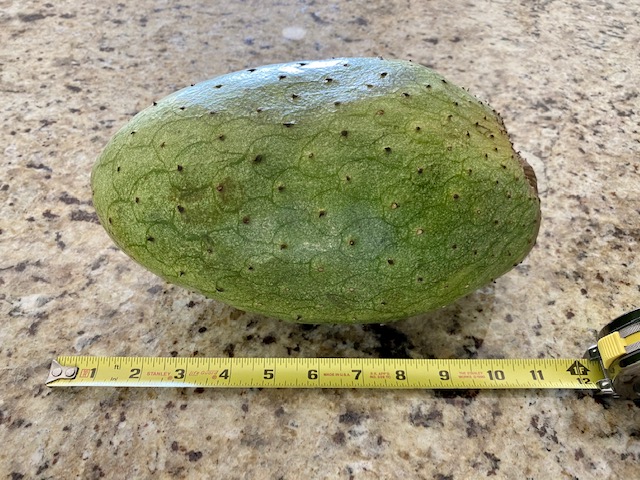
For that reason, we decided it would probably be best to take the time to attack it immediately, following the steps PVG had laid out.
At this point, it might have been better to figure out what this fruit was and see if the Internet had other processing options. Silly us, we just went full speed ahead.
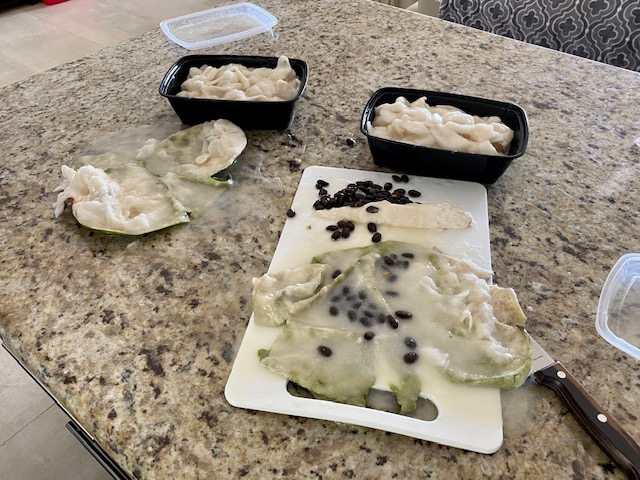
PVG was right – when cut open, slimy and fibrous is the best description of what you find. It’s kind of weird because the large black seeds are contained in their own little slimy, fibrous pouches, and you have to dig them out individually.

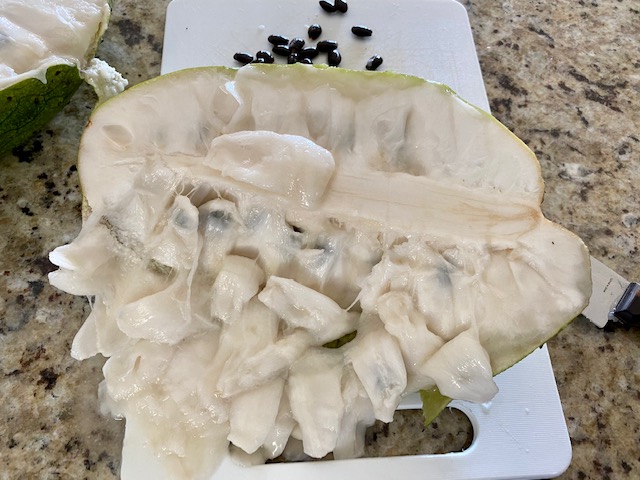
John hadn’t been too excited about the procurement of the large, mystery fruit to begin with, and spending the afternoon digging seeds out of slimy, fibrous packets that continued to ooze more and more juice all over the counter, did not make him any more enthusiastic.
Finally, we worked through the entire fruit, storing the slimy, fibrous packets in two plastic storage containers, which I promptly shoved into the freezer. Cleaning up the oozy mess on the counter wasn’t fun, either. It was an exhausting process.
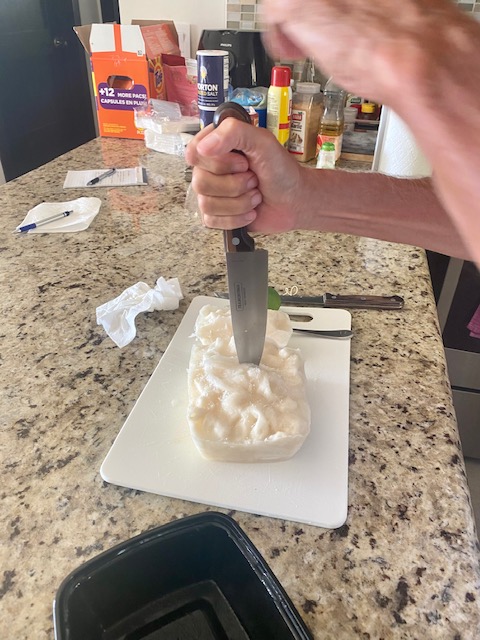
The next day I took out one of the containers and tried to dish out the contents to put in the blender. No deal. The stuff was hard as a rock. John took a knife and stuck it in it, to see if he would have any luck cutting it out. The knife blade penetrated half-way down, sticking straight up, but refused to go further. He was finally able to wrestle it out again, and as he waved the knife in the air, I declared him to be “Arthur, King of England.”
Proclaiming John to be royalty didn’t entice him to participate further, so I was on my own. I let the stuff sit for a couple of hours, to see if it would thaw a bit. At long last, I was able to cut out a bit and dropped it into the blender. The semi-frozen fruit was impervious to the blender’s blades, although they whirred furiously.
Our available blender was no match for this fruit.
I felt like I was on the TV show “Chopped,” had been given this difficult fruit in my basket and was required to use it. Maybe I could salvage the investment by breaking it down, transforming it into a compote? It made a clanging sound as I dumped it into a pot. I added sugar and water and felt a primal satisfaction bringing it to a boil – take that! It did produce a compote, of sorts – it was mushy. I added vanilla and allowed it to cool down.
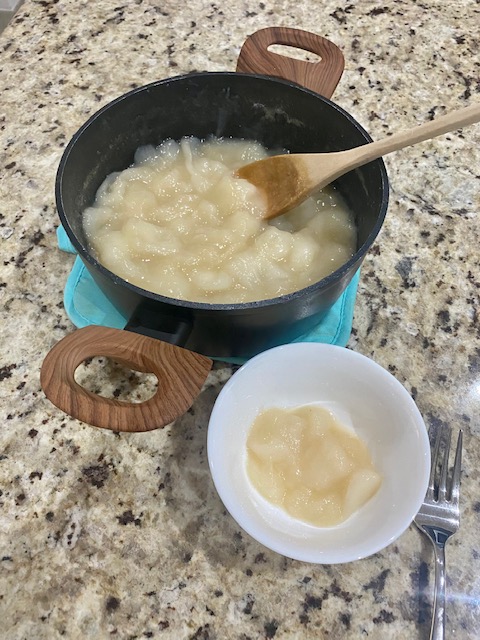
I dished out a small amount into a custard bowl to try it. The result was both soft and chewy. I can’t describe the taste. I think I added too much sugar and vanilla, so it was too sweet, but with a sour undertone. After that much effort, I felt compelled to eat the entire contents of the custard bowl. The rest I threw out, finally admitting defeat.
An Internet search yielded the name of the fruit; it is a Soursop. It is used for juices and smoothies – something Pura Vida Gringos would definitely be into for nourishment as they moved tranquilly toward enlightenment – as long as they had a very good blender.
 Remember, it's an adventure.
Good Reads. Take care
LikeLike
Good Reads. I guess the fruit was a no! Take care, Elena
LikeLike