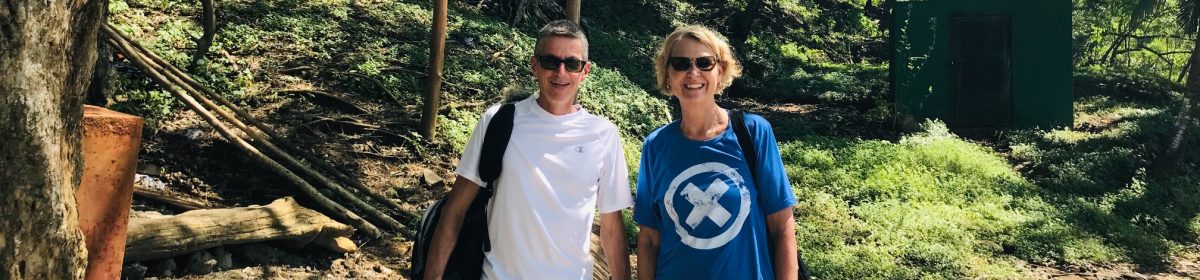
We lived a year in Costa Rica without a vehicle of any kind. Our apartment in Escazú Village was located just across the street from Walmart, that proved very convenient for obtaining groceries and other household items. We were within walking distance of PriceSmart (very similar to Costco in the US). There were also restaurants, pharmacies, a home improvement store (EPA, like a Lowes in the US) and other grocery stores nearby. Additionally, we were able to walk to a large mall, the Multiplaza. We could walk to our Spanish classes, when they were held in person, before COVID. And, when we needed to go somewhere where it was too far to walk, or we wanted to purchase more than it was feasible for us to carry (think large quantities of paper towels from PriceSmart), it was easy to get an Uber. Admittedly, it was weird for us not to have a vehicle of any kind for an entire year. In the US we had always owned two cars, one for each of us.
Now with our impending move from Escazú to the Playa Flamingo area, we needed to have a vehicle. There is nothing within walking distance of our new rental house in the Mar Vista development. In fact, it takes about five minutes’ drive time to get to our rental house from the Mar Vista security gate. And we needed to get it soon, as we had about a month until we were moving.
We Sold Our US Cars
In the US, we had a sporty red two-door Nissan Ultima (a good commuter car for John, but it not good for transporting any more than one other passenger) and a relatively new Mazda CX-5. When we bought the Mazda, we thought that car would carry us into our retirement, in the US. For example, we added a bike rack, in anticipation of driving to biking trails. When we changed our retirement plans, we needed to be realistic about what vehicles would work in Costa Rica.
Costa Rica is NOT known for having good roads, so you need to take that into account when you are deciding what to drive. It is also not known for having good drivers. It can also make a difference where in the country you are driving. If the only place you were going to drive is around the country’s capital, in the San José area, like where we had our Escazú apartment, you could get by with the Mazda. In fact, we did see similar Mazda models driving there.
But we needed a vehicle that would be suitable for all our future driving in Costa Rica – the new rental near Playa Flamingo and ultimately, the house we are having built near Nosara. The house we are having built is in a development accessed by gravel/dirt roads with some steep hills, not to mention an occasional river crossing. Even our Mazda would be challenged in that environment.
We sold our vehicles in the US before we moved to Costa Rica, as we knew that neither vehicle would be entirely suitable for the area where we would ultimately be living. Even if we had thought one of them might do, it would have been an expensive proposition. For a car from 1 to 5 years old, you would have to pay an import fee of 52% of the current value of the car. Cars hold their value in Costa Rica. Oh, and there would also be the cost of shipping the car to Costa Rica, which is about $1000 from a port like Miami. I have heard that there are brave souls that do drive from the US to Costa Rica, but that would be a daunting proposition for us! You would cross almost every Central American country along the way – Mexico, Guatemala, Honduras, El Salvador, and Nicaragua, all of them except for Belize and Panama. We’ve heard that border crossings can take hours (and bribes?), and who knows what you might encounter along the way?
What Vehicle to Buy?
So, yes, we sold our cars in the US, and were without a vehicle for a whole year in Costa Rica. Now we were faced with a vehicle purchase. We had the choice of buying a brand-new vehicle or buying used. You might think that buying a used vehicle would be entirely out of the question for us. After all, we’re not car mechanic type people. With the state of the drivers and roads in Costa Rica, you need to be able to look at a car as a professional to assess it. And, in our year of Spanish lessons, we are not covering a lot of car stuff. (We know how to say the word “car” – “carro.” If you look up “car” in a translation program, like Spanishdict.com, “coche” is going to come up first as the translation for “car.” But in Costa Rica, “coche” is used for shopping carts or baby buggies, neither of which was going to help us with our transportation needs.)
But buying used wouldn’t be entirely out of the question. There are enterprising individuals here who provide a service for people like us, for a fee. They can assess a car, speak Spanish and English, and will help you find sellers with the type of vehicle you are looking for. We have friends who used a guy like that and were very happy with the resulting purchase. He even told them not to buy one vehicle that they really liked, after he checked it over thoroughly and found problems with it.
We thought about purchasing a used vehicle but figured that any used vehicle would require more maintenance, as things would likely be going bad sooner, and there wouldn’t be a warranty. If the vehicle was out of commission because it was being serviced, we wouldn’t have a second vehicle to use. Plus, who knows where you might have to take it to be fixed? In the end, we decided that even though it was going to be more expensive initially, we would just buy a new vehicle.
Deciding what brand of vehicle was a fairly easy choice for us. Toyota has been in Costa Rica for years, and for years was the brand that most people advised you should buy, because they could be easily serviced. If you look in forums, people will say that advice is somewhat outdated, that there are other brands that are available and can be serviced. In the capital city area of San José, it is easier to find a lot of dealerships with different brands and presumably service. But, when you get to the area that we would be living, Liberia is the closest largest city, and dealerships are much further and farther between. Purdy Motors, which sells Toyotas, has several locations in Costa Rica, including a dealership in Avenida Escazú, within walking distance of our apartment, and one in Libera. Plus, we’d owned Toyotas before, and were always happy with them. We decided that we would go with Toyota.
We walked past the Purdy Toyota dealership in Avenida Escazú whenever we went to PriceSmart. They always had three brand new vehicles out on display. The Purdy dealership in Avenida Escazú doesn’t look like what we are used to a dealership looking like in Iowa. It’s more like what you find in a big city elsewhere. It is on the ground floor of a building that holds retail and businesses, including Costa Rica’s only P.F. Chang’s. They have cars inside the building, but the three cars out on public display are really along the side of a central walkway area.
We originally thought we might want a 4-wheel drive SUV. Before we decided to move, as walked by the dealership and thought that a vehicle purchase was still in our distant future, we had noticed a nice-looking silver pickup truck on display. Every time we walked by, we began to think, well, maybe a pickup would be useful, and we gradually warmed to the idea. Now we were under a time crunch, with about a month to make the purchase and take possession before our move. We walked over to Purdy and looked at the vehicles on display. The silver pickup was gone but in its place was a shiny white pickup – a Toyota Hilux.
They don’t sell the Toyota “Hilux” in the US now. In 1968 it was originally introduced by Toyota to markets world-wide. Over time in the US the Hilux name was dropped and became the Toyota Pickup. In the US in the 1990’s, it was replaced by the Tacoma. But the Hilux has continued to be sold in other world markets including Costa Rica. Even in the San José area, we saw a lot of them driving around. The Hilux has a reputation for having a high level of durability and reliability during sustained heavy use or even abuse. (Sadly, that has also made the Hilux a popular vehicle among militant groups in war-torn regions.) That sounded like exactly what we needed for Costa Rica! Um, I mean the part about it being durable and reliable, not because we are part of a militant group.
Making the Purchase
We walked into the Escazú location for Purdy Motors. When the receptionist greeted us in Spanish, we immediately asked if there was anyone who spoke English. She made a quick call and signaled for us to wait. Soon Danielle came out to meet us. She was a pleasant young lady (of course, almost everyone seems young to us now…). Danielle said her English wasn’t that good, which we have found a lot of people will tell us, even when it was quite good, especially compared to our limited Spanish. (People are also kind enough to say our Spanish is good when we manage to sputter out that we are from Iowa in the United States, have lived in Costa Rica for a year, and are taking Spanish classes twice a week.)
We said we wanted to buy a Hilux, like the one that was sitting outside the dealership door. She retrieved the keys, opened it up, and let us look around inside the vehicle. There was no talk of a test drive. The Hilux was sitting in a pedestrian walkway; we’re not even sure how the dealership parked it there. We liked what we saw and went inside to discuss purchasing that Hilux. Danielle explained that the Hilux came in several different engine capacities, and that there were options we could choose. We came to find out that we would choose the type of Hilux we wanted, the color and the additional options. After that, we would make a deposit, and they would find the vehicle that met our criteria, either in the country or from elsewhere, put on the options we selected, and give us the vehicle. We had already decided that we wanted white, and the engine type we wanted was exactly what the vehicle sitting right there had (the most powerful 4-cylinder available). We were a little surprised that Danielle seemed to think that we would not be getting the vehicle that was sitting right outside the door.
We reviewed the options with Danielle, and after discussion at home, decided to get the following:
Tinted windows. There is a lot of sun in Costa Rica, and there is no carport in our MarVista rental.
Skid plate. Have I mentioned the roads are not good here? A skid plate provides extra protection. It actually saved our bacon within a month from when we moved to the Pacific Coast. It’s still too soon to talk about that incident – maybe someday we’ll confess what happened.
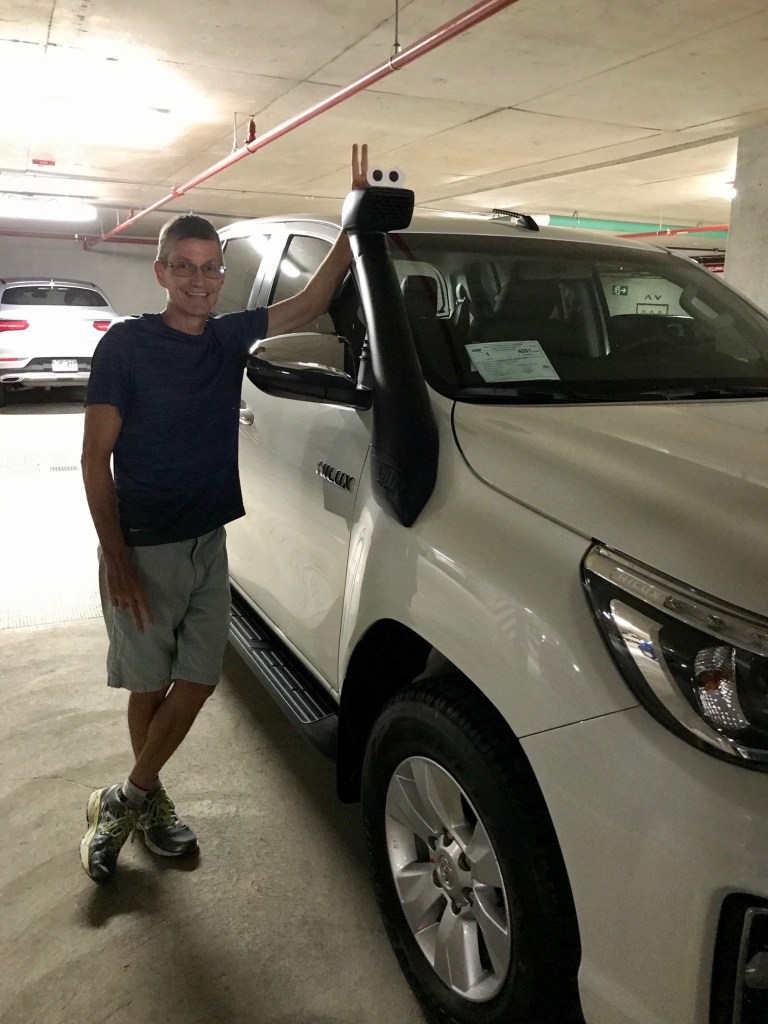
Snorkel. Most people think that the benefit of a snorkel is for water crossings, which we know we will have to do in our future. But the real benefit is for driving on dusty roads, which we will be doing frequently. The snorkel draws air from above where it is cleaner, rather than sucking up a lot of road dirt into your engine.
Cover for the truck bed. We wanted to protect anything we might carry in the truck bed from dust and rain, to be prepared for both the dry and rainy seasons.
Diesel. This wasn’t really an option. Most vehicles are diesel here. Diesel is cheaper than gasoline and there are a lot of diesel mechanics. The government controls the price of diesel and gasoline, so they are the same price at every gas station in the country.
In the end, we decided on our options, signed papers and paid for the vehicle through a wire transfer. Interestingly, only one person can own a vehicle in Costa Rica. We couldn’t own the vehicle jointly. We were told that it would be a few weeks before the vehicle would be ready. We were going to move on July 3rd, and needed it by then, if not sooner.
Insurance
Of course, you need car insurance in Costa Rica. There is a high probability with the combination of bad roads and bad drivers that you will be in an accident. Purdy Motors offered a low rate of insurance with the national insurance company, INS. Although the INS option may have been a bit cheaper, our ability to successfully interact with the insurance company if there was a claim of any kind would be a problem. We also received quotes from several insurance companies through a broker that spoke English and Spanish. We had been given the name of the broker from our friends. The fact that she would interact with the insurance company on our behalf was extremely attractive. After doing an Excel worksheet comparison, we made our insurance decision.
Taking Possession
In mid-June, within a few weeks of our initial purchase, Danielle called to inform us that our vehicle was ready. We walked to Purdy Motors and the receptionist led us to a small office in the back to wait for Danielle. Just outside the door of that office area was a vehicle completely draped in red fabric. Hmmm… could that be our vehicle? Why yes it was! Danielle led us to the front of the vehicle, and John had the honor of unveiling our new vehicle! We’ve never had such a ceremonious vehicle handover in all of our years of vehicle purchases.
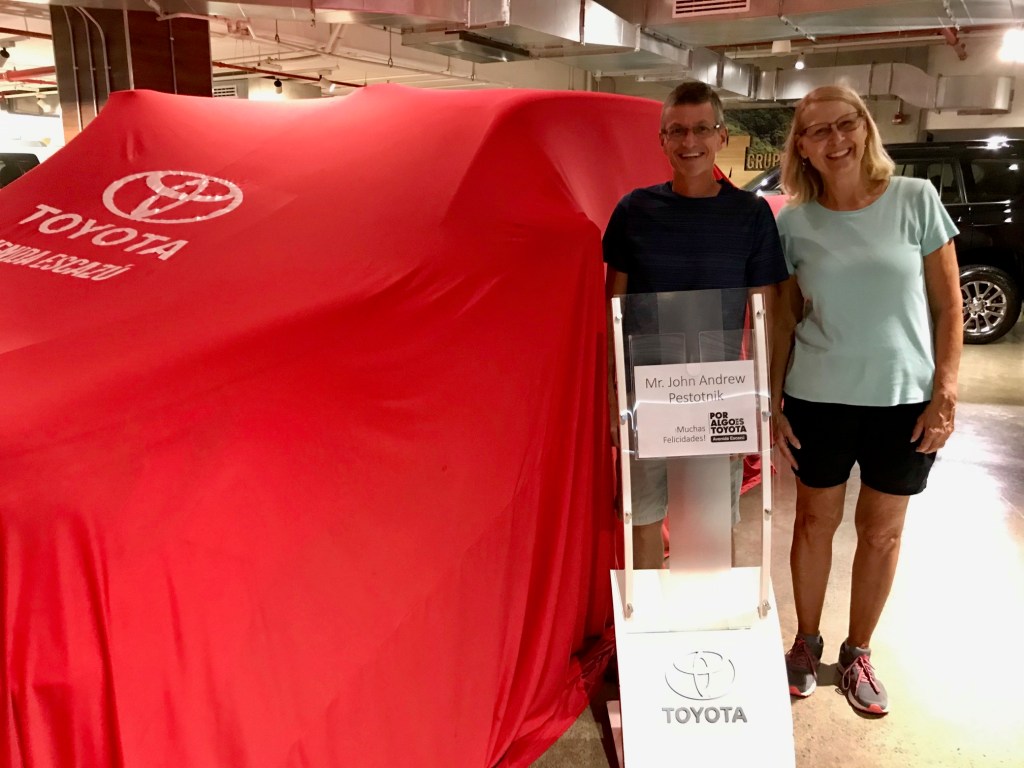

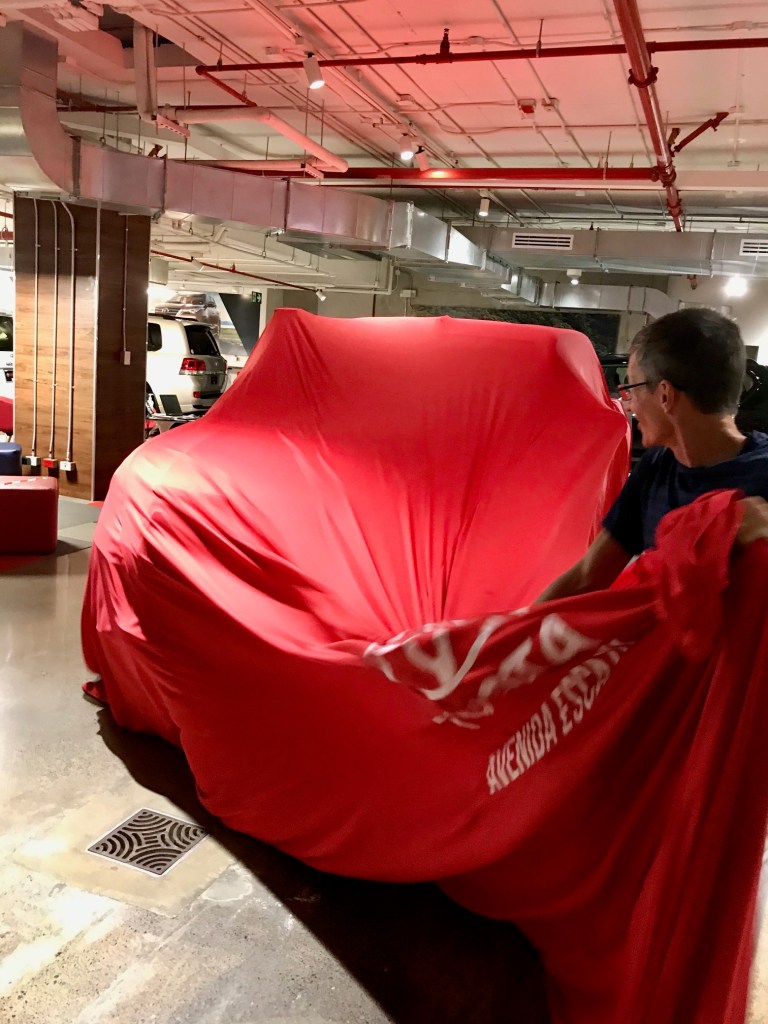
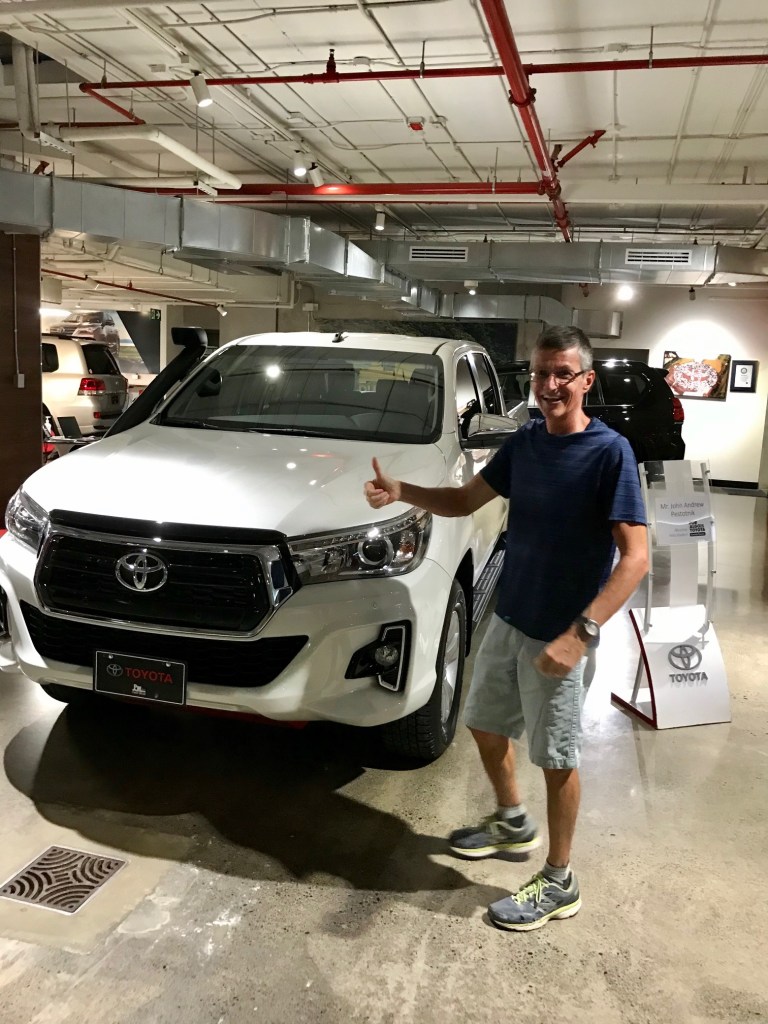
We gave the vehicle a once-over, making sure we had the operational basics covered, including how to open, close and lock our truck bed cover. If we had problems and needed to reference the manual, well, there was one included – in Spanish. Danielle promised that she ordered one for us in English, and when it arrived would be shipped to their dealership location in Liberia for us to pick up. We’re still waiting.
By the way, we suspect that our new white Hilux really was the vehicle that had been parked outside the dealership. We had noticed that the white Hilux had disappeared from its spot outside the dealership and was replaced with another vehicle not long after we made the purchase.
License Plates
Just like in the US, we needed a Costa Rican license plate to drive legally. Unlike in the US, a license plate is associated with the vehicle and not with the person who owns it. If we would ever sell our Hilux, the license plate would go with the Hilux to the seller, and not stay with us.
We needed a temporary license plate until our metal license plate arrived. Purdy took care of obtaining the metal license plate for us, but it was going to take some time to get it from the government. In the meantime, like the US, we were given a temporary paper license. In the US, the temporary paper licenses are displayed in the back window and have a hand-written expiration date. Danielle appeared with a nicely printed temporary license. We could see that it had a large number printed in the middle of it, the number “9.”
If you’ve been following our blog posts after the start of COVID, you may remember that Costa Rica has been limiting driving on different days based on the last digit of the license plates. When we took possession of the vehicle in mid-June, from Monday through Friday, there was one day when you couldn’t drive, based on the last digit of your license plate number. The number “9” would have prevented us from driving on Friday. Uh oh, that was no good. We had already arranged with the moving company to move on Friday, July 3rd. We quickly explained our situation to Danielle, who returned shortly with another nicely printed temporary license that ended in “1.” That number prevented us from driving on Mondays, so would work for our move.
(Actually, we were quite lucky that we ended up with the number “1” for our move. Although the moving company did the actual transport of our meager possessions on Friday, July 3rd, they packed us up on the morning of Thursday, July 2nd. Faced with the prospect of nothing left in our apartment for most of Thursday, we decided to drive ourselves that day. The number “1” wasn’t the best overall, as there are also driving limitations on the weekends, based on even and odd numbers. The number “1” prevents you from driving on both Sundays and Mondays – two days in a row. You have to plan ahead when you can’t drive two days in a row every week. However, we found out that there is a worse number for your plate to end in than “1” but more on that later.)
Danielle slipped the temporary license in a plastic cover and neatly taped it to the bottom, passenger, side of the front windshield. Presumably this is so police can easily identify if you are driving on the right or wrong days when you pass through a checkpoint, and pull you over, if necessary.
There was no handwritten expiration date on the paper license. It did have an expiration, although we didn’t realize it at the time.
Orange and Yellow
We decided that it would be a good idea to get our regular dental checkups with the dentist we had been seeing in San José, before we moved. John had been able to take advantage of Costa Rica’s low dental costs and had been in the process of undergoing dental implants. (Costa Rica is a dental tourism destination.) We had anticipated needing to return to the dentist for the next steps in that procedure around October. But, as it turned out, during the regular exam we scheduled the Monday of the week we moved, the dentist found that John’s mouth was ready for the next steps. In fact, they asked John if he would be OK with them starting that day, with a follow-up visit in a few weeks. John agreed, not realizing that it would mean he would be at the dentist that day, starting around 9:30 a.m., until 4:30 in the afternoon! I hadn’t known that either and ended up sitting in the waiting area for the entire time after my appointment. The staff finally felt sorry for me and gave me water. I also asked for and received a cell phone charger to use. (We’ve found that our dental clinic doesn’t mess around with scheduling additional appointments if they find something that needs to be taken care of. They will ask if you are OK with going ahead with the procedure, and are willing to pay for it, and then just start right then! This is convenient for us now that we are retired and don’t have to get back to something, like work, following a dental exam.)
The follow-up visit would need to take place after our move to Playa Flamingo. It’s a 4+ hour drive from Playa Flamingo to San José, and we just didn’t want to deal with it the week directly after we were just moved in. So, we set up the appointment for July 15th. But then we got caught up in the Orange versus Yellow area designations in Costa Rica.
When Costa Rica started seeing their COVID cases rise, they designated certain areas of the country as Yellow or Orange, with Orange being worse than Yellow, meaning that there were more cases. The government restricted activities, business operations and driving based on the color designation. We moved from the San José area just before it was designated an Orange area. Most of the Guanacaste area, where Playa Flamingo is located, was designated Yellow, although Liberia, also in Guanacaste, was designated Orange for a while too. We were affected by this in several ways.
For a while, the driving restrictions were exactly the opposite during the weekdays between Orange and Yellow areas. With our license plate ending in “1”, in the Yellow area where we now lived, we could drive every day but Monday. Since it was an “odd” number, we could drive on Saturday, but not on Sunday. But, in July, when they clamped down on the Orange areas, we were only allowed to drive with a “1” license plate on Monday in an Orange area. Also, in the Orange areas, they only allowed people to travel to grocery stores, pharmacies, medical appointments, and some other necessary stores (unless traveling for work). That rule effectively shut down driving between the Orange and Yellow areas. We could go wherever we wanted, as long as we stayed in our Yellow area. We could only go to an Orange area on Saturday since that was only day we were allowed to drive in both areas, and then only if we were going to a grocery store, etc.
The US Embassy helped to keep us updated with their daily emails, but it was confusing, nonetheless. We had to reschedule our dental appointment originally scheduled for the 15th to the 22nd. When I talked with the receptionist at the dental office, we both expressed hope that the mutually exclusive driving restrictions would be relaxed by then. We also had to stay at a hotel when we went back, that also had to be rescheduled. Fortunately, we were able to successfully make it back to Escazú for the dental appointment, which turned out to be fortuitous.
After we moved to Playa Flamingo, and before we returned to Escazú for the follow-up dental procedure, we received a call from some guy at Purdy Motors. He called on John’s phone, and since John was outside at the time, I picked up the call. Unfortunately, the call was breaking up, and I was having a hard time understanding him. I explained that to him, and he said he would call back. He never did – not that day, nor the next, not ever. We figured it must not have been important, maybe a customer service follow-up? We didn’t give it much thought.
Before we returned to Escazú, we did wonder about the status of our actual plates, so called Danielle from Purdy. She said that no, they hadn’t received the actual plates, but did helpfully inform us that our temporary license plate had expired at the end of June (apparently it was only good for the month that we took possession of the car). She knew that Liberia would be the closest dealership and told us that we needed to go there to get a new temporary license. Guess that explained the mysterious phone call. We asked if we could get the new temporary license in Escazú, since we were going to be there, and she said, yes, just call her when we were ready to pick it up, and that we needed to give her back the temporary license we currently had taped in our window.
We would be lying if we didn’t admit that we were a bit anxious driving back to Escazú, knowing that we were driving with an expired license. There is at least one seemingly permanent police checkpoint along the way. Fortunately, the expiration date was printed so small, the police wouldn’t have been able to see it unless we were stopped for another reason, like driving on the wrong day. We made it to Escazú without incident and breathed a sigh of relief.
Our hotel in Escazú was just down the street from the Purdy dealership. During our stay, we called up Danielle, removed the license from our window and walked to the dealership to meet her. There we traded paper licenses. Now we just had to retape the new paper license to our windshield.
That turned out to be easier said than done. We thought we would just walk to our old Walmart and pick up some scotch tape. We were able to walk to Walmart, but things had changed there since the Orange lockdown. We’d only been gone a few weeks, but we hardly recognized it. Before when the country had put restrictions in place, where people could only drive to the grocery store, pharmacy and medical appointments, Walmart had remained open. It was a place where you could pick up not only groceries and drugs from the pharmacy, but anything else you could usually buy there, like electronics, clothes, and supplies like the sort we were now in need of – scotch tape. The Walmart we found was also locked down. There are two entrances into Walmart. During COVID, they designated one as an entrance only and the other as the exit. The entrance had been the one at the far end, and you entered into the electronics section of the store. The exit was near the grocery section.
When we arrived at Walmart this time, we found that they had switched the entrance and exit, so you entered into the grocery section. We tried to make our way back to the school/office supply aisle, where the tape was located, only to find that every aisle that didn’t have groceries was blocked off with black tape! The only thing you could buy was groceries!
Disappointed, we decided to try the Universal store in our old apartment building on the walk back to our hotel. That store sold school and office supplies, in addition to household items, electronics and toys. During COVID it had cleverly converted a section of the store to sell groceries, so it could remain open. We were disappointed to find that yes, here too, the only section in which you could shop was the grocery section. By the way, we also had decided to walk to PriceSmart during our stay to pick up a few things. It was the same there as well – non-grocery aisles were blocked off. Like Costco in the US, clothing for sale is laid out on tables. The clothing tables were draped with blue tarps – not only could you not buy clothing, you weren’t even allowed to see what clothing had been for sale.
In desperation we stopped at the front desk of the hotel to ask if they had tape and if we could use it. Luckily, they did, and we affixed our new temporary license in the passenger side of the front window. We returned to Playa Flamingo without incident.
1000 Km Checkup and (Finally!) Our Metal Plate
In the beginning of August John received an email from Purdy, all in Spanish, of course. From the translation, it appeared that they were encouraging us to bring in the Hilux to their Liberia dealership for a 1000 Km checkup. In addition to the regular checkup, we also wanted them to install our metal license plate and give us our English owner’s manual (if they had them), and look at our skid plate (after the incident we aren’t talking about).
We spent a lot of time crafting a carefully worded an email in Spanish outlining everything, copied our friendly representative, Danielle, and sent it to them. John received back a one-sentence email in Spanish saying that we could call to set up the 1000 Km appointment and didn’t address any of the items we had brought up.
Discouraged, I called Danielle. She told me that the yes, the metal plates were in and had been sent to Liberia. She also told me the plate number of our new metal plate, which ended in “0”. She said that she would help us and arrange the appointment in Liberia. By this time, Liberia was back in Yellow status, like Playa Flamingo, meaning that the driving restrictions were the same in the two places. What made it trickier was that the service department was only open Monday through Friday, and our temporary license ended in “1”, which had a different driving restriction day than our new plate ending in “0”.
Danielle called back to tell me that she had set up the appointment for Friday, August 14th.
“That’s not going to work,” I said. “With a license plate ending in 0, that’s the day we can’t drive.”
“No,” she replied, “with the driving restrictions, that is the only day you can drive.”
“That’s true in the San José area, where you are,” I explained. But we are in Guanacaste, and it is just the opposite here.”
She seemed puzzled, but said, “Let me check,” then hung up.
A bit later I received a call back from her. “You’re right,” she admitted. “So, I set up the appointment for Wednesday, August 19th, at 1:00 p.m.”
“Great – that works!”
On Thursday, August 13th, John received an email reminding him of our appointment the following day, on Friday, August 14th. I called Danielle. She answered the phone with a “Hello, Cindy,” before I even told her it was me. I explained about the reminder we had received for the appointment that we thought had been rescheduled. She said she would check. She called me back to assure me that everything was in order for the following Wednesday.
We drove to Liberia on Wednesday, and only had to drive around the block once after missing the entrance to Purdy the first time around. For us, that’s a success. The security guard at the parking lot guided us to the English-speaking service person. He told us they would give our Hilux the standard 1000 Km checkup, put on our metal plates, and also check our skid plate, which had one end hanging lower than the other, from the incident we don’t talk about. It took a while, and this was the first place we had been to in all of Costa Rica, that was too cold due to over air conditioning. It all turned out well, especially the skid plate. It wasn’t broken, and they just had to tighten it back up.
We are now driving around with our new metal plates, except for when we can’t, based on our license plate number. It turns out that with a license plate ending in “0”, the two days you can’t drive are, inconveniently, Friday and Saturday! When the government gives you a license plate that ends in “0”, it makes you a real zero!


looks great !!!!
LikeLike
Good Living. Take care!
LikeLike
Good Living! Take care
LikeLike