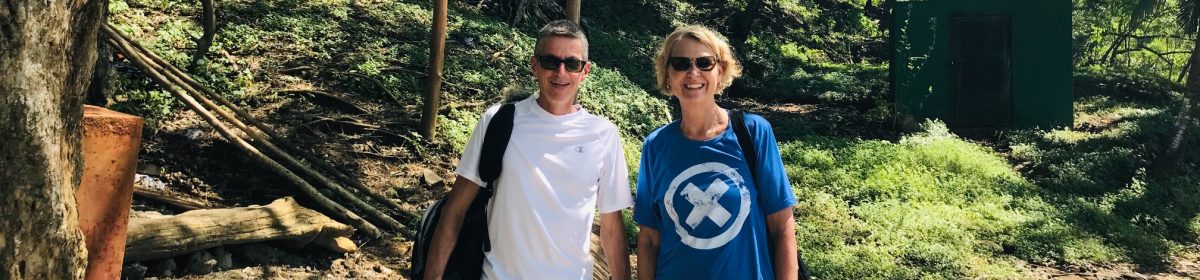
We are building a new house near the Pacific coast in Costa Rica. We moved to Costa Rica a year ago, thinking that we would have to wait a little more than a year for our home to be built. Unfortunately, our estimated timeframe was a bit unrealistic – permitting ended up taking more time than expected, so construction didn’t begin on our house until March of this year. Now that construction has started, we receive visual construction progress updates via email. In May we did ask for and subsequently received an updated construction schedule. We were a bit disappointed to learn that the updated date for us to be able to move into our new home was now June 2021. Admittedly the new schedule is probably more realistic in that it takes into account delays due to the rainy season (October is extremely dicey for construction, as it is known to rain heavily during that month), and also extended shutdowns for the Christmas and Easter holidays.
Faced with the prospect of another year in our apartment in Escazú, we decided that maybe it was time to move to another location to wait it out. This post is about our decision to move and to where for the next year.
Why Move?
We had originally thought we would be in our Escazú apartment for about a year. Our lease is up at the end of July, although Costa Rica allows for continued monthly rental for another three years, if desired. So, we weren’t obligated to move from our apartment – we could easily stay until our house would be finished.
There are a lot of advantages to living where we do in Escazú. Our apartment complex is modern with communal amenities like a large pool, and others by reservation, including a Wine Garden, Beer Garden, conference room, and importantly for us, a ping pong room just down the hall from our apartment. Everything is well maintained and very clean. It is conveniently located near shopping and restaurants, including right within the first two floors of our building, and the Walmart right across the street. We did not need to have a car for the entire year that we lived here. If we needed to go somewhere that was too far to walk, we could easily catch an inexpensive Uber.
Of course, the coronavirus changed some of this. We haven’t been able to play ping pong since March. For a long time, there was no pool usage, then you had to reserve the pool. Only people from the same apartment can use the elevator at a time. We know that these restrictions will hopefully pass within the year, but who can really say when.
But what are the real disadvantages of staying put? Well, for one, as the construction on our house progresses, it won’t be easy to make on-site visits, due to the distance. It is a good 4+ hour drive from where we live to where our new house is being built.
And speaking of construction, our apartment complex has two massive construction projects underway on two sides of it. The construction projects were underway when we first moved in, but as the year has progressed, they have become more visible and noisier each day. When we look out of our floor-to-ceiling sliding glass doors to our balcony, we now see at least four stories rising above the roofline of our complex (across the way). The workers start at 6:00 a.m. Monday through Saturday and sometimes on Sunday. They usually finish around 5:30 p.m., although there have been times when they are there later. One Saturday night a few didn’t finish until 11:30 p.m. The coronavirus did not negatively impact these projects. The only time there weren’t workers there were the three days before Easter.
As far as construction goes, everything appears to require constant pounding, with some grinding, whistles, sirens, truck honking and backup beeping thrown in for good measure. We are greeted by pounding first thing in the morning, which continues all day long, even in the rain. Anytime we need to do a phone call or Zoom meeting, like for our now on-line Spanish class, we have to shut the doors to the outside, due to the noise. Our bedrooms have air conditioning, but our main area doesn’t. We do have a stand-up fan, which we automatically turn on when we shut the balcony doors.
Now that the construction is above the roofline, our view directly from our balcony is not that attractive. There may be some people who would enjoy monitoring daily construction progress, but we are just not “Bob the Builder” types.
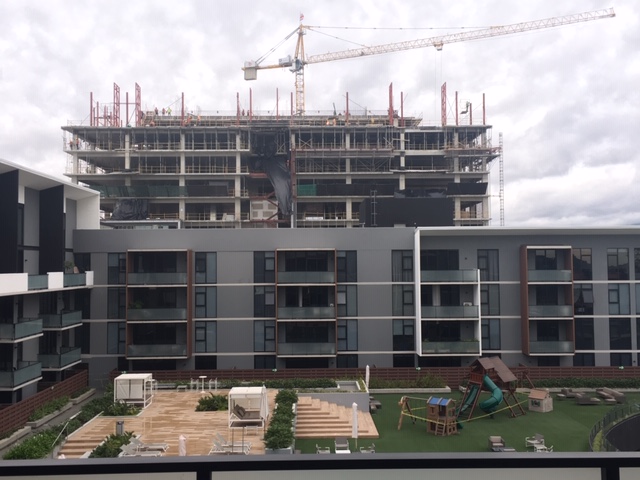
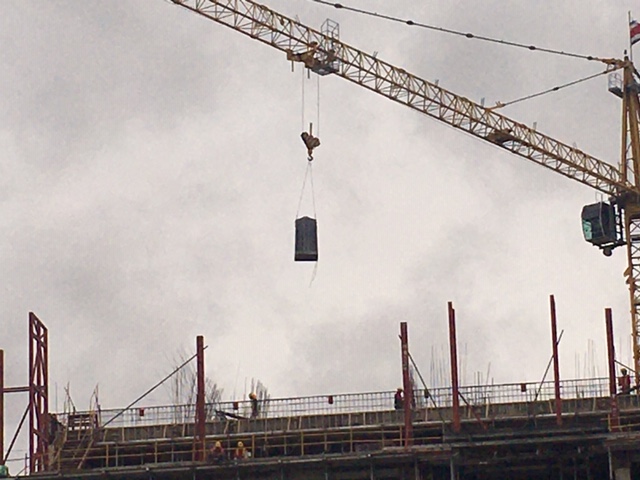
An additional “benefit” has been our view of the open urinals that have been placed on the top floor. They continue to be moved up onto the new floors as they are constructed. It certainly is fun to look out our window and see guys taking care of their business!
Even when the construction subsides in the evening, we are still located next to a busy intersection, where there is a lot of noisy traffic when there aren’t driving restrictions, and a lot of noisy delivery vehicles when there are. When the buildings are finished, it is reasonable to expect even more traffic congestion.
Faced with the uncertainty of communal amenity access in our complex due to the virus, and the absolute certainty of continued construction and traffic, we decided it might be time to explore other living options for the next year.
Where?
We chose to build our home on the Pacific side of Costa Rica, near a beach. That was what we were looking for in a home, so why not rent somewhere near there for the next year? We would have to break down and buy a vehicle of some sort to live there, but our original plan a year ago was to buy about now, anyway. Also, we wanted to be able to check on our house construction progress, which requires a vehicle.
We decided that we would try to find a rental in an area near developed beach areas. This would help us with our gradual transition into the living conditions where we are building our home. There we will need to drive a short way to the beach, but longer for groceries or even to get to a Walmart or PriceSmart. If we moved to a developed beach area, we may have to drive for shopping, but maybe walk to the beach?
John and I started looking at on-line realty sites for long-term rentals along the area from Tamarindo to Playa Flamingo.
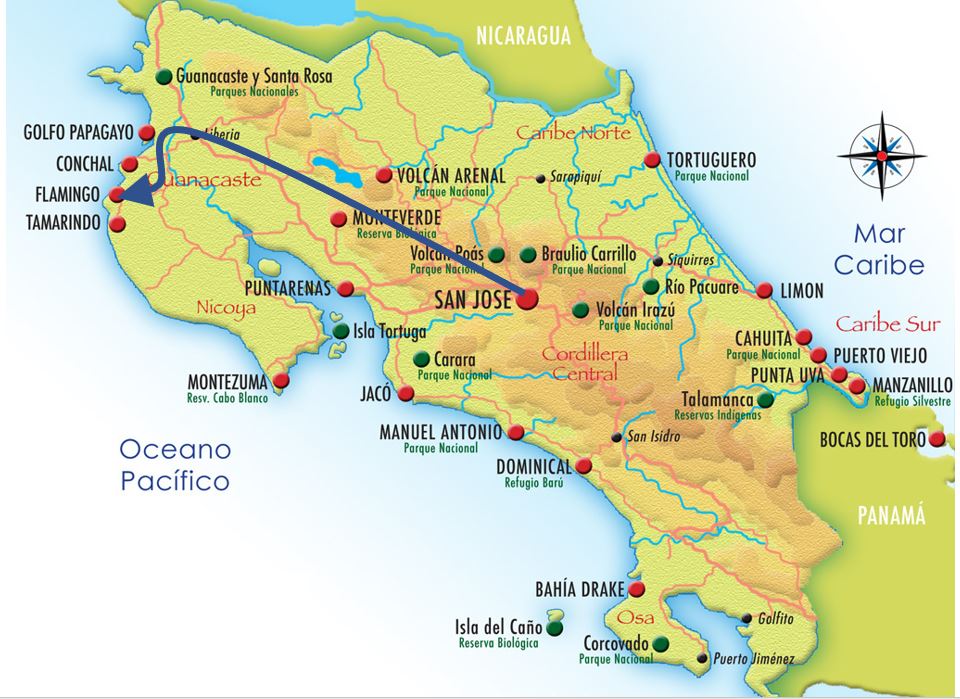
This is north of where our house is located, but these areas are developed. We were looking for 2-3 bedrooms and bathrooms, access to a pool and close to a beach.
We watch the HGTV House Hunters shows, and now, the special House Hunters: Comedians on Couches episodes. We watched an episode recently where everyone was doing eye rolls about a guy who made a spreadsheet for their house hunt. I know I cringed, not because that guy had made a spreadsheet, but because we also made a spreadsheet to compare likely properties. And just like House Hunters, all realty websites had names for the properties, just like they do on the show – things like “Casa Jungle”, “Casa Mega”, “Casa Tigre”, etc. Admittedly, it did make it easier to refer to them in discussions.
So, we dutifully entered the names, the listing company, price, and important information based on the descriptions provided, like the number of bedrooms, bathrooms, amenities, distance to beach, and even ratings on view, outside space, etc.
Consulting our current rental agreement, we found that we needed to give 60-day notice to our landlord for moving. It was already near the end of May, so we needed to hustle to get our new rental and give notice so we wouldn’t still be in Escazú into the fall. We decided to go house hunting the last week in May, which was about our only remaining opportunity, due to timing. In this high-tourist area, most of the rentals are short-term. We were hopeful that rental property owners may be having a hard time getting renters, due to the country’s coronavirus shut down, and would be willing to take on long-term renters, perhaps even for a deal.
Until the end of May, Costa Rica was only in Phase I of reopening. From what we understood, this meant that “smaller” hotels (of 20 rooms) could be open at 50% capacity. We looked online and found that Margaritaville, located in Playa Flamingo, was accepting reservations, for reasonable prices. I am not sure how Margaritaville was able to meet the “smaller” hotel criteria, but we weren’t going to question it. We also booked a rental car through National since they had a location within walking distance of our apartment.
So now that we were able to get there and had a place to stay, the next order of business was to reach out to the realty companies to set up viewings. In our spreadsheet we had ranked each of the properties (eyerolls anyone?). The top properties on our list were near Playa Flamingo with three different realty agencies.
The first two agencies were the most difficult to deal with. As with all the agencies, we first used their website to indicated interest in the individual properties. We didn’t receive a response, so we called. At this point we discovered that even though our top three listings were shown on different company websites, Premier Casa Costa Rica and Summer Cost Realty, they were the same people handling the listings. We found that out because the same person answered the phone when we contacted the two different agencies and were told both times that “Enis” would be getting back to us.
Once Enis did get back to us, it was somewhat disappointing. One of the properties was already rented (she said she would update the site), one of the owners didn’t want to show the property, one she “might” be able to arrange, etc. After asking our criteria, she did have two other properties that were available. The first was a house that we had already seen online and decided against, and the second, well, that was hard to figure out. First, she sent 50 pictures of an apartment with a very confusing layout. Then told us that she sent the pictures of the wrong apartment in that same building, so sent other pictures that weren’t much clearer. In the end, we decided to meet Enis in the afternoon of our arrival date to see the house we had originally dismissed, declined the second confusing apartment, and were hoping she could arrange a viewing of another property that was high on our list, but also high in price. Through all of our correspondence, Enis seemed a reluctant participant.
The next ranking tier include homes from Tropical Homes of Costa Rica. Their agent, Rita, was more engaged, but we found that some of the properties we were interested in were not available, or not available for renting for a whole year. Still, we were able to arrange for several viewings through her.
We started getting a bit discouraged by our housing prospects, so John reached out on an Expat forum. He received a couple of promising leads. One was a guy who lived in a development that we were going to see another house in, Mar Vista. His family was going to be moving to a larger house, now under construction, and he would be renting their current house. He would be happy to show us his house. The second was from a woman who lived in the Westin Conchal development, which she highly recommended. She provided a contact, who was eager to show us around, as well.
We dutifully entered the new prospects into our spreadsheet and were ready to take our trip to Playa Flamingo.
Car Rental
We left for Playa Flamingo on Wednesday, May 27th, returning on Monday, June 1st. Up until this time, we had never rented a car, nor driven in Costa Rica. Of course, we had taken Ubers, taxis, and shuttles, and also rode a couple of times with our neighbor, when he had rented a car. We know that not everyone has insurance here, and people talk like accidents are somewhat common, and many people drive without insurance. Rental prices don’t look that expensive, until you start adding on the cost of insurance, which is highly necessary. We opted for complete coverage, so no matter what happened, we wouldn’t have to pay a dime.
When we made our car reservations, we thought a 9:00 a.m. car pick up would allow us enough time to get going in the morning and walk to the National Car rental site, in Plaza Tempo next to the Holiday Inn, about a 25-minute walk. The night before, we decided that getting on the road earlier would be better, so Wednesday morning we got around early, and arrived at the rental site by 7:30. We had checked the website and that location said it opened at 7:30 a.m. But, when we got to the location, it was closed. The posted hours on the door said it would open at 8:00. We waited until after 8:00 and the location didn’t open. At this point we got a bit worried, so I called the National number, pressed the appropriate number for “English” and finally got a hold of someone. The bad news was that location had been closed due to the coronavirus. The good news was that they were going to deliver a car to that location at the time we requested on our reservation, which was 9:00. So much for getting on the road early!
I did ask another question about the license plates of the vehicle. Costa Rica had restricted driving based on license plate number, and we needed to be sure that the license plate would allow us to drive on Wednesday and Monday, the days we were going and returning. In May you couldn’t drive on the weekends unless you were going to the grocery store, pharmacy, or medical facility, so we knew we would be stuck in the hotel Saturday and Sunday, anyway. However, it might be nice to drive on Thursday or Friday, if necessary. We reviewed the license plate driving list and figured that we absolutely could NOT have a plate that ended with a 5, 6 (Wednesday restriction) or 1, 2 (Monday restriction). It would be best if we had a plate that ended in a 3 or 4, as that was the Tuesday restriction, and we would not have the rental car on Tuesday. I asked the person on the phone about the license plate number of the vehicle we were going to receive, as we wanted to make sure we could drive it Wednesday and Friday. She said she would check and get back to us. She never did.
Much to our relief, two young people from National arrived in two vehicles, shortly before 9:00 a.m. Thankfully, they spoke English and couldn’t have been nicer. We handled the paperwork and vehicle inspection curbside, in front of the closed Enterprise office. They provided us a Toyota Fortuner, which they told us was a free upgrade from the size/type we had requested. They also said that since we had opted for full coverage, it didn’t matter what happened, and the vehicle inspection was for their reference only. We noticed that the back had some broken plastic and there were some dents. Of course, we also looked at the license plate number. It ended in 9. That was fine for Wednesday and Monday, but meant Friday was off-limits for us driving.
They also told us that they would come to the same location to pick up the vehicle at 5 p.m. the following Monday, the time that we had said we would return it, although if we called and said we wanted a different time, that would be fine.
We drove the vehicle back to our apartment complex, loaded up our suitcases, backpacks, etc., and were on our way.
The Trip to Playa Flamingo
It is a 4+ hour trip from Escazú to Playa Flamingo. The main highway to take from Escazú west, is highway 27. It is very near our apartment complex, so it was easy to get on and go.
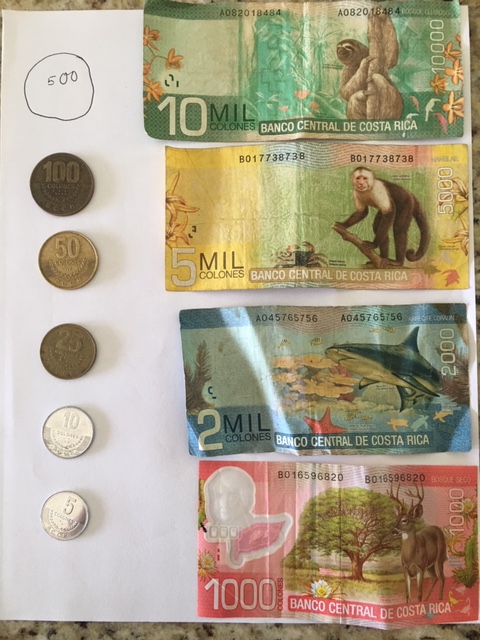
Because we had taken this highway before as passengers on shuttles, we knew that we would have to pay tolls. Tolls cost anywhere from 380 to 570 colones, roughly the equivalent of 66 cents to $1.30 in US dollars. It is not the cost so much as it is the inconvenience of having to pay the tolls. Still, highway 27 is a decent road, and well worth the price and inconvenience if it helps maintain the road. There were about 6 toll booths each way, with a different price at each one. At least there was a sign as you approached, so you know how much to get ready to pay. It is definitely a plus to have a second person in the car counting out the change for the toll.
The lowest paper bill denominator in Costa Rica is 1 mil colones (1000) which is roughly equivalent to $1.70 USD. We prefer to pay for things by credit card, but sometimes you need to pay for things with actual money. The coins you receive in change range from 5 colones up to 500 colones. The larger 100 and 500 colones coins are heavy to carry around. Tolls are a great way to use (i.e., get rid of) these coins.
We knew that we would need a break about two hours or so in, and decided we would stop at Mi Finca restaurant, a place we had stopped when we used the shuttle buses. This was the restaurant with the giant macaws in the back, and the 4-foot Jesus head in the dining area. Up until the time we stopped, the weather had been fine. We ordered lunch, and as we waited for it to arrive, we could see and hear an approaching storm with bright lightning and loud thunder. When the rain started, it was not a gentle rain – it came down in torrents! We found that we had rather inconveniently parked under a rain spout that poured a steady stream of water onto our vehicle. Fortunately, the rain eased up a bit by the time we finished our lunch. When we got back into the car, John had to figure out how to operate the windshield wipers. That should not have been a surprise.
We used Waze to guide us to Playa Flamingo. Mi Finca is located at the junction of two highways that will eventually take you to Playa Flamingo. Waze was directing us to take Highway 1, which runs through Liberia. We ran into a lot of road construction at first, but with the downpour, there wasn’t much going on, so figured that we lucked out. The road was better closer to Liberia, which may be why Waze directed us that way. It was good for us to drive through Liberia, the second largest city in the country, since that was likely where we would go for shopping trips to Walmart and PriceSmart, when needed from our hopefully, new home. And, we did pass the Walmart and PriceSmart, as well as the airport, as we proceeded toward Playa Flamingo.
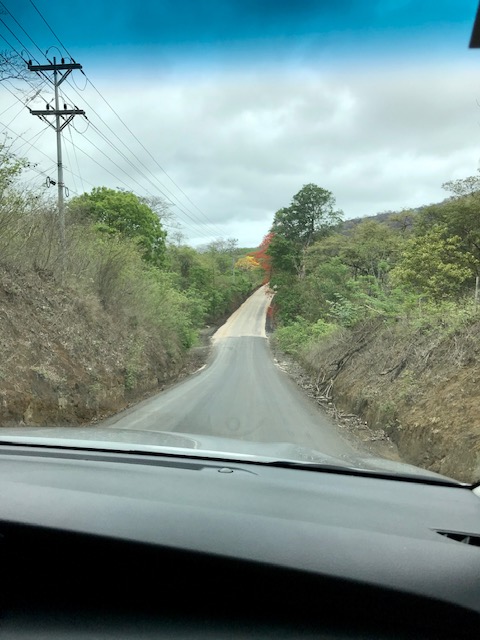
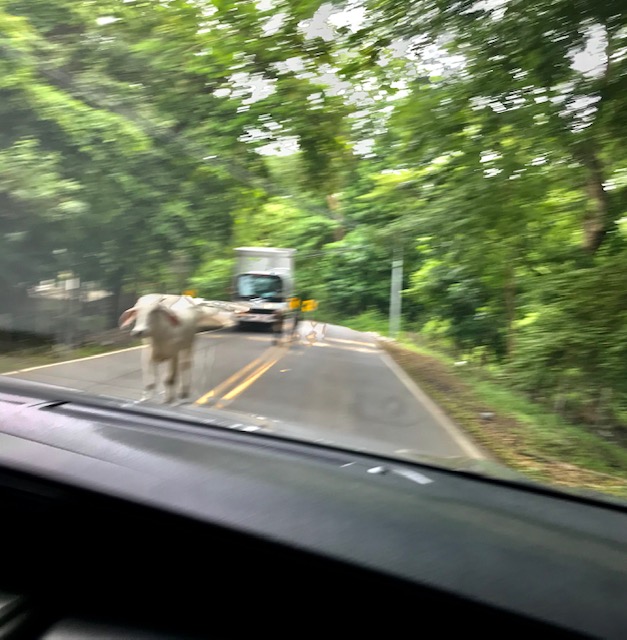
The final stretch into the Playa Flamingo area, Waze decided that we needed to cut 10 minutes off of our drive and directed us onto 911. This road is not paved the entire way, is one-lane in parts, is hilly, and is not well traveled. You really feel you are in the middle of nowhere. Knowing that Playa Flamingo is a popular tourist destination, I couldn’t believe that this would be the way that most people would use to get there. On a positive note, being not well-traveled is fine when there is only one lane and you are afraid of meeting an on-coming car as you round a corner going uphill, with no shoulder. Thank goodness our local Kolbi cellular service continued to be available. Eventually we came to the Potero beach area, just north of Playa Flamingo, where we encountered small houses, restaurants, and even some cows trotting happily down the road. Civilization at last!
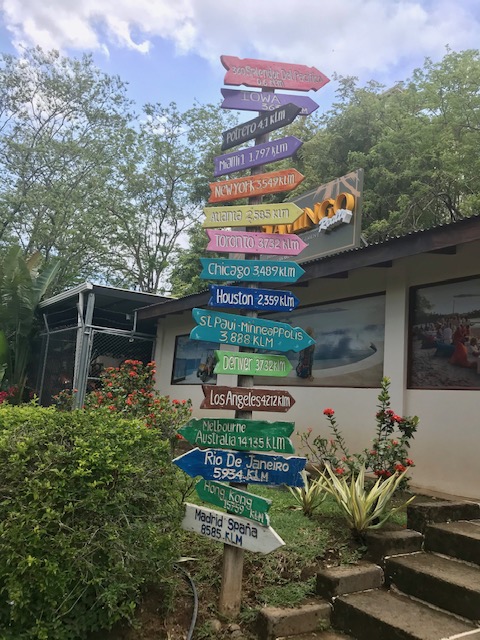
From Potero it was a short distance to Playa Flamingo, and the Margaritaville resort. We were amused to find a signpost that included Iowa, just down the road from the resort.
In our next post we will continue with our stay at Margaritaville and our own version of House Hunters International.


Thanks for the update of your ventures!
LikeLiked by 2 people
Gosh – these delays must be frustrating. Possibly not helped by Covid?
LikeLike