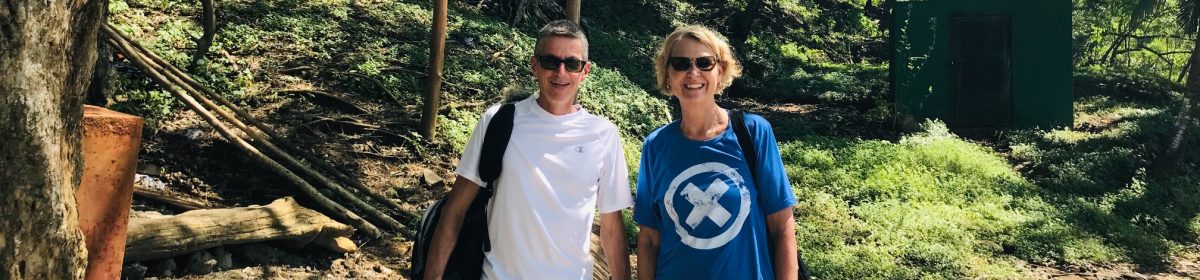
This is the second post about our half-day tour of San José, where we finally made it to the downtown area.
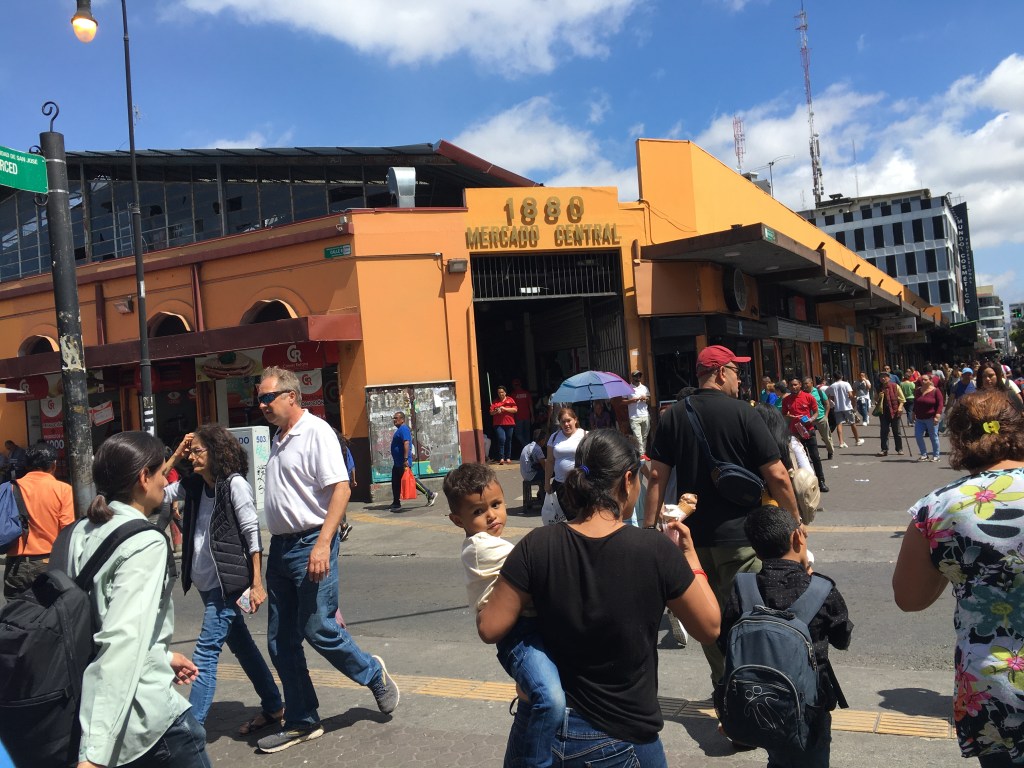
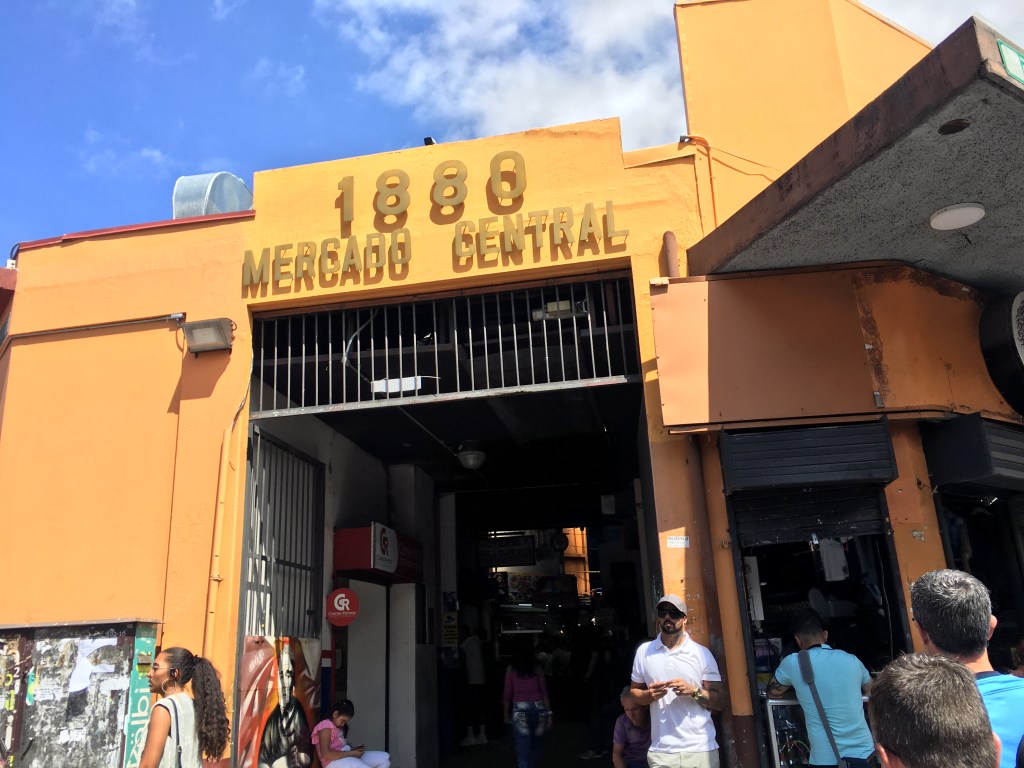
When at last we made it to downtown San José, we were deposited on a pedestrian road where we then walked a few blocks to the Central Market. There were quite a few people there, and some street vendors that had their wares laid out on blankets on the street. We also saw a couple of vendors selling peeled fruit on sticks wrapped in plastic wrap, stored in plastic buckets. Our guide stopped to talk to a couple buying from a vendor. I don’t know what he said, but after we were further away, he told us to never buy food like that on the street. He said it was OK if it was whole fruit but not that. I don’t think we would have been tempted to make a purchase like that but appreciated the advice. Still, we were now getting hungry so I asked about lunch, which was supposed to be included in the tour. Our guide said that we would eat about 1:00. I was relieved that it was still on the itinerary.
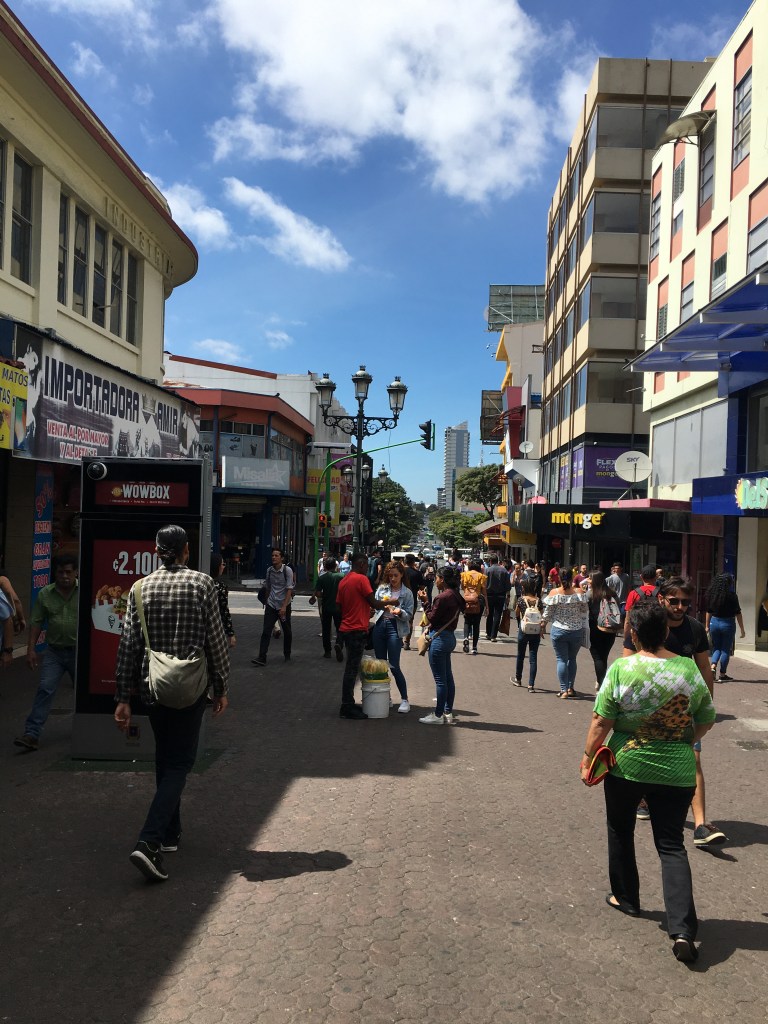
Fruit seller we were warned about 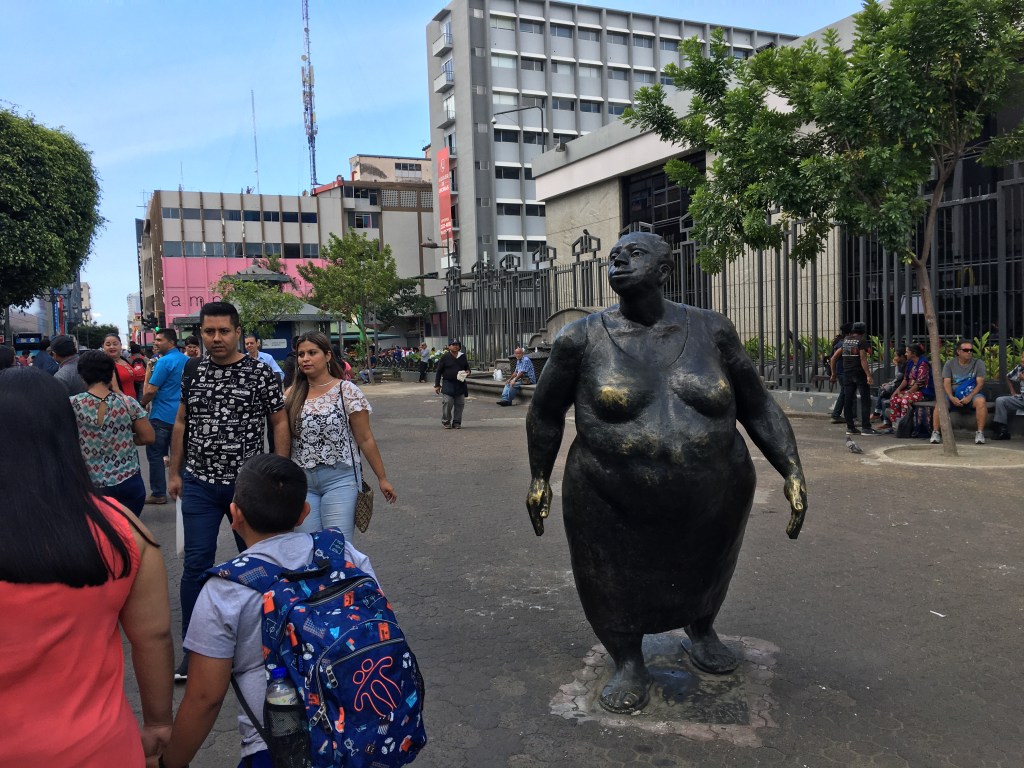
Statue in pedestrian street
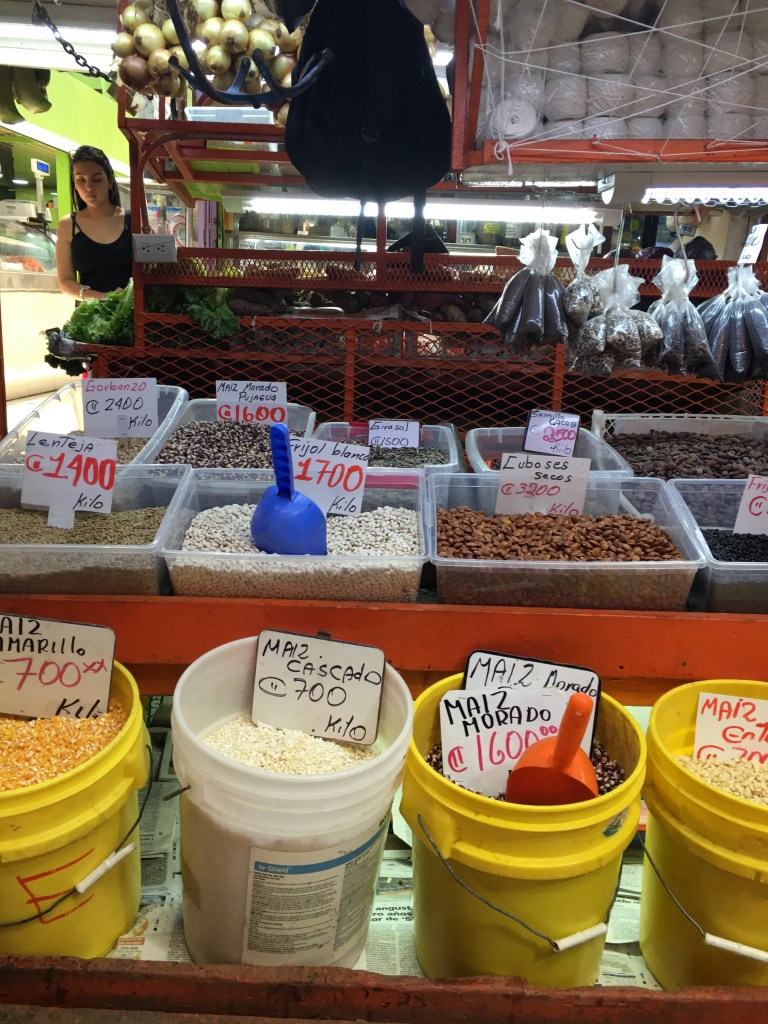
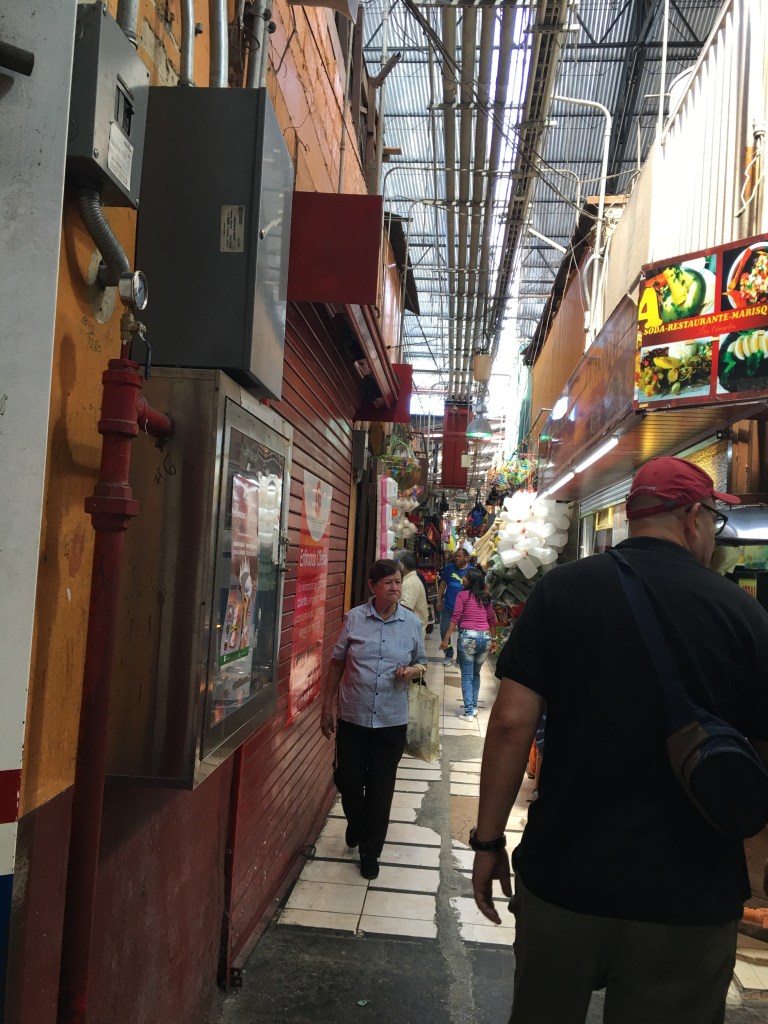
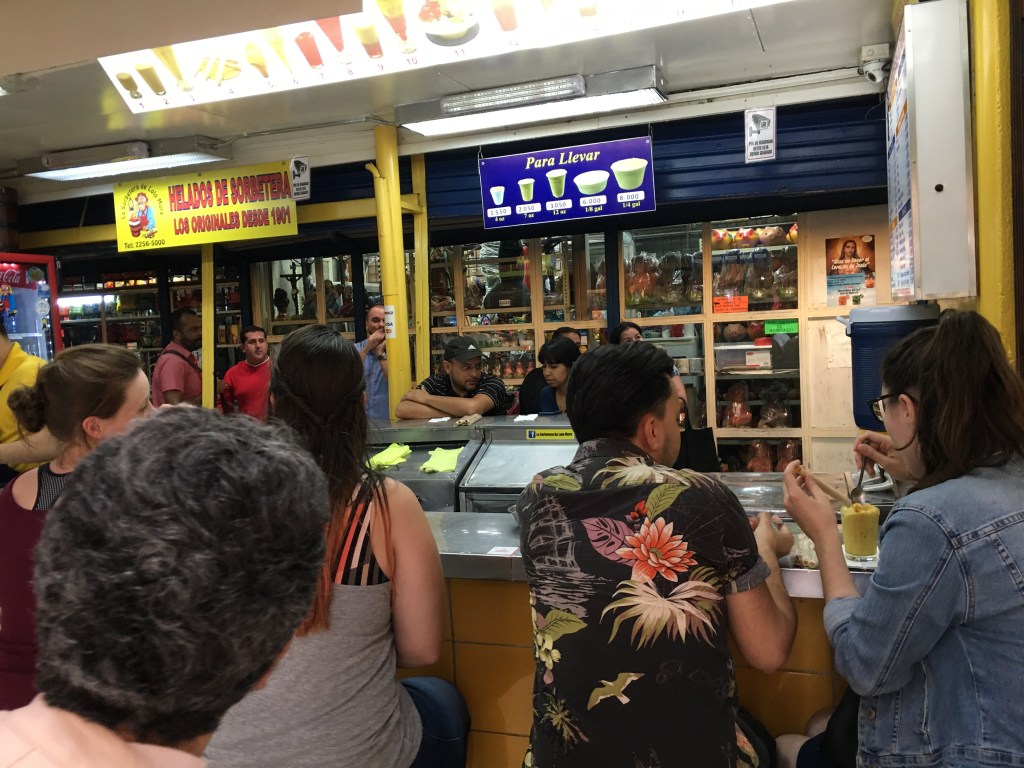
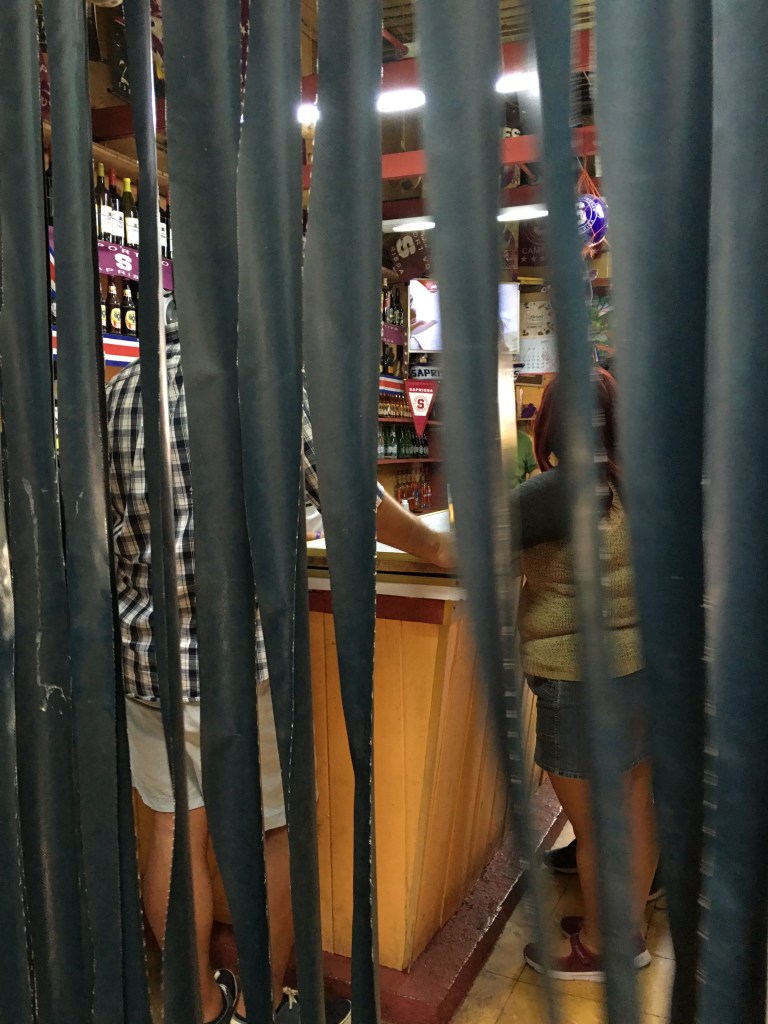
The Central Market is a covered shopping area that houses a multitude of small vendor stalls selling produce, spices, clothing, knick-knacks, etc. The passageways are narrow and maze-like, but the market has high ceilings. There are also some sodas (small local restaurants) and bars. Our tour guide told us that the traditional bars were for men only in the old days. The opening to one of the bars was covered by long rubber strips. Our guide pulled the strips aside and told us this was typical of a more traditional bar (except for the fact that there was a woman drinking there, in addition to a man).



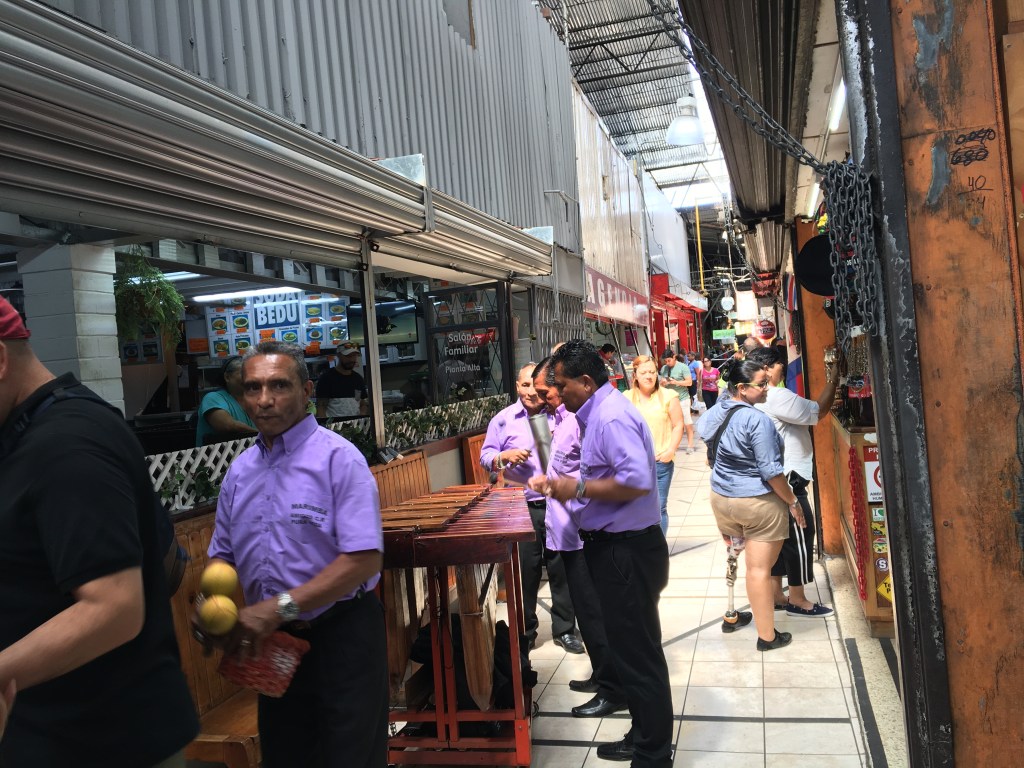
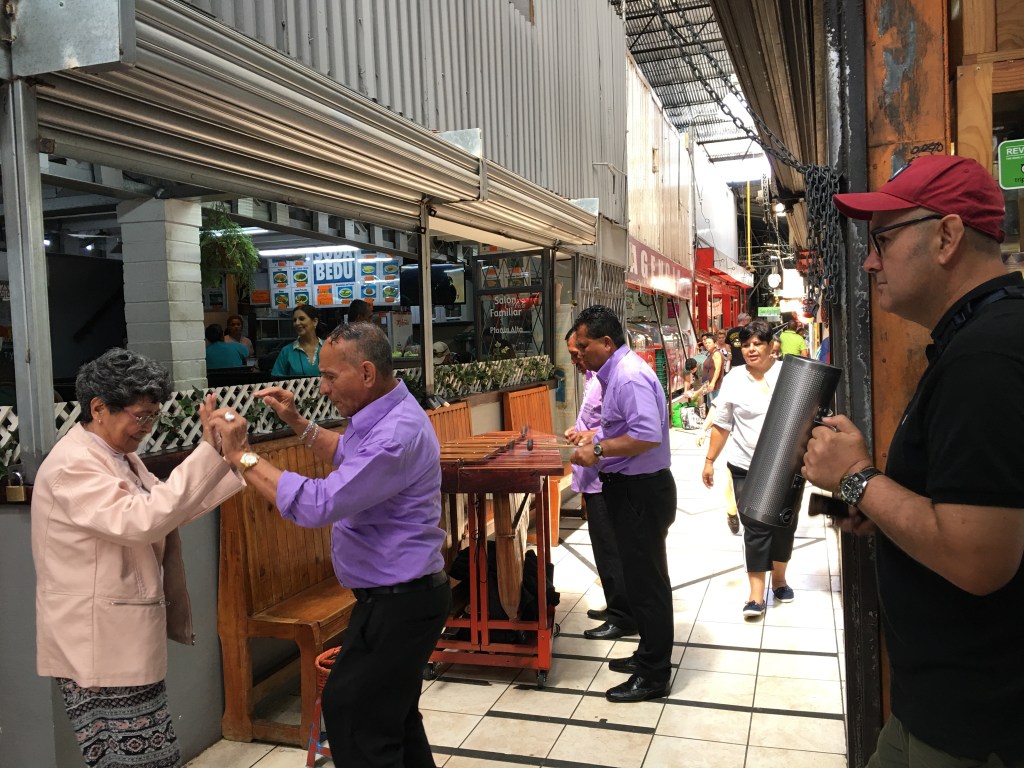
At one point in the Central Market we encountered a small band wearing purple shirts with a large marimba and several other percussion instruments (two markets with marimbas in one day!). Our tour guide started dancing with the older lady on our trip. He then took over playing the güiri, while the band member that had been playing it continued to dance with her. They danced for quite a while, with our tour guide really seeming to enjoy playing the musical instrument. Later he would tell us that he played in the percussion section of the National Orchestra. He did seem to know his way around the güiri. Seemingly he was a man of many talents!
After leaving the Central Market, we walked to Central Park (Parque Central). Along the way our guide noted the influence of French architecture. He had also told us earlier that the Costa Rican flag contains the colors red, white and blue because the government is structured similarly to the French government.

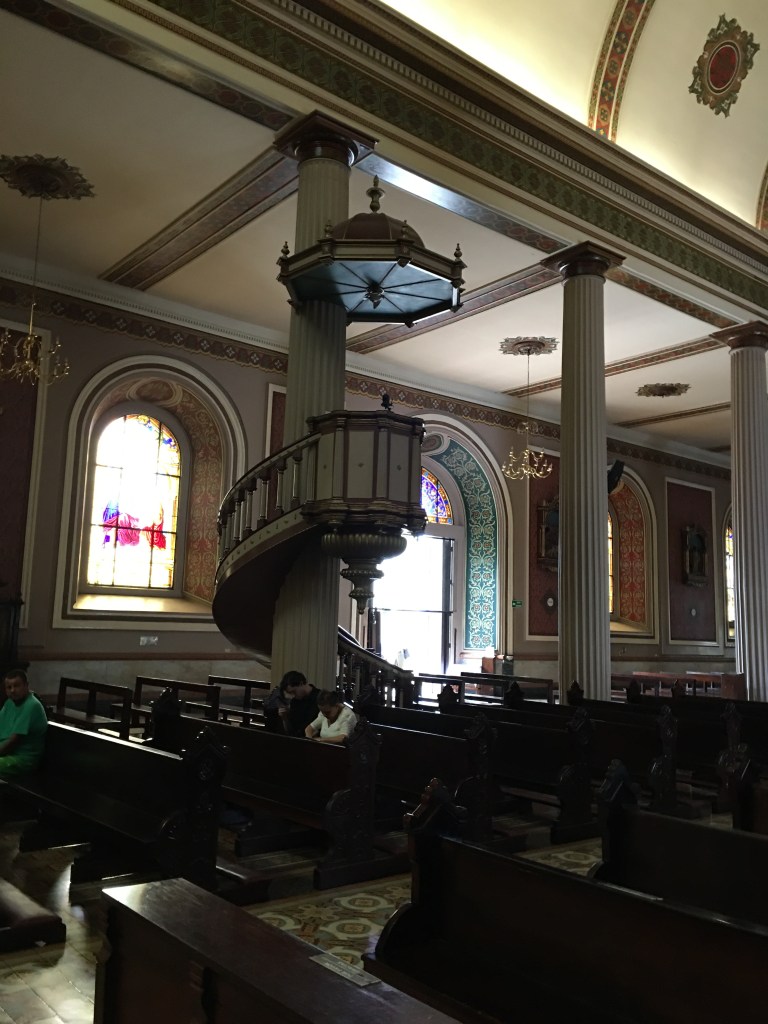
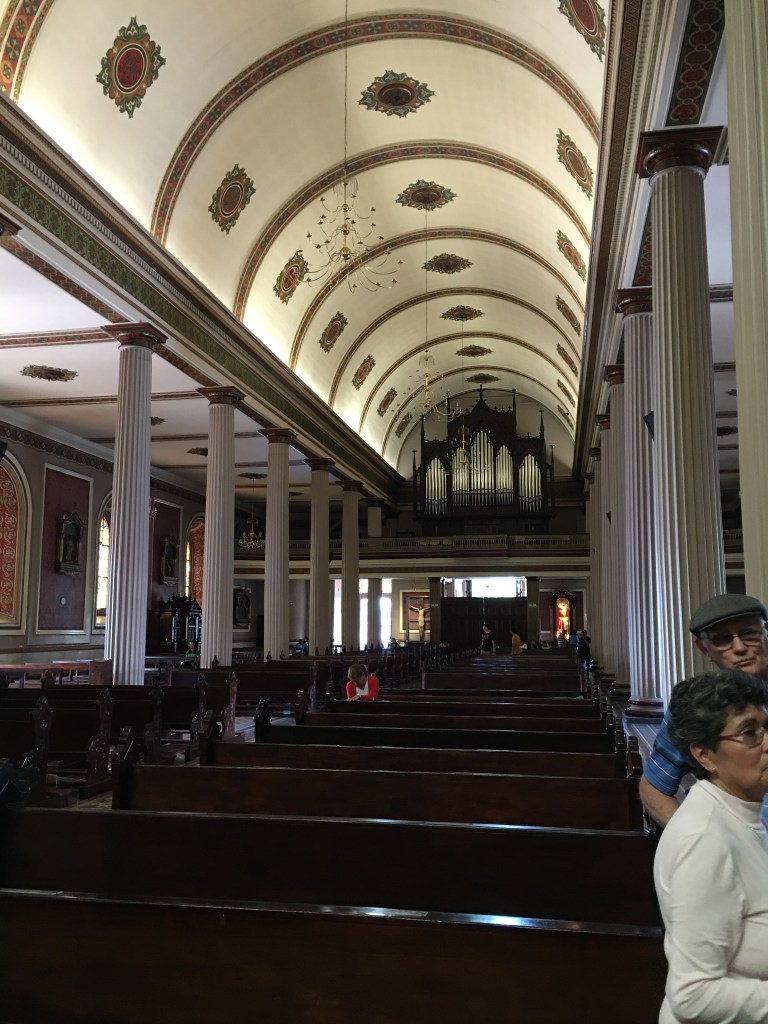
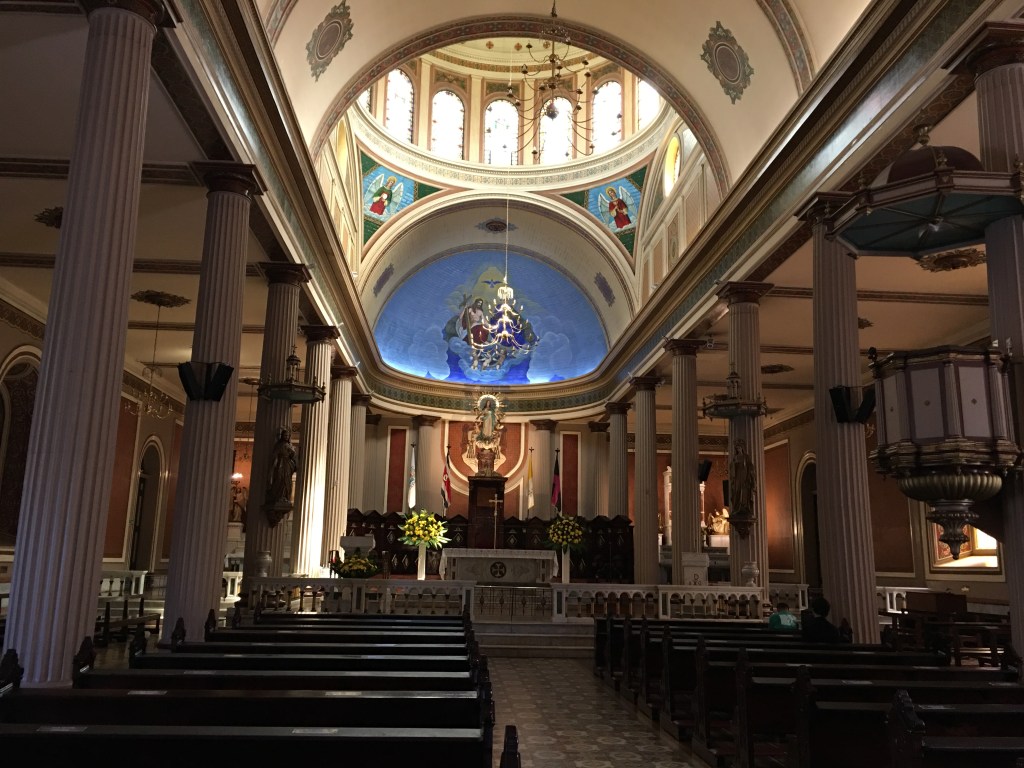
We crossed the park and entered the Metropolitan Cathedral (Cathedral Metropolitano). As we stood at the entrance, our guide made a comment to three pretty girls sitting along the wall. They smiled and one of them flashed a peace sign. He then turned to us and told us that he had told them that three angels had escaped from the church. It’s surprising it took him six months to decide the priesthood wasn’t for him!

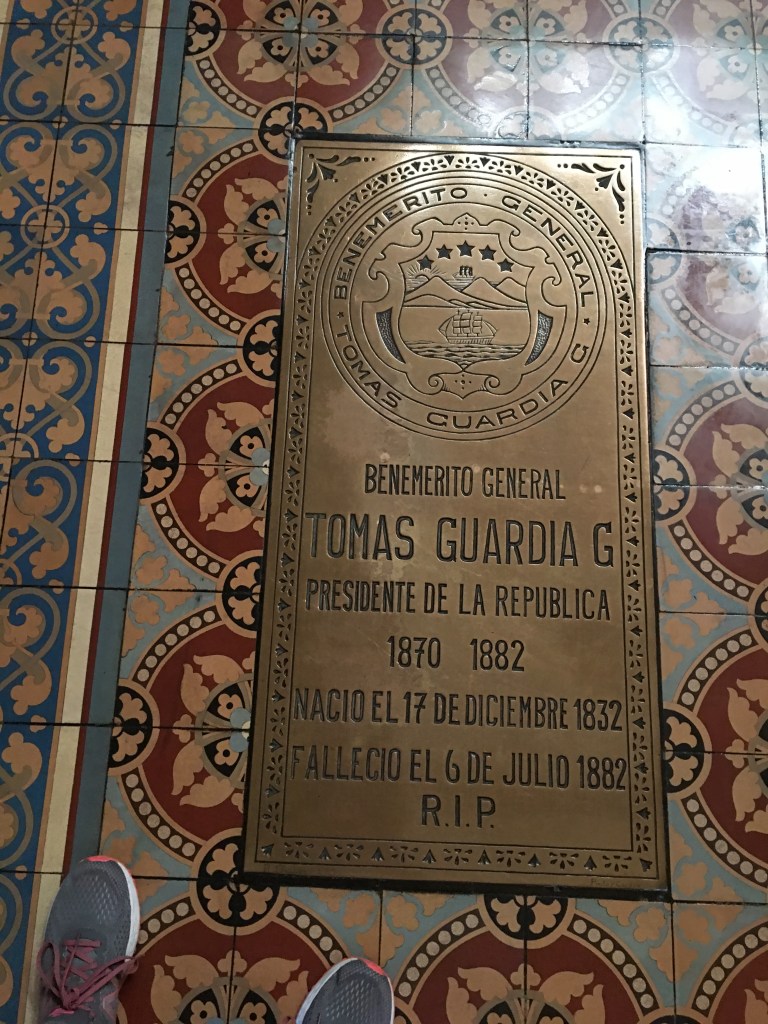
The inside of the cathedral was beautiful and included the resting place of Tomas Guardia, one of the presidents of Costa Rica in the 1800’s.


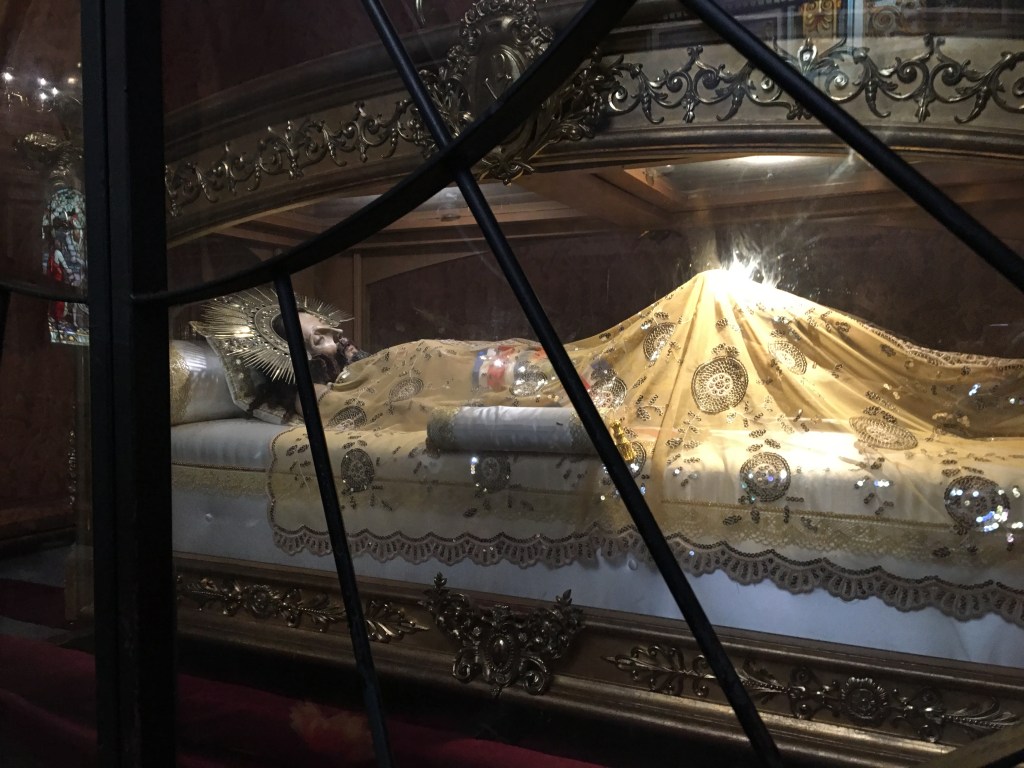
There was a small walkway between the large chapel and a smaller chapel in the Cathedral. It contained a figure of Jesus resting on a gold bed with white linens and a gauzy gold cloth to cover him. Our guide pointed out to us that the sash of one of the important historical leaders in Costa Rica was on Jesus’ chest, under the gold cloth. (I think it was the sash of Jose Figueres, who famously abolished the Costa Rican army in 1948, but I could be wrong. There were a lot of important leaders mentioned throughout the tour.) The sash seemed a surprising addition to the figure of Jesus, but considering the comfortable gold bed and cloth, maybe it shouldn’t have been.
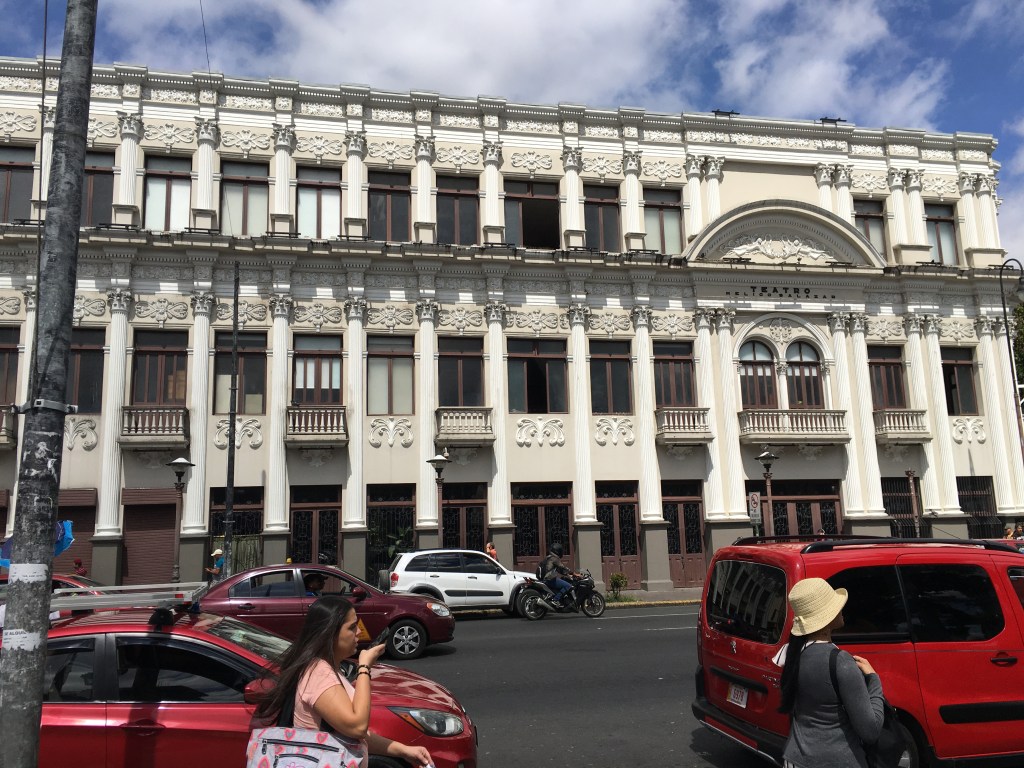
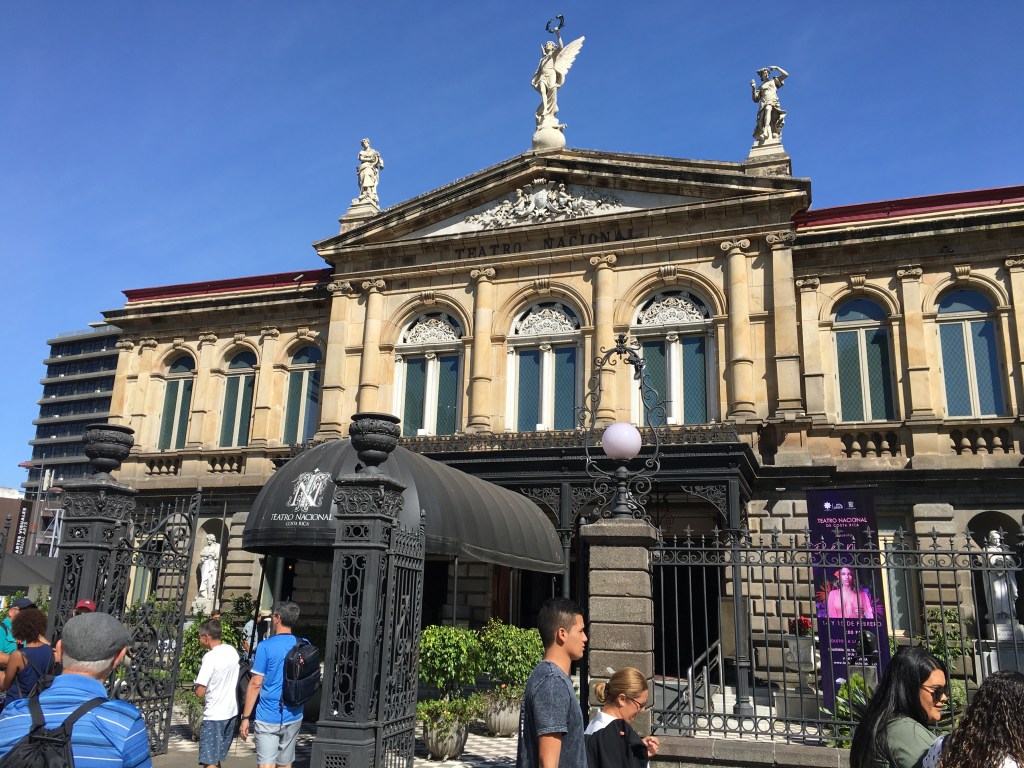
After the cathedral, we walked to the National Theater (Teatro Nacional), where we entered the lobby. Our tour guide informed us that our tour didn’t include an actual tour of the National Theater. But, if we were willing to pay the $10 entrance fee, he would be happy to give us a tour of the facility himself. This is where he mentioned that he had played with the National Orchestra over 80 times in the percussion section. This is also where he mentioned that the marimba player in the Escazú market had been a student of his. It would all be a bit too much to be believed, but everywhere we went, people knew our tour guide. The other tour guides knew him, the people at the different stops knew him, and guys at the National Theater knew him. And they seemed to know him in a good way.
We all agreed to take the tour of the National Theater, but our tour guide had ordered lunch for us, so we needed to come back after we ate. (When we were in the lobby of the National Theater our guide asked us if we wanted chicken, beef or fish for our lunch. We could each order individually. The older lady wanted fish, and that didn’t sound bad to me, but I asked our guide, “was it a good kind of fish?” He kind of screwed up his face and said it was Tilapia. The older couple settled on beef and the three of us ordered chicken, the safe bet.)
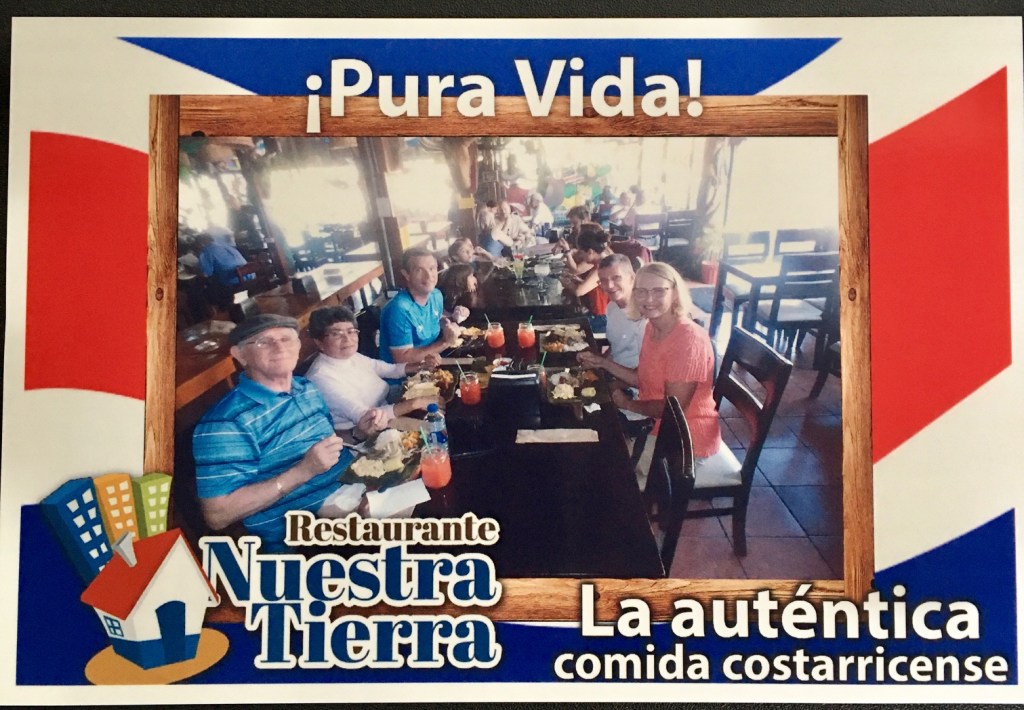
We drove a few short blocks to our lunch restaurant, the “Restaurante Nuestra Tierra” (Our Land Restaurant), where we would be served what they call a typical Costa Rican married man’s meal, casado. The restaurant claims it has authentic Costa Rican food. We know, because they took a group picture of us and gave us a copy for free with those words in Spanish printed on it. Think locals come here?
We were served our choice of seasoned meat, with black beans, rice, vegetable-potato medley, macaroni salad and a sweet plantain. We were also given a fruit drink and a very small dessert, what they called rice pudding, which was more like milk with rice in it. Still, we were very hungry by the time we were served lunch, and the food was good and filling. The free photo was just icing on the cake.
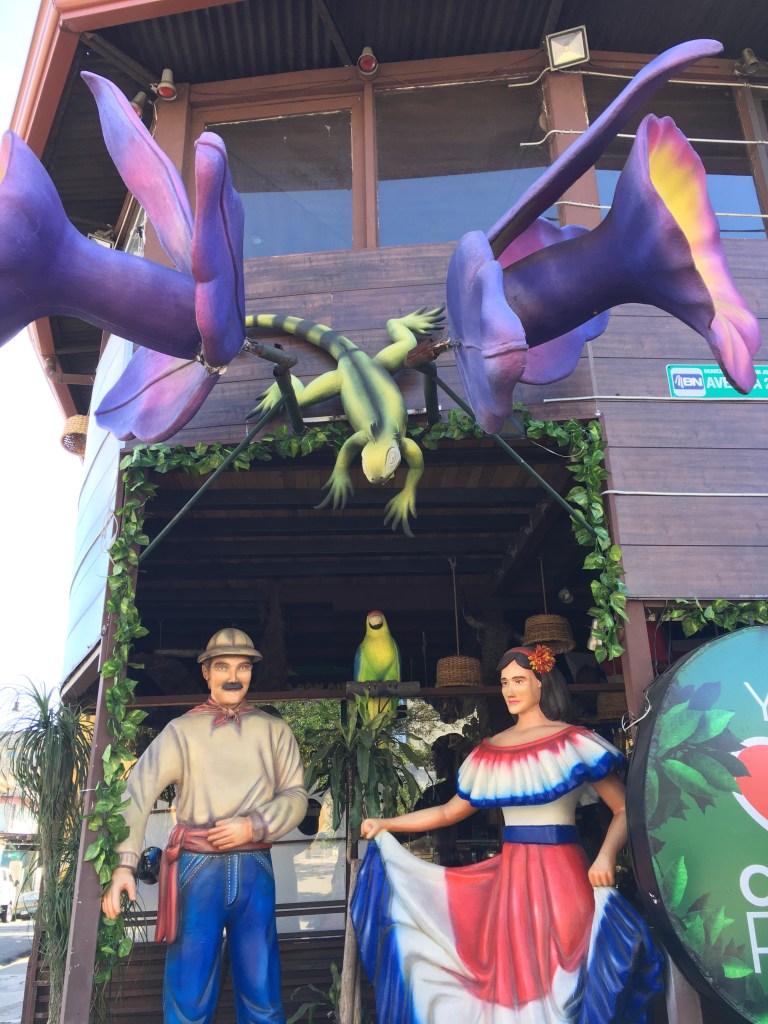
Outside of restaurant – everything is life-size or larger! Obviously meant for photo ops. 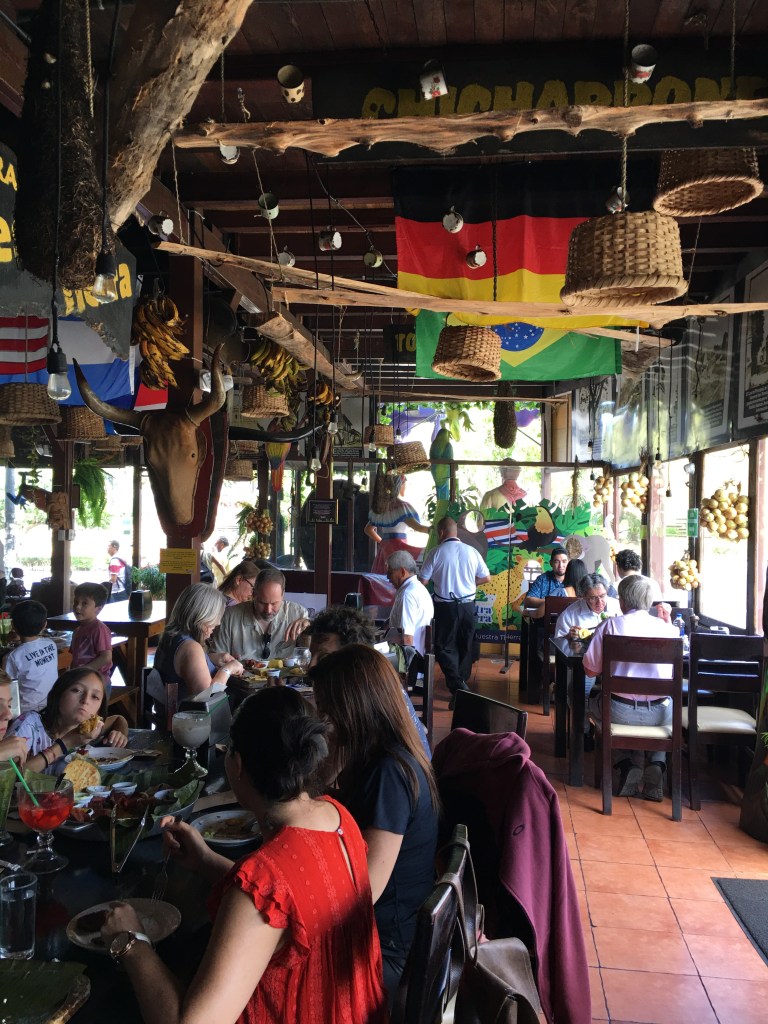
Inside of our lunch restaurant
After lunch we walked across the street to the Plaza de la Democracia, where the National Museum is located, another museum not included in our tour. The National Museum is in a large yellow building that was a fortress in the 1948 civil war. One of the building’s side turrets still has bullet holes, which have been intentionally left as a reminder of war’s violence and bloodshed.


On the other side of the plaza is the Jade Museum, that houses the largest collection of pre-Columbian jade artifacts in the Americas. (Yet another museum not included in our tour.) We also saw the new legislative building under construction. It looks like a square concrete tower, with hardly any windows. Can’t even imagine how dark it would be in there. Makes you wonder if the architect is playing a joke on the government.
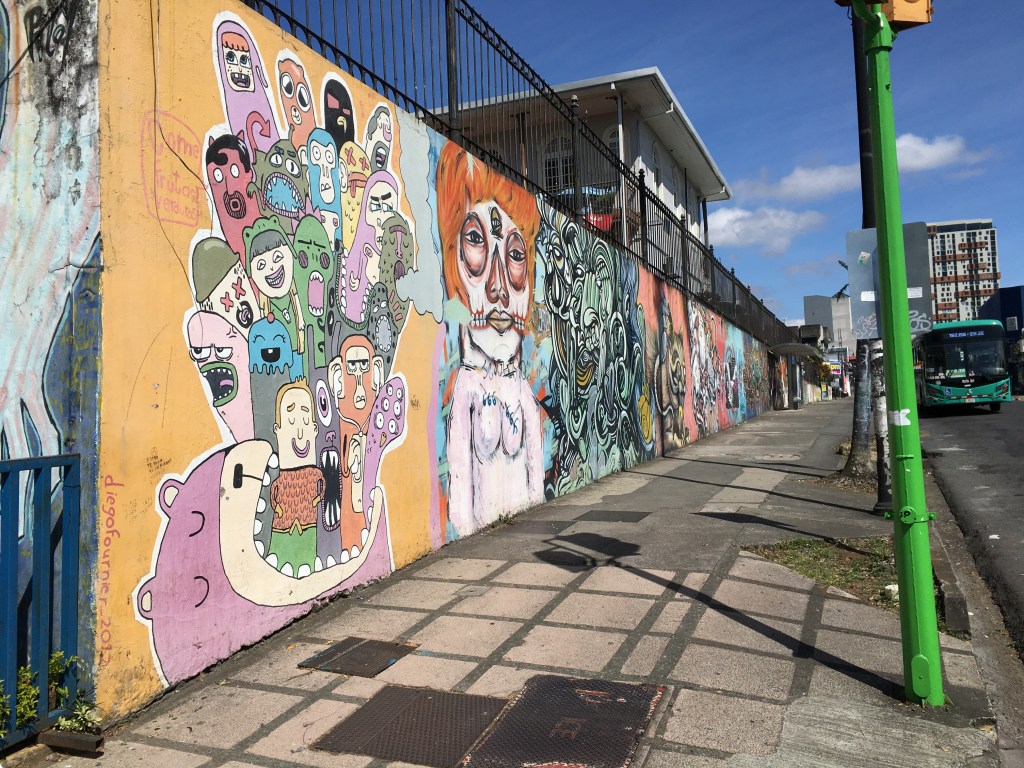
We also saw some interesting graffiti as we headed toward the National Park (Parque Nacional). There we saw a couple of statues. The large one in the center depicts the defeat of a local gringo, William Walker, who tried to conquer Costa Rica in the 1800’s. Our tour guide told us the other one has generated a lot of interesting poses for pictures – use your imagination.

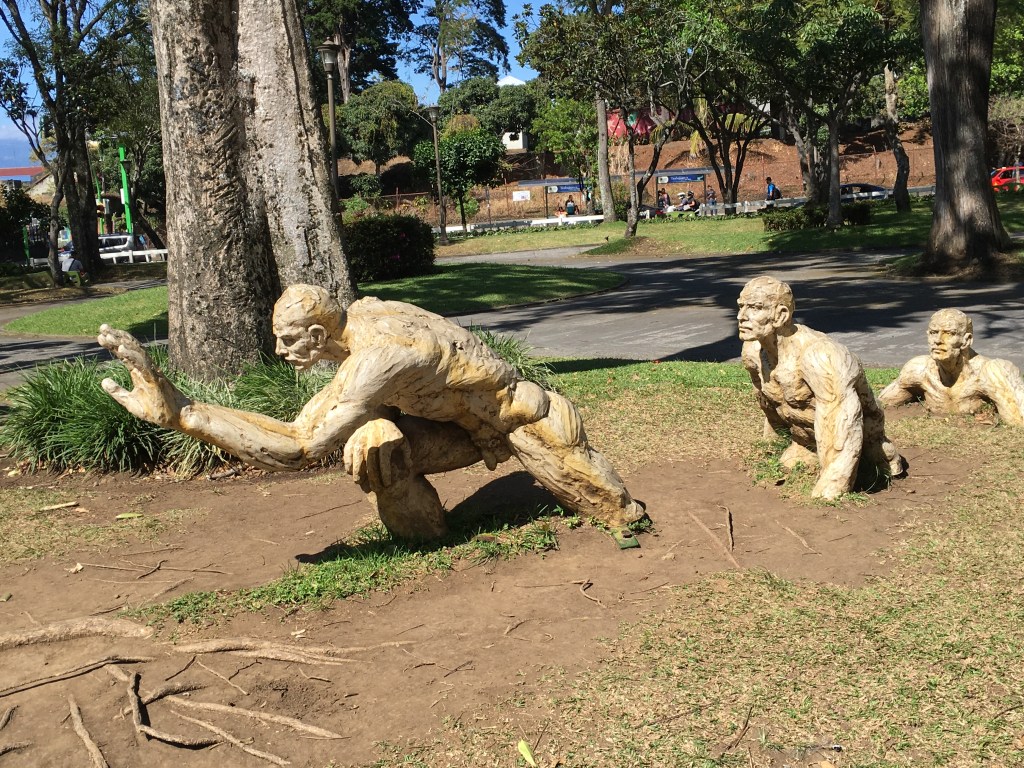
Our guide told us the old train station was up the street. He said that in the olden days, single women would parade down the street in a line going one way, and single men would parade down the street going the other way. If a couple caught each other’s eye, they would link arms and I guess that was the beginning of a courtship. The street is called the Paseo de las Damas (Walk of the Ladies), which you would think would be named for this tradition. However, sources say that the street is really named for the damas trees that line the street. Damas trees have long yellow fruit that reminded early settlers of the braided hair of European women.
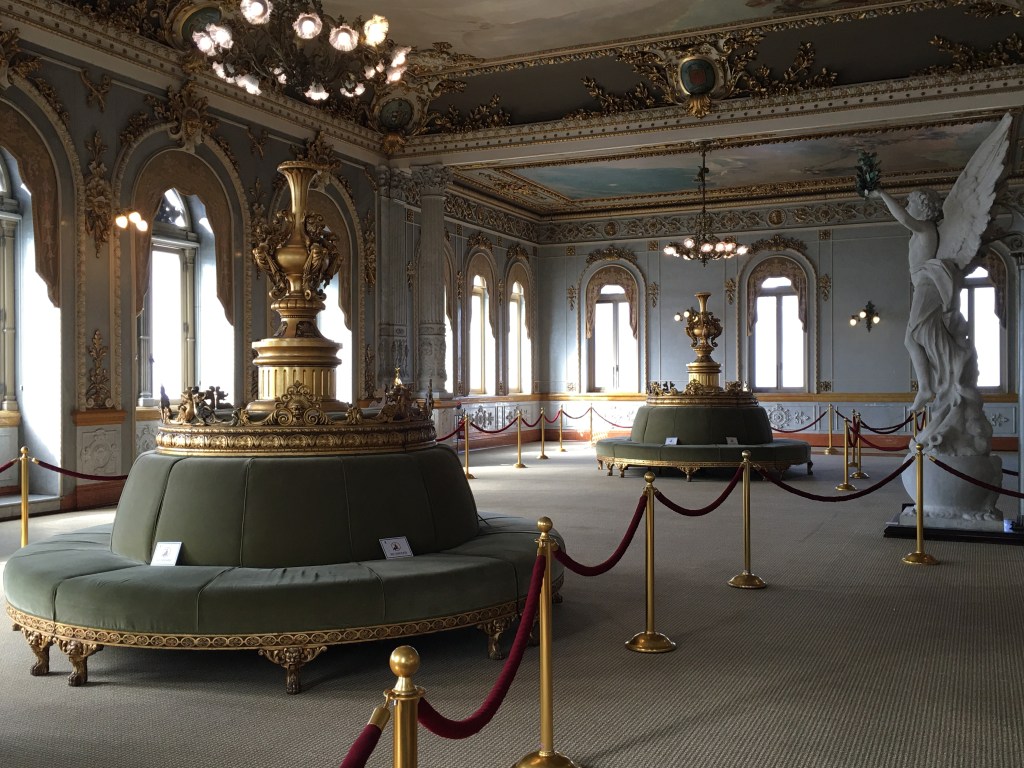
We then reconnected with our van and drove back to the National Theater. The National Theater was opened in the 1890’s and is a scale replica of the Opéra Comique in Paris. It is absolutely beautiful, and worth the pittance of an entrance fee. Our guide led us onto the main floor with seating. The theater was built before speakers, etc., so it was designed in a horseshoe for the best acoustics. The main floor of the theater can be raised to the same height as the stage, using a large corkscrew. We saw a video of how this worked, multiple people pushing bars around that moves a corkscrew and pushes the floor up. It takes over one hundred revolutions. In the video it looked like tourists were doing the work, for the experience, I guess. I wonder if they offer tourists this “experience” when they need to raise the floor?


The large, grand original chandelier still hangs in the center of the theater. It is still operational because it is electric. Interestingly San José was the only the third city in the world to boast electric lighting, behind New York and Paris.
On the stairs up to the next level there is a large mural depicting people near the coast in Costa Rica. The mural was painted by an artist who had never visited the country. According to our guide, it contains over 20 mistakes. (Our tour guide invoked the phrase “happy accidents” from Bob Ross.) For example, the man is holding the bunch of bananas upside down, and the women look European, to name a few.
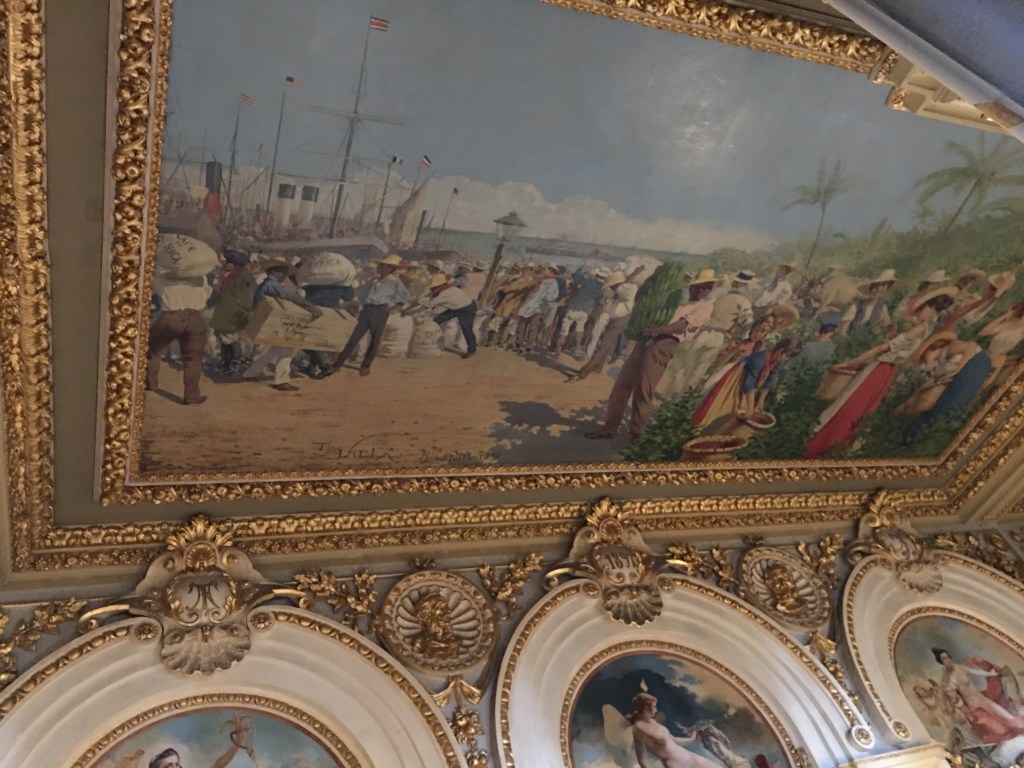
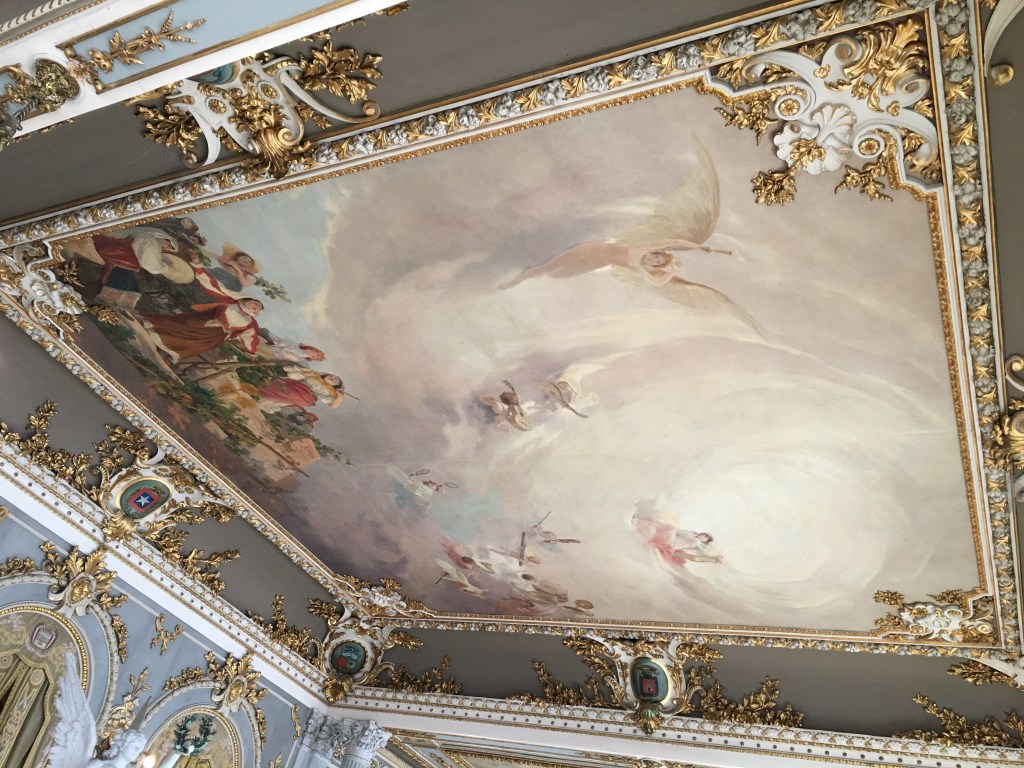
The lobby is on the second floor and features a mural on the ceiling with figures whose eyes follow you around the room. We walked around the room and yes, they did. Our guide told us that they also hold smaller concerts in this room.
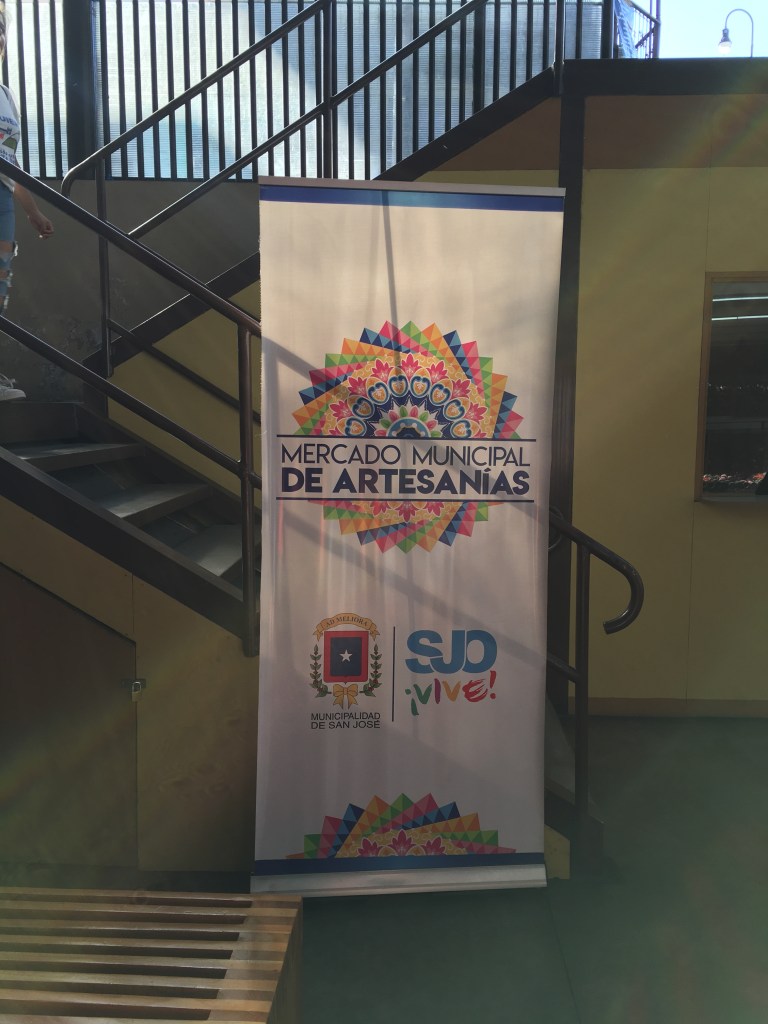
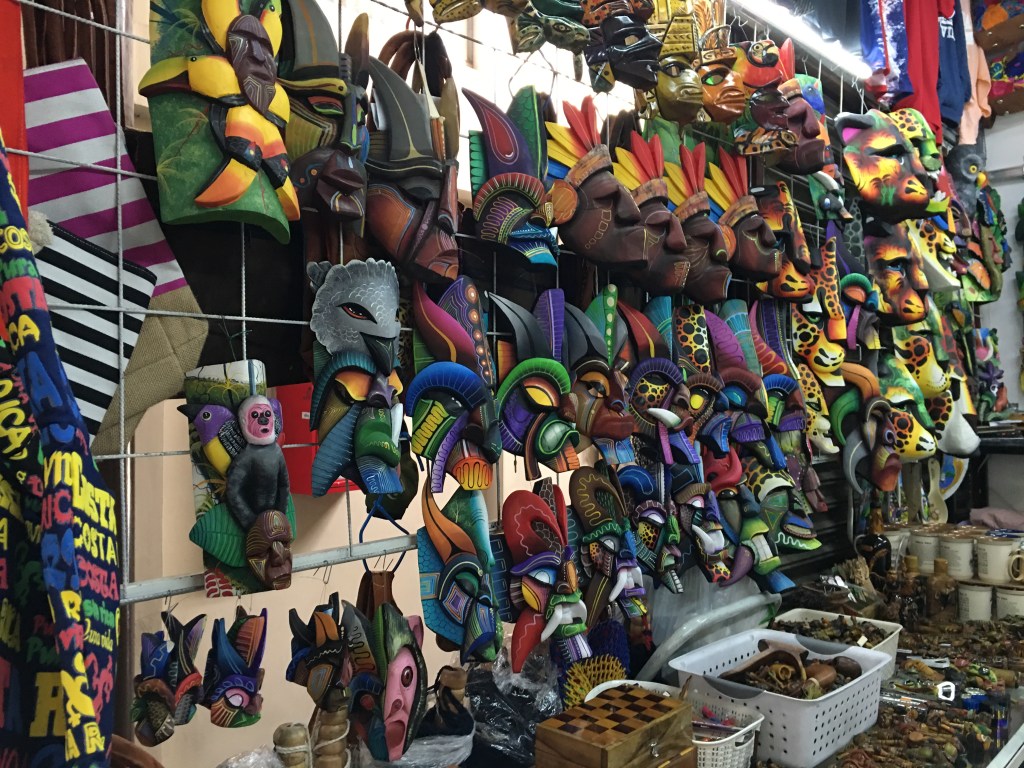
After the National Theater, our final stop was the “Mercado Municipal de Artesanías” (Municipal Craft Market), which we were told is relatively new. This stop was highly disappointing. Like the Central Market, it was a building with small vendor stalls, selling mostly souvenirs. It really did look like most of the stalls were selling exactly the same merchandise. We were given a lot longer to look around there than needed.

We returned to the van where we were told we could be dropped off where we wanted. Our guide actually got off first. He said he lives in Guanacaste and needed to get back to his hotel, get his suitcase and catch the public bus back to his home. Guanacaste is a province that is a ways from downtown San José, so he had more than a few hours bus ride ahead of him that day. The driver dropped off the older couple next, in a hotel in/near the downtown San José area, but not as close as we thought, based on their discussion with our guide for their desire to return to the Central Market for more shopping. Finally, we three remained, and we were able to be dropped off at our apartment complex, Escazú Village directly, and not at the Wyndham Garden Inn Hotel.
All in all, it was a good tour. It gave us confidence that we could grab an Uber to downtown San José and visit the museums that we still want to see, as well as show the sights to anyone who may visit.
 Remember, it's an adventure.
Great story, but I’d go for the peeled fruit on sticks wrapped in plastic wrap, stored in plastic buckets every time! What could be unsanitary about it?
LikeLike
You’re right – what could possibly go wrong?!
LikeLike
Enjoy touring!
LikeLike