Our neighbor John H asked if we wanted to do a tour of San José one Saturday, and we readily agreed. He pointed us to Tripadvisor and asked if any of the tours listed sounded interesting to us. There were some things I wanted to see, the Central Market, the National Theater and the Gold Museum were a few that we had heard about that sounded interesting. I tried to review the different tour options. Most of the tours had most but not all of what we wanted, and some included other spots. The tours were 4-5 hours, some included lunch, some said they had hotel pick-up, some you had to meet at a street corner, some were earlier in the morning, some accommodated a lot of people, some capped the number, etc. It became highly confusing. I even tried to put together a spreadsheet to make comparisons. After a while I decided on a few choices that I reviewed with (my) John, and then I sent a message to John H with options. He replied that he didn’t want a bus tour alone, but anything else was good.
In the end I decided on the tour that included a hotel pick-up, lunch, and mentioned walking around some of the sites. This (I thought) aptly named tour, San José City Tour, didn’t have any reviews on Tripadvisor, nor information on start time, so was somewhat risky. Still, the tour company did receive positive reviews, so I booked for the three of us, not really sure how it was going to turn out.
This is the first of two posts about our San José City tour, where we mostly are not on a tour of the city of San José.
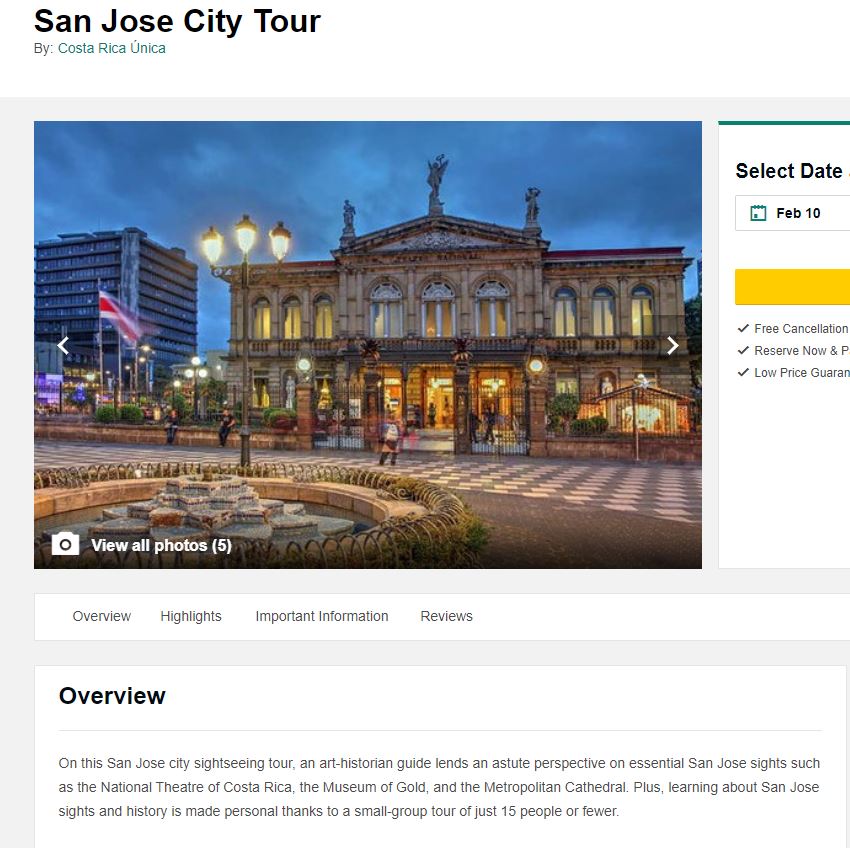
After booking the tour, I received confirmation from Tripadvisor. However, as the week went on, I didn’t receive information from the tour company on pick-up, start time, etc. By Thursday I finally called the tour company, who told me that they hadn’t received anything from Tripadvisor. I provided the confirmation information and arranged for pick-up. They let me know they would provide pick-up from the Wyndham Garden Inn in Escazú at 10:00 a.m., and not from Escazú Village, where we lived. This is the same as the other trips we’d taken to-date. At least this time we didn’t have to figure out how to get luggage there and we could easily walk. They also gave a brief overview of the itinerary. Turns out the Gold Museum they listed wasn’t the famous gold museum, but according to them, a smaller one where they would show how indigenous peoples made gold icons, etc. That was a miss, but since it was already Thursday and we were going on Saturday, I took a leap of faith that we would still manage to enjoy the tour, or at least get some good stories from it.
Saturday morning John H, John and I walked to the Wyndham Garden Inn, and arrive 15 minutes before our pick-up time. Our van was already there, and the tour guide walked toward us when we entered the lobby, for some reason able to instantly recognize us as part of his tour when we walked in the door.
There were only two other people on the tour with us, an older couple from the US, although the woman was originally from Colombia, and spoke fluent Spanish. They were celebrating their 12th wedding anniversary. The tour guide was from Costa Rica, and gave the tour in English, although he occasionally spoke to the lady in Spanish. We also had a van driver who never spoke to us.
We hopped into the van and started off. Our tour guide explained that we were first going to visit Escazú. What!? This wasn’t even part of the itinerary I was provided, we live in Escazú, and we were taking a tour of the city of San José, or at least that is what I had signed up for. Not much to do at that point except to shake my head and whisper to our neighbor that this hadn’t been mentioned by the tour company.
The van made its way uphill through the streets of Escazú, but it wasn’t smooth, due to traffic. The older couple sat in the row of seats just behind the driver, right in front of us, and the lady was filming all of it on her iPad. I could see what she was filming, and combined with the van stopping and starting, I was beginning to “feel” the trip. I bit off part of a travel sickness prevention pill and hoped for the best.
As we headed to our first stop in Escazú, our tour guide explained that Escazú is the city of witches. Of course, we had heard this before, and I’ve included this in previous blog posts. Our tour guide said that one of the possible origins of Escazú being the city of witches was from Jewish immigrants practicing their faith in secret but being seen by Catholics. We had not heard this before, but later verified that this theory was not just something our guide made up. By the way, we’ve seen many Jews going to temple when we take our walks on Saturdays so do know that there is a Jewish community in Escazú.
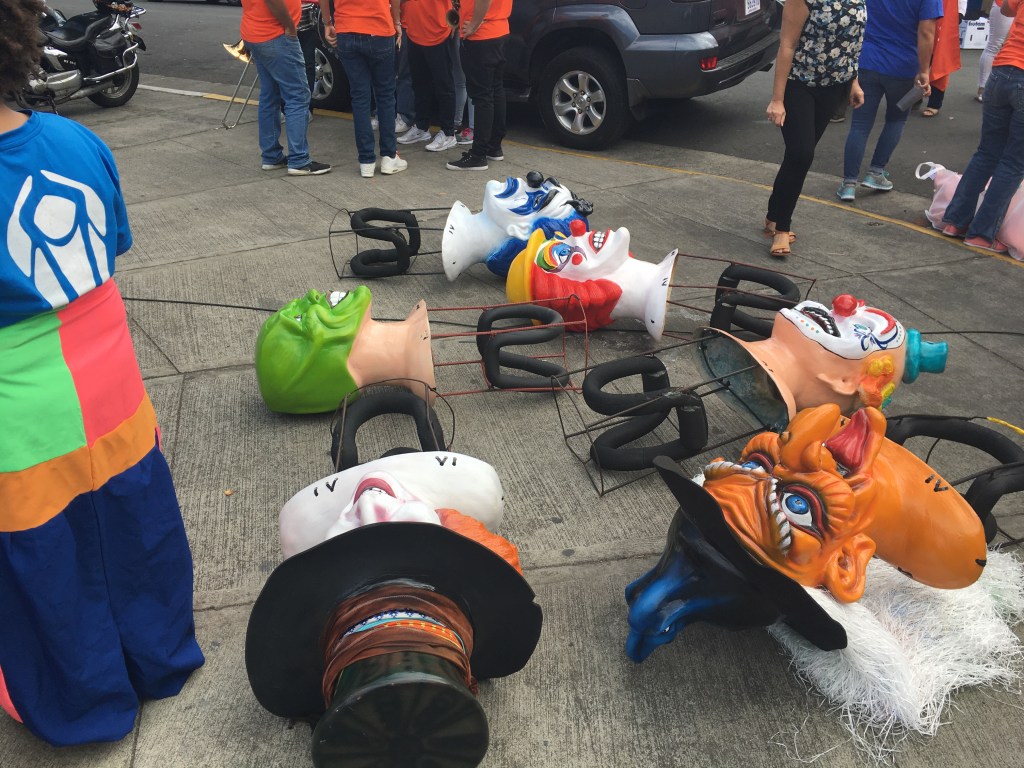
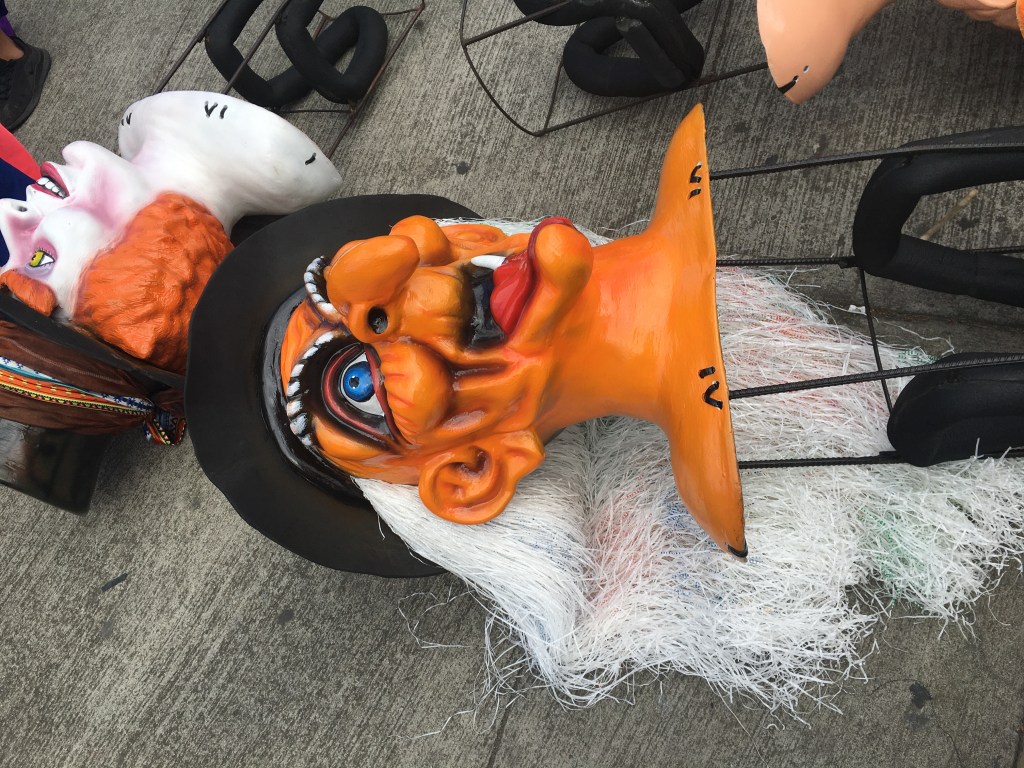
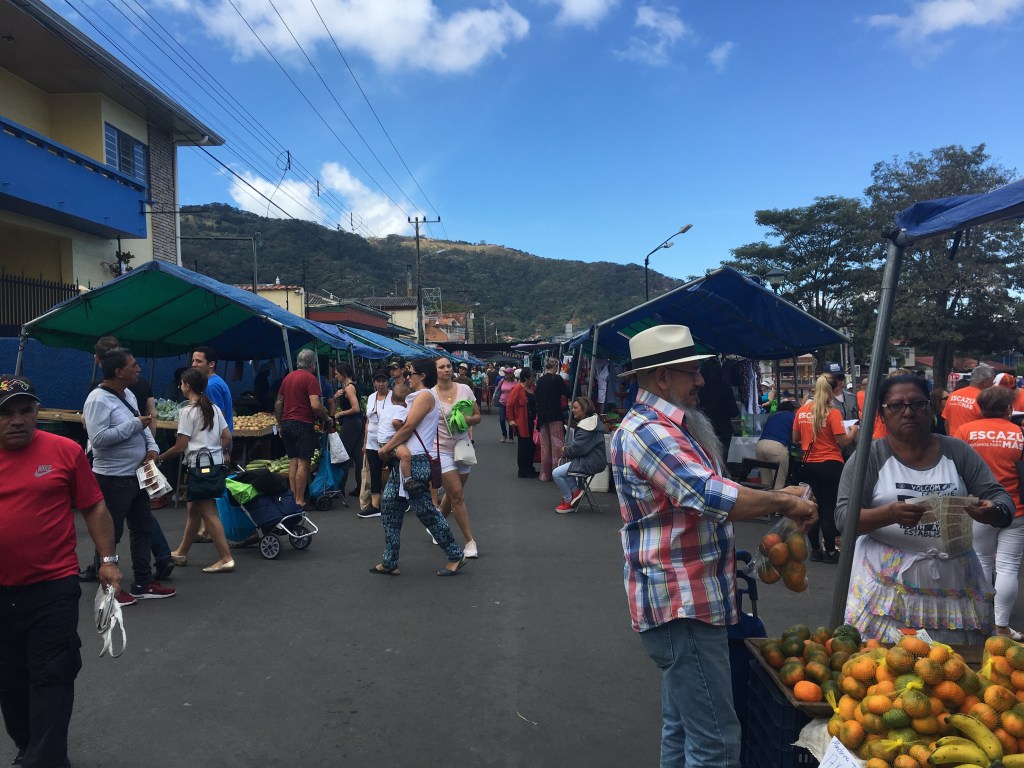
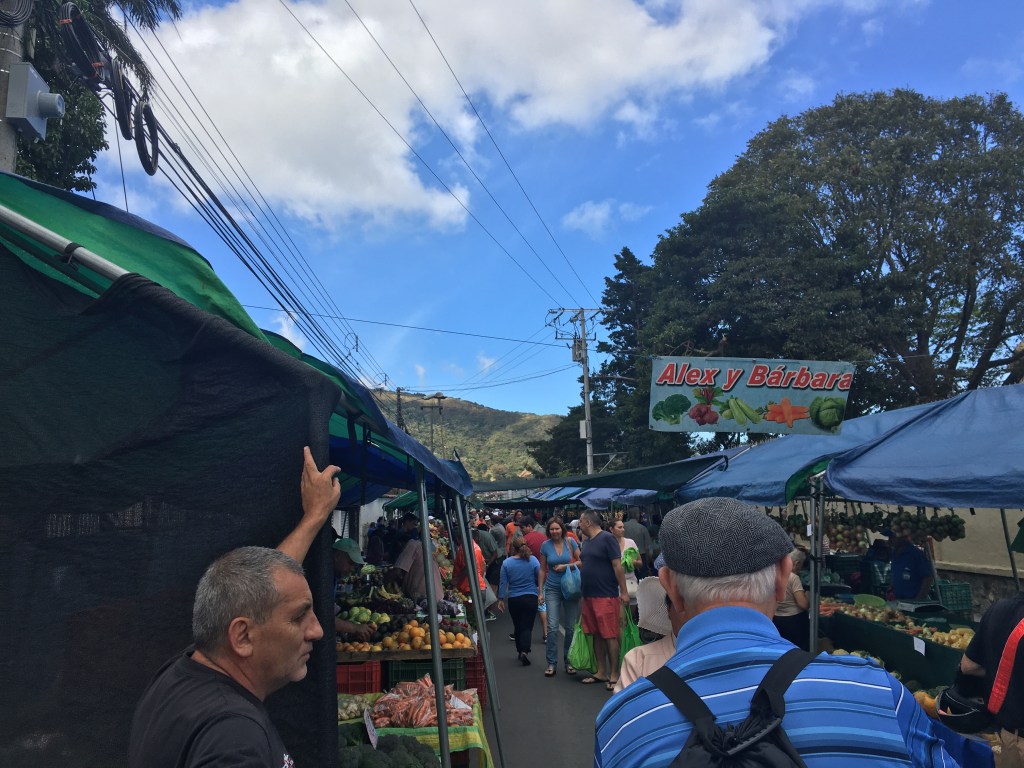
Our first stop in Escazú was the farmer’s market that is held every Saturday in old Escazú. The central area of old Escazú is laid out in traditional Spanish style, with a church, a central park, and the municipal government building across the street. We had been there before, but our neighbor hadn’t. Our tour guide stopped and talked to a young marimba player, that he seemed to know. It looked like there was going to be a parade where people wear large puppet heads. We hadn’t seen that before but had heard about it – it’s a “thing” in Costa Rica. Unfortunately, our timing was such that we didn’t see the parade. We walked through the market, with the other woman on the tour filming everything on her iPad, as she would continue to do throughout the entire tour.
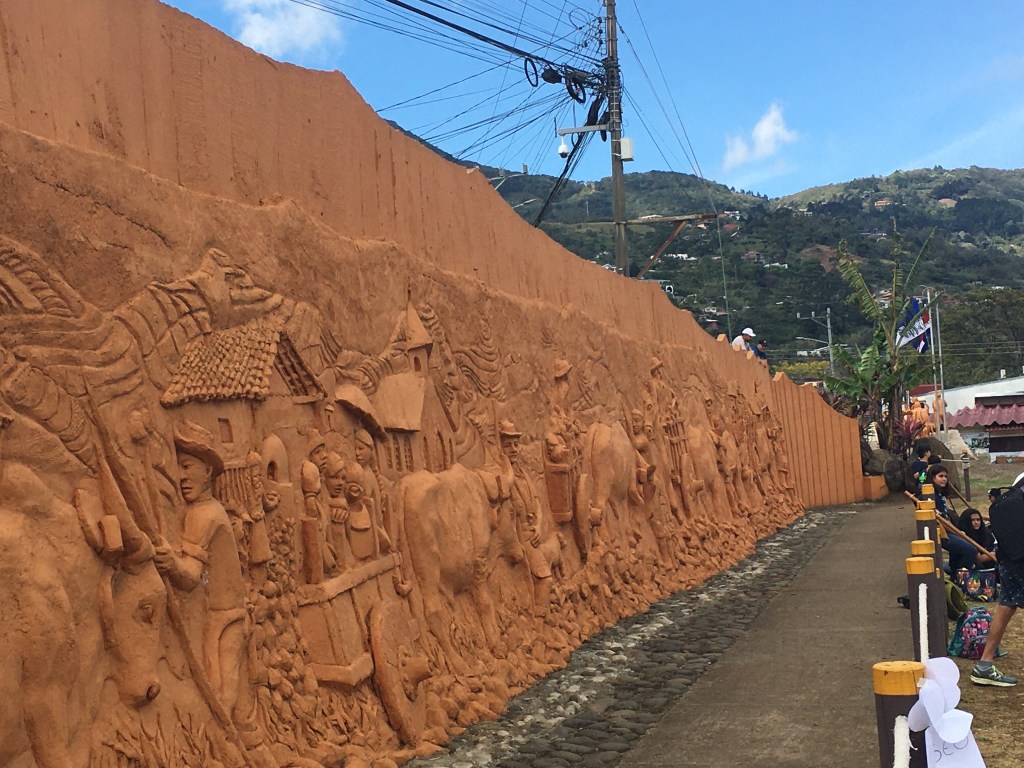
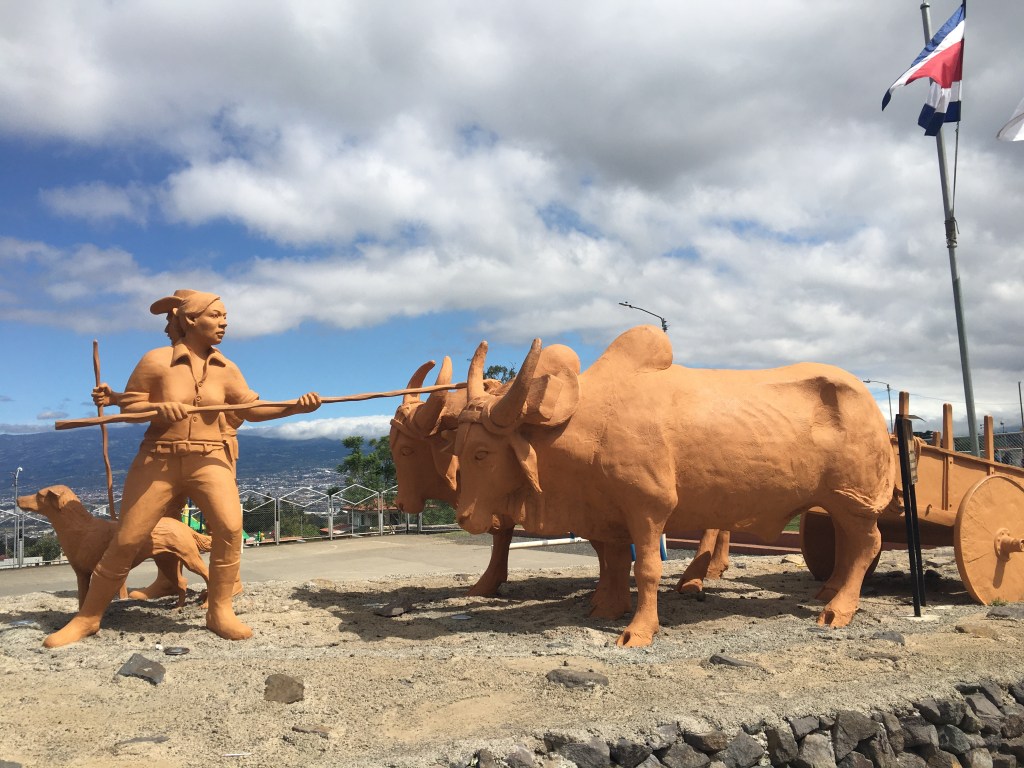
After we left the farmer’s market, we drove to San Antonio de Escazú, which is further up the mountainside. None of us had been there before. In the San Antonio Plaza, across from San Antonio Catholic Church, there was a wall commemorating the history of Escazú and a monument to the ox carts.
Escazú wall plaque, view of wall and several close-ups of wall sections:



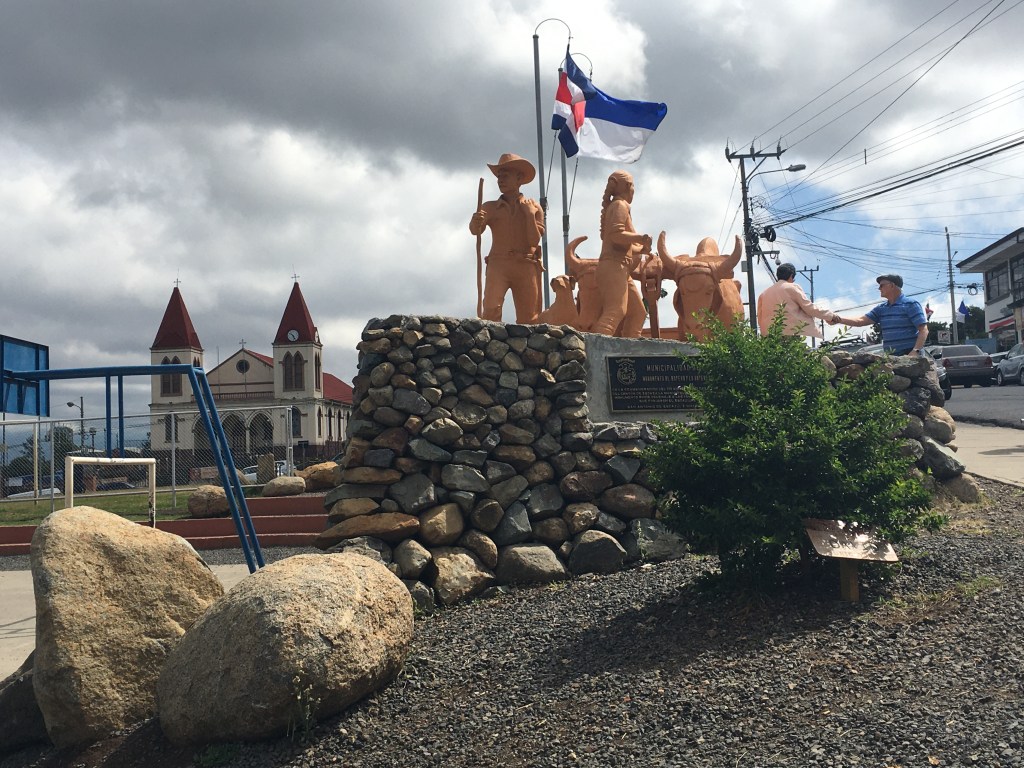
Ox carts are also a “thing” in Costa Rica. There are parades where farmers lead their oxen pulling colorful, hand-made and hand-painted carts. The ox carts were used by farmers to transport coffee and bananas to the ports, before the railroads. Our tour guide said that the phrase “riding the ox cart” describes a drunken person or alcoholic in Costa Rica. According to our guide, men would steer the carts on the long journeys and those that drank too much would fall and die when their oxen/cart ran over them. It was happening so much that they began to station officials every so many kilometers to spot the intoxicated men. When spotted, the men were forced to ride in the ox cart. Thus, the phrase “riding the ox cart” became to mean a drunken person or alcoholic. (I tried to verify this Tico (Costa Rican native) expression with a quick Internet search and was able to find the expression to be about right, but couldn’t confirm our guide’s detailed history of it.)
Monument to the Ox Cart:

There were scouts in the plaza, both girls and boys, engaging in an activity that pretty much involved having water dumped on them by their leaders, for whatever reason, so they were soaked. The day was cloudy and a bit windy, so I wouldn’t think this would have felt great. They seemed to be enjoying the activity, though.
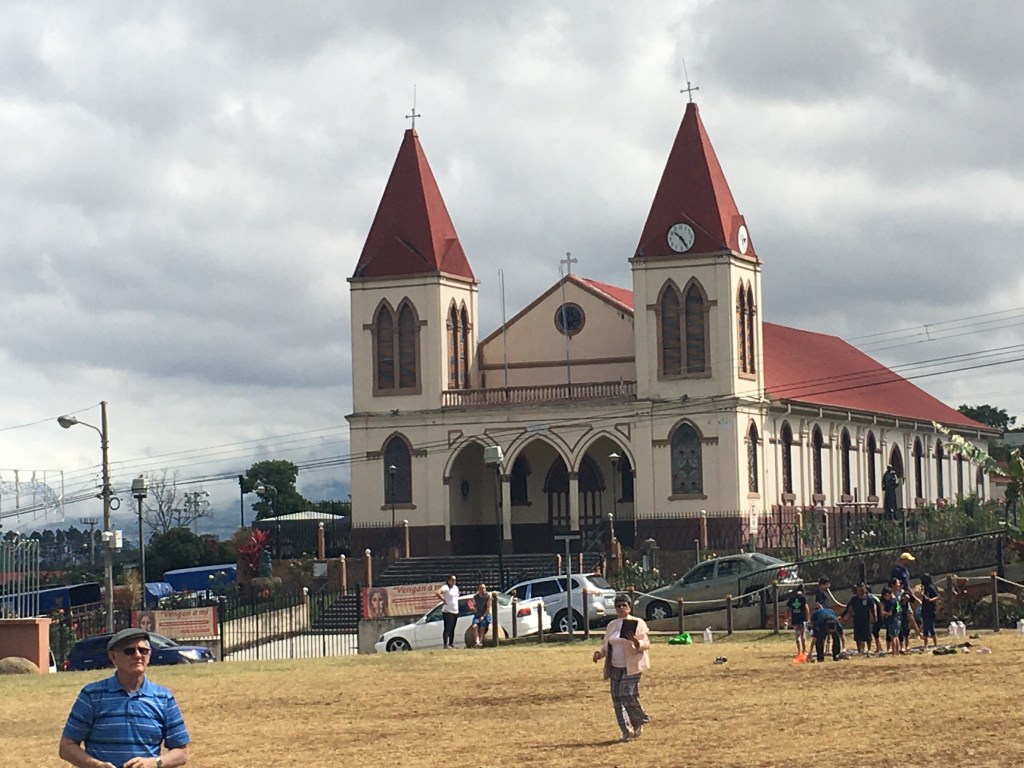
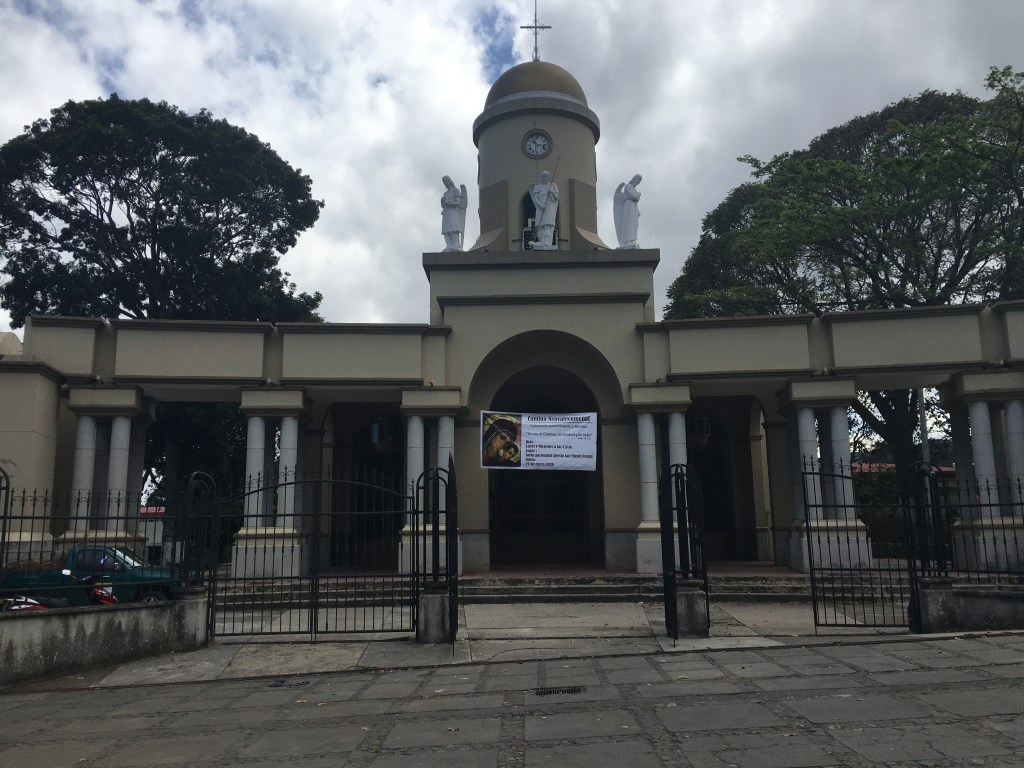
San Antonio Catholic Church 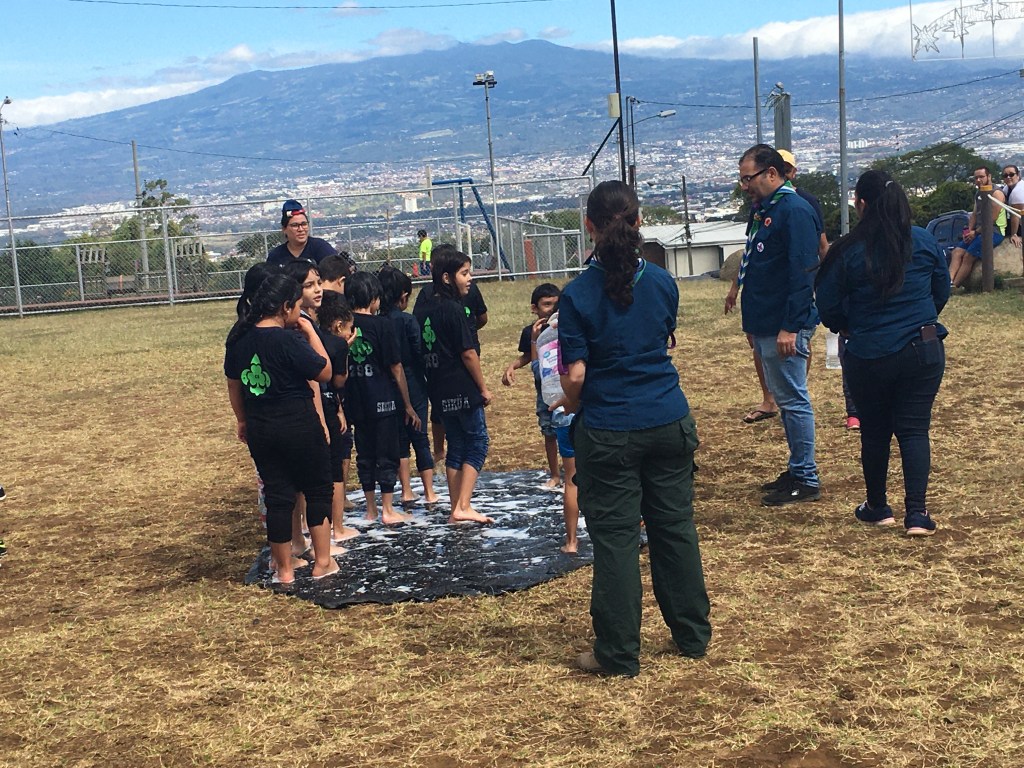
Soaked scouts in the plaza across from the church
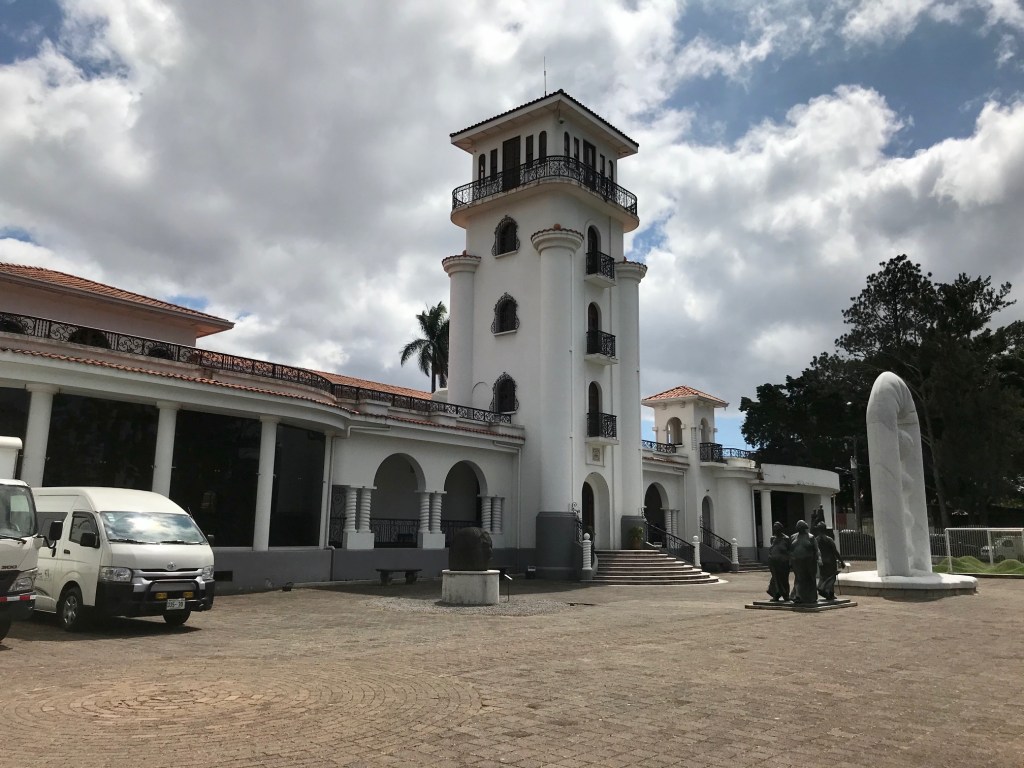
We then walked back to the van and headed toward Sebana Park in San José. Sebana Park is the area where the old international airport was located. Now it is a very large park area, with soccer fields, jogging trails, an artificial pond, trees, the National Stadium, and the Costa Rican Museum of Art. The National Stadium was built here by the Chinese government, as a reward for ending diplomatic ties with Taiwan in 2007. (There were other rewards in addition to the stadium, including a police academy, police cars, and a free-trade agreement, to name a few. If you read a previous post about our trip to Playa Cocles, you may remember that the Chinese are in the process of building a better road there. As we continue to hear, the Chinese build using their own labor, so no construction jobs are created when they make these infrastructure improvements.)
On our way to Sebana, our guide showed us the beginning of an old travel movie from 1947, in Technicolor, that showed a US plane landing at the old airport. We subsequently found the movie on YouTube, a travelogue of sorts for the time period, and found it interesting and entertaining. If you are interested – https://www.youtube.com/watch?v=YTinTEHSWkg

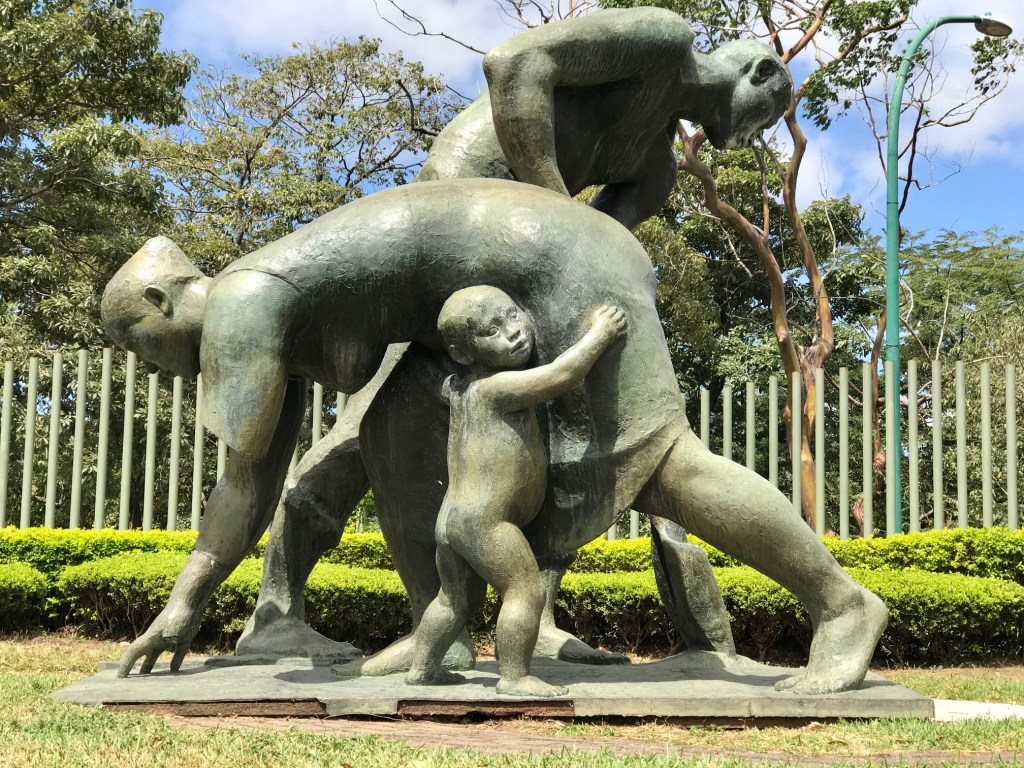
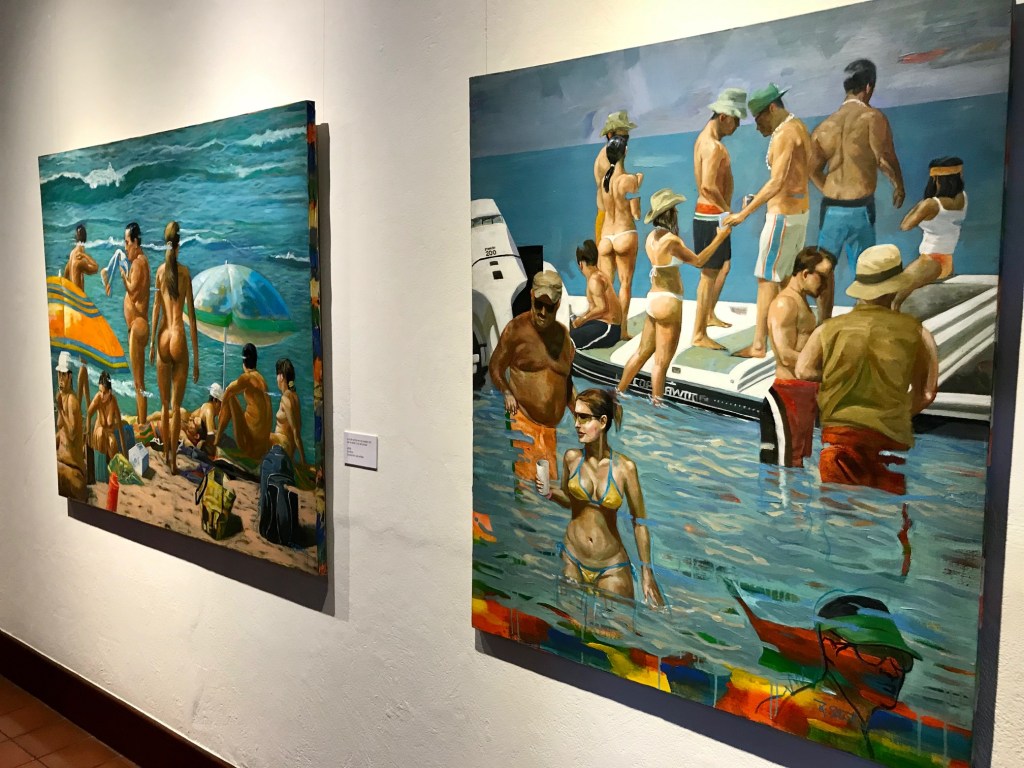
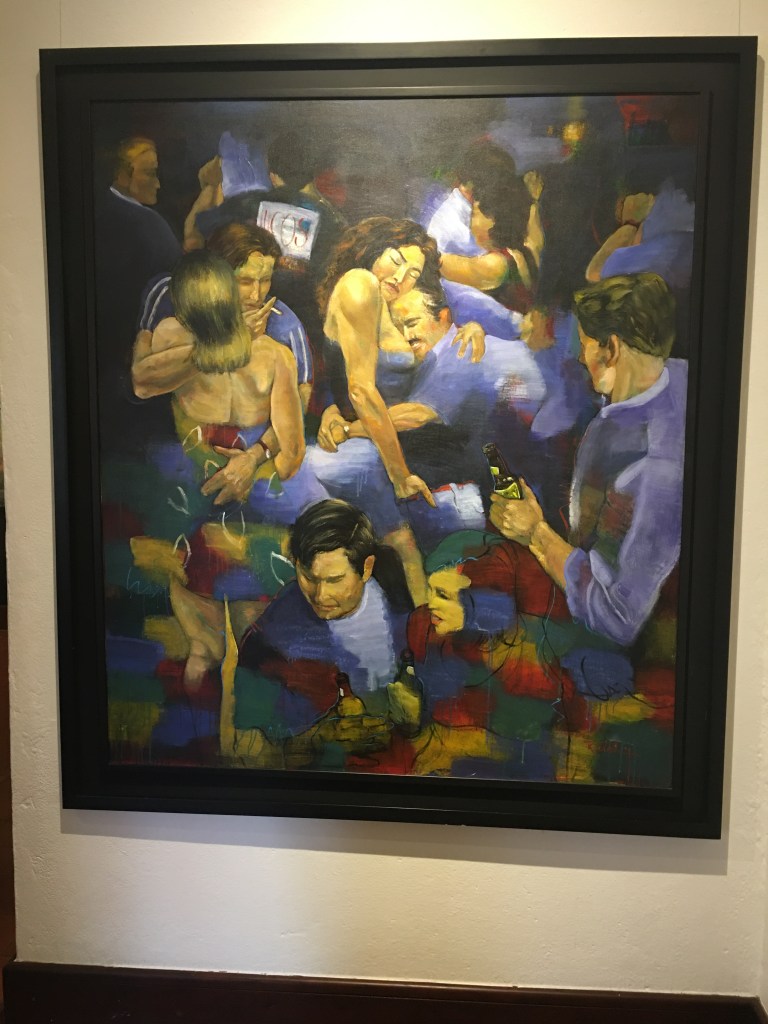
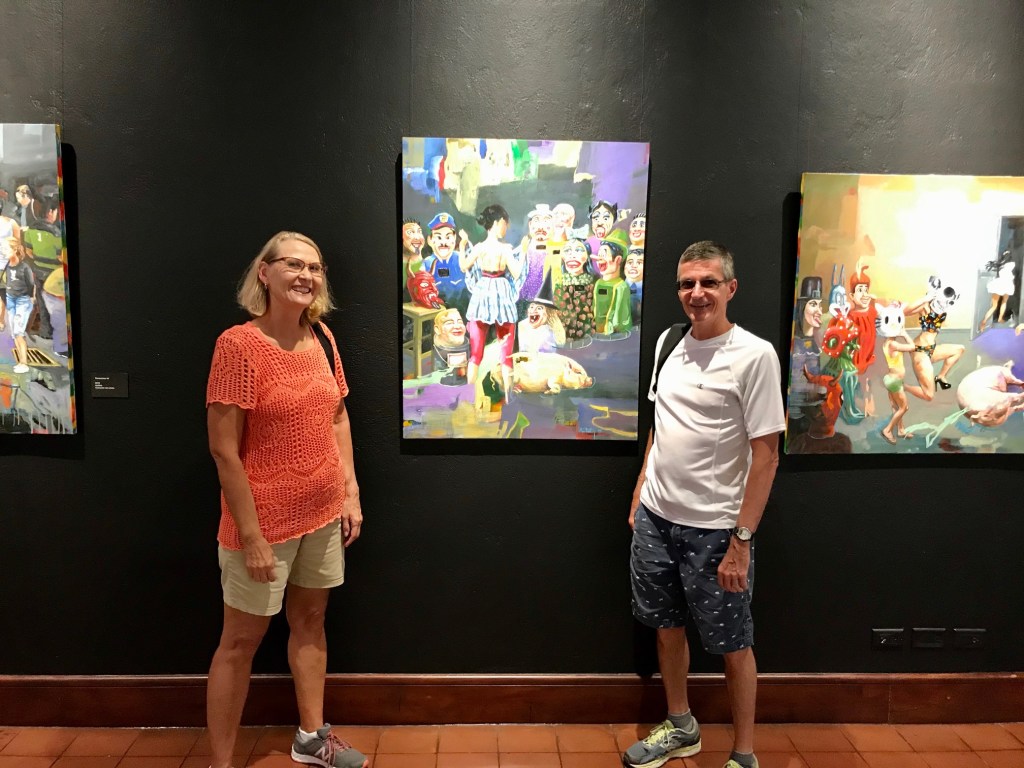
In Sebana, we toured the small Costa Rican Museum of Art. The building is the old airport terminal. It held colorful pictures by Costa Rican artists depicting life in Costa Rica, with sculptures outside.

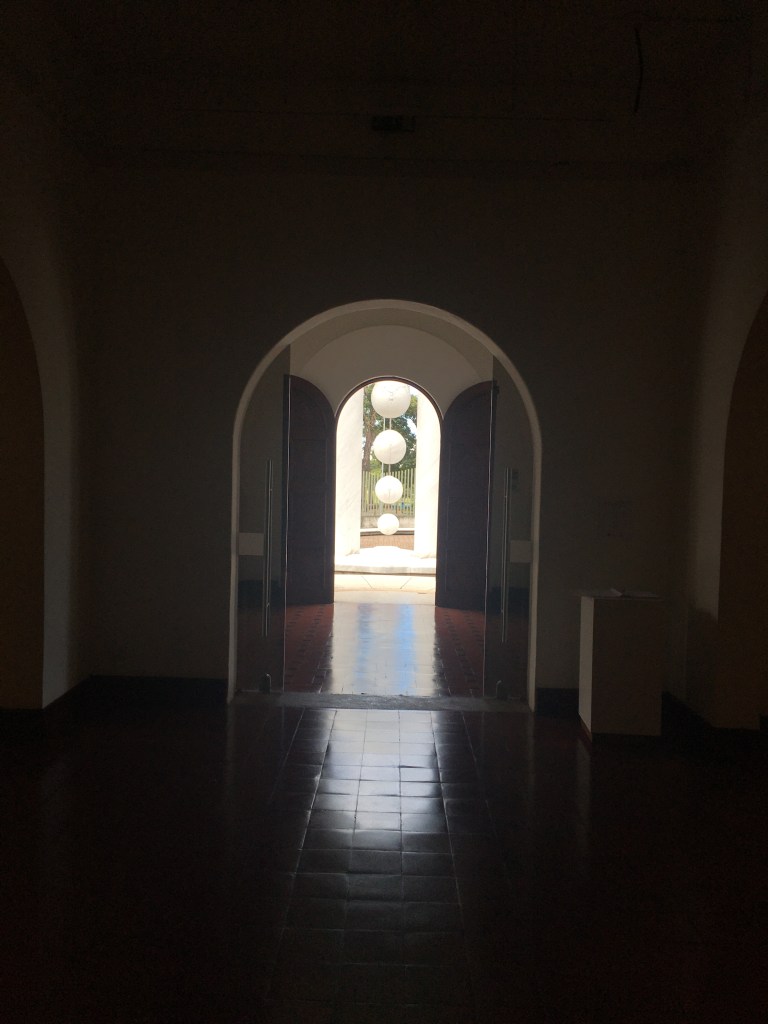
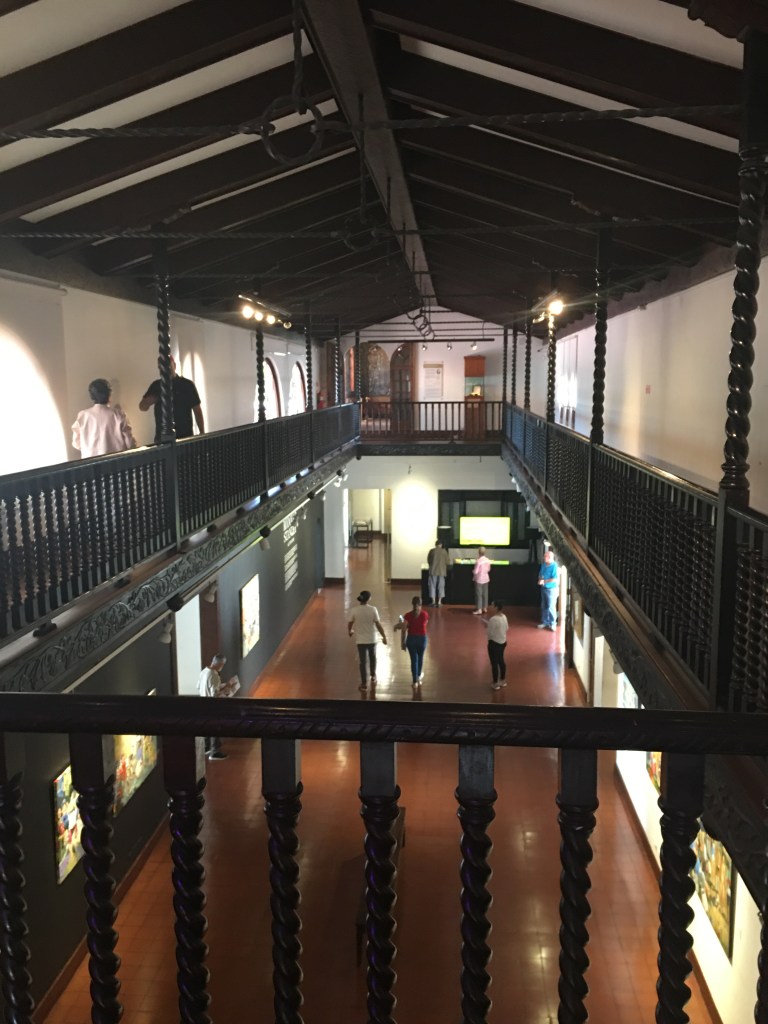
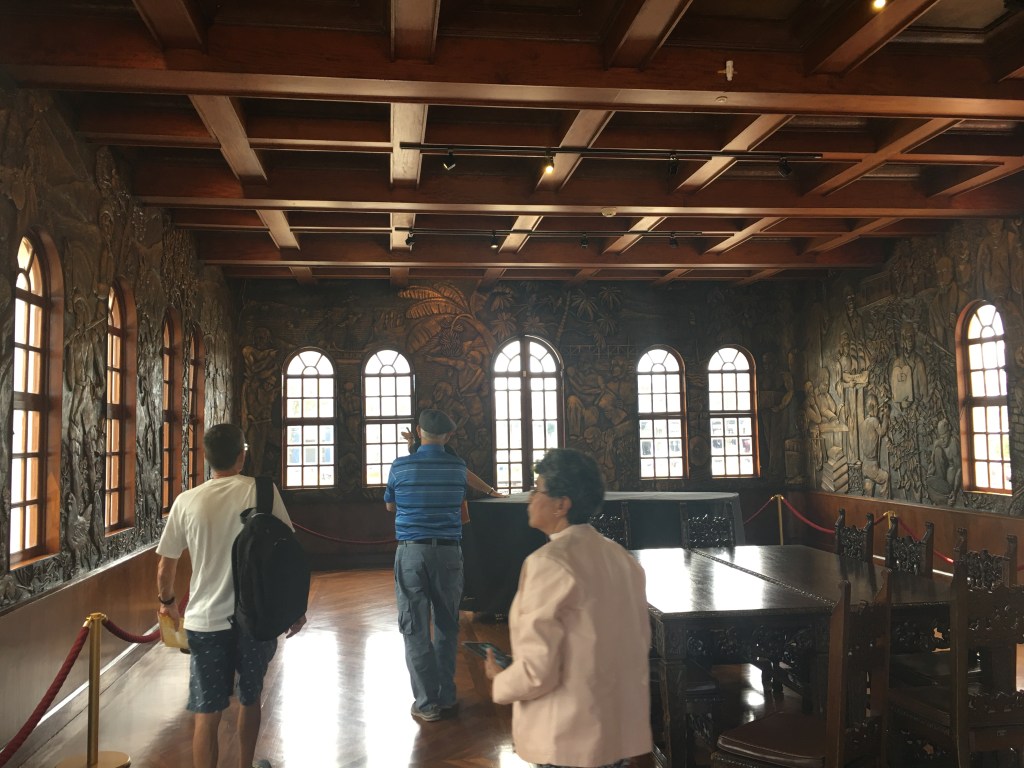
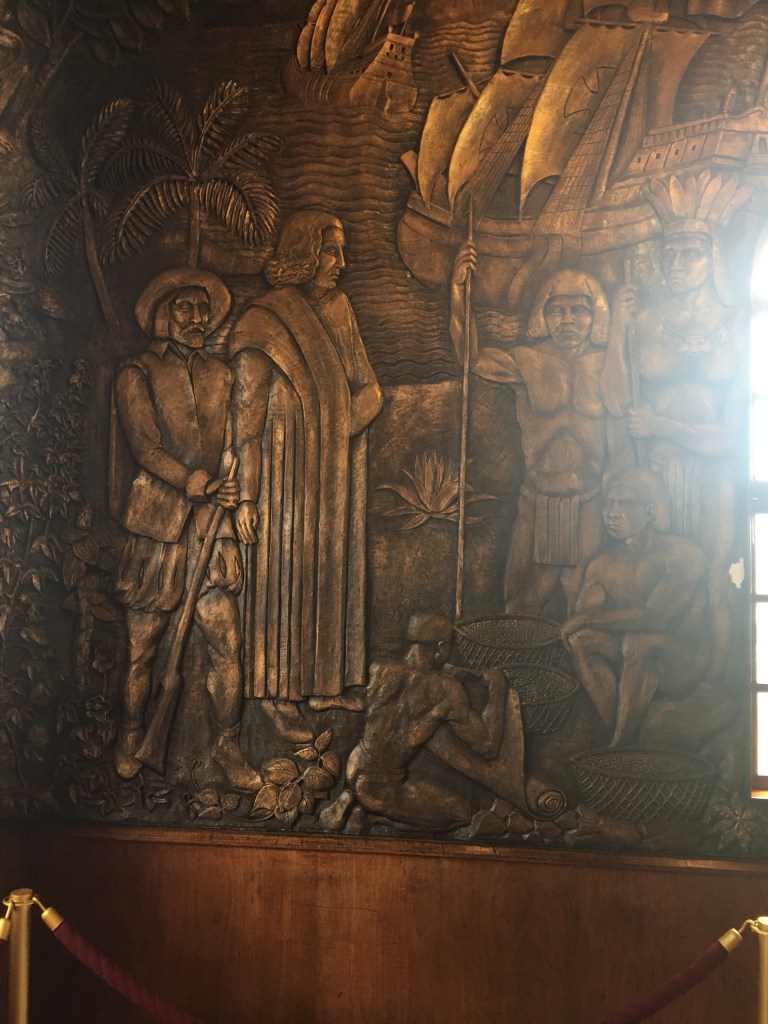
The Salón Dorado (Gold Room) is the old diplomat lounge on the second floor of the art museum that houses a 3D mural on the four walls depicting the history of Costa Rica. Our tour guide attempted to lead us through all of it. We were able to follow what he was saying on the first wall, depicting nature and indigenous peoples, and could spot Christopher Columbus on the second wall. But, by the time we got to the fourth wall, we were admittedly, very confused. At that point our guide attempted to explain changes in government and leaders that occurred in quick succession in the 20th century. This inexplicably led to our guide telling us that he was educated in a Jesuit school, seriously considered the priesthood for about six months, and speaks fluent French, which he then proceeded to demonstrate. I have no idea how we got from one thing to another and have no idea if he was really speaking French – it kind of sounded like it could be, but anyone with a nasally tone can sound like they are speaking French. With our heads spinning we quickly used the bathrooms and jumped back into our van. We did not explore the rest of the park nor the stadium.

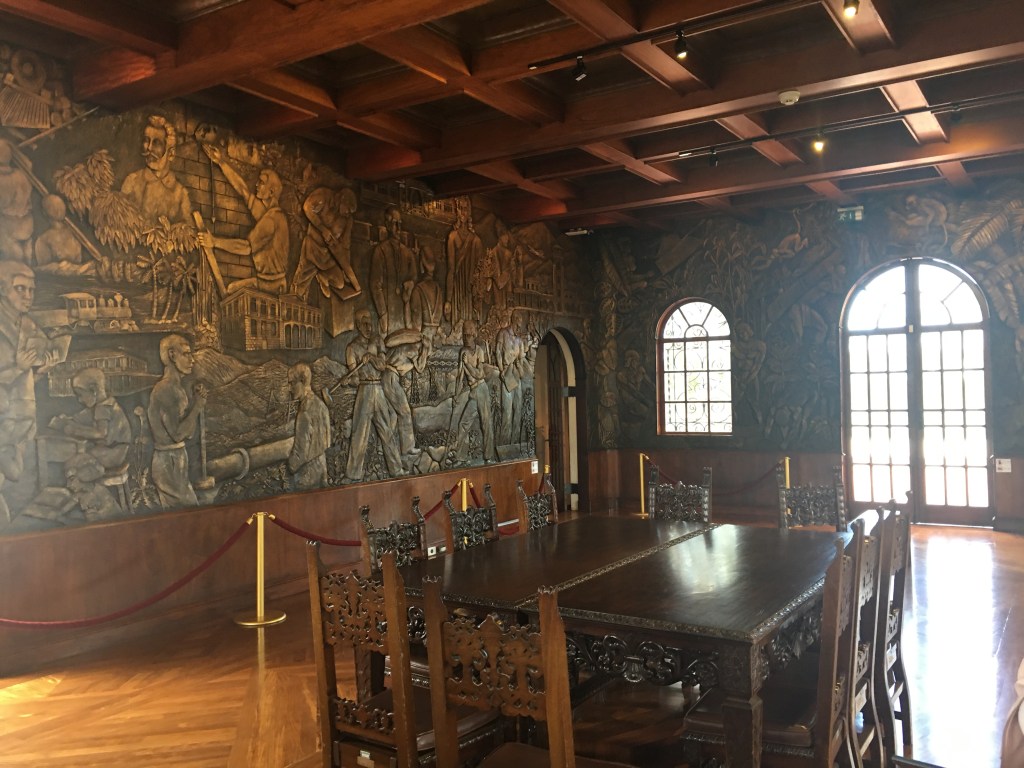
It seems only fitting that we went from the “gold room” to the “gold museum” that had been listed on the tour itinerary. Again, it was not the famous Pre-Columbian Gold Museum that I wanted to see and thought we were signing up for on this tour. That museum is located downtown, and we still hadn’t made it to downtown San José at this point. We unloaded at a small shop, right behind a large double-decker sight-seeing bus I had seen a picture of in another tour. I guess ours wasn’t the only tour that included this stop. In reality, it was a jewelry store masquerading as a museum. (We’ve run into this kind of thing before on tours, one memorable one in Greece, where a jewelry store was masquerading as a Natural History Museum.)
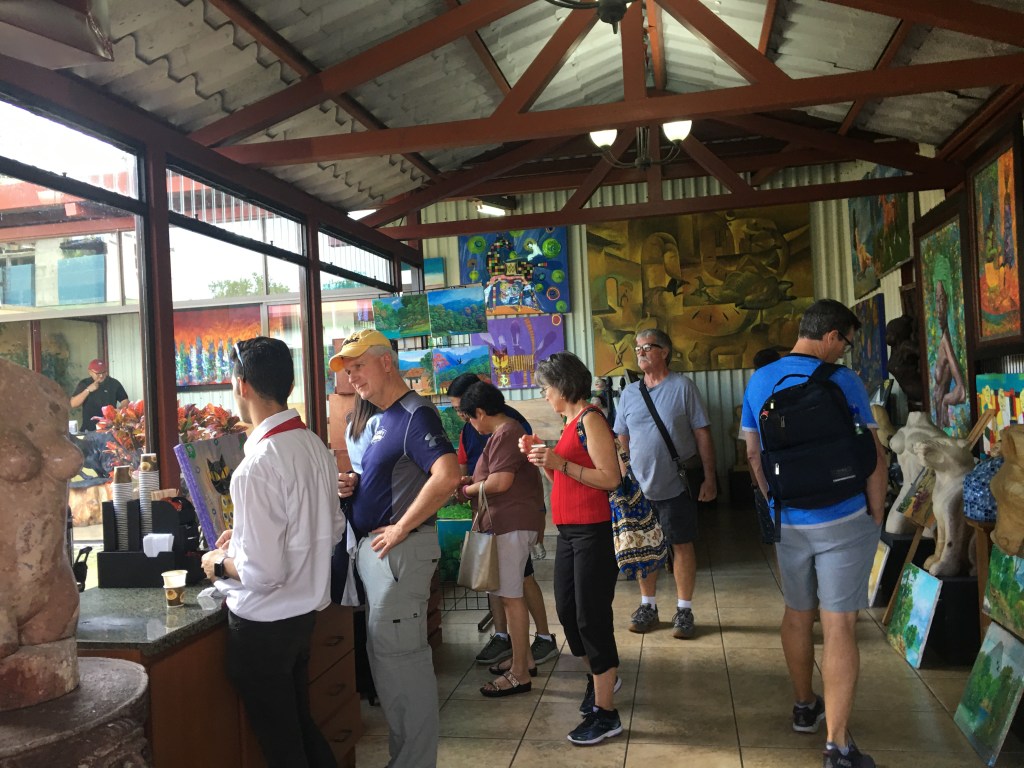
We stepped inside and were greeted by a young man who immediately told us that we couldn’t take pictures in the front part of the “museum.” He stepped behind a glass display case and for maybe five minutes, explained how indigenous peoples had made gold figurines using a mold. He had three very small props, including the non-gold figurine to be used for the mold, the mold itself, and the resulting gold figurine after the process. After that, he walked around to the other display cases and showed us the jewelry for sale, which was organized by semi-precious/precious stone types. There was a large window that opened to a back room where you could see where they made the jewelry on-site. I suspect that the real reason they don’t want people taking pictures there is because they are afraid of someone casing this obvious jewelry store (and not museum) for a robbery.
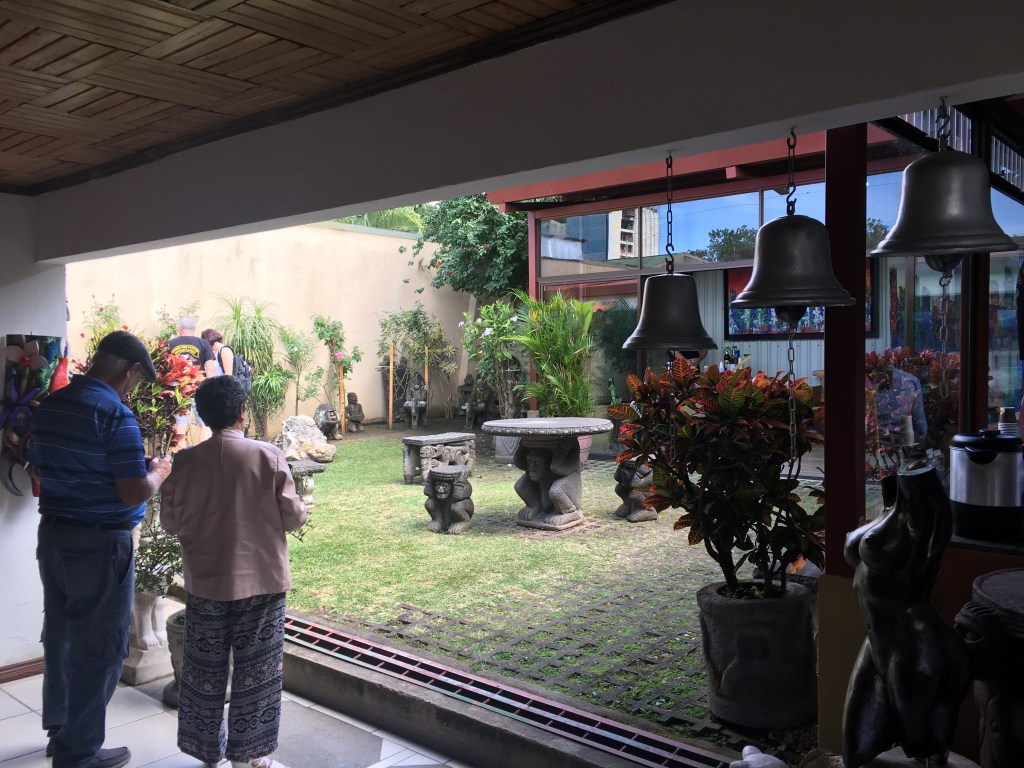
There was also a garden area in the back where we could take pictures. The garden area had various art canvases and coffee for sale. We were just about to take a sample of the coffee when our guide brought us small paper cups filled with a home-made liquor (also for sale?) mixed with soda and ice. The John’s and I politely tasted it – it had a noticeable kick and did not go down easy! When our tour guide wandered off, we quickly threw away our (full) cups and grabbed the coffee sample to get the taste out of our mouths. We were given sufficient time to definitely decide there was absolutely nothing we wanted to buy there and returned to our van. The tourists from the large bus had already departed.
Our van then (finally) proceeded to downtown San José. We’ll continue with that part of the tour in the next post – stay tuned!
 Remember, it's an adventure.
Sounds like I shouldn’t get an ox cart ?!
LikeLike