Our hot water heater … isn’t. We only have a few but necessary uses for hot water – taking showers and doing dishes by hand. You could also throw in laundry (please!). When we turn on the hot water in the kitchen sink or in our showers, we have to turn the temperature knob all the way to the red dot, to get what we would consider even close to hot water.
For washing dishes by hand, it hardly seems like it is going to kill any germs. (Apparently we’re now following the “don’t be so clean, it helps build your immune system, so it’s probably better for you anyway,” movement, but not on purpose.) For showers it starts out hot enough that you can comfortably enter the “gentle fall of rain” created by the showerhead. But, if both of us are taking showers at the same time, seven or so minutes in, it starts turning chilly. (And yes, I take at least seven minutes in the shower if I’m washing hair, shaving, etc., all the necessary things you need to do in the shower as a female.)
John did some on-line research on our hot water heater model. He found a YouTube video where a guy with a British accent (so he must be smart) talked about needing to get hotter water and have the hot water last longer. In the video he demonstrated how to remove both the upper and lower panels on the hot water heater and make adjustments. Seemed easy enough – for him. After all, he’s British and making a YouTube video. We aren’t British and every time we try to follow a YouTube video about repairs, especially anything plumbing related, we end up with much wailing and gnashing of teeth, in addition to additional charges for a plumber to come out on a weekend to fix the damage we imposed. We decided that if we tried to make the adjustment and there was a problem, because, well, we always end up with a problem, it was going to come back on us. We know how expensive hot water heaters are – we had to replace ours right before we moved from our house in West Des Moines. And that kind of thing is more expensive in Costa Rica.
We talked to our landlord, Eliza, about the hot water heater and were told that it was installed and maintained by the apartment complex, so we would need to check with them about it. Our apartment complex uses an app for interactions with its residents, iCondo. This is where we receive notifications about our water bill, information that may affect residents, and also where you submit repair requests. The trouble for us is that it is all in Spanish. Figuring out how to submit a repair request seemed more troublesome than living without reasonably hot water. I just started making it a point to get into the shower first.
This is the rainy season in Costa Rica. In Escazú that usually means it is sunny to partly cloudy in the morning and may or may not rain in the afternoon, but always looks like it will. The last several days we have been having more rain, where it even starts (unusually) in the morning. Yesterday John was sitting on the couch, looked toward the TV and said, “Why is there always water there?”
“What do you mean?” I asked.
“There’s a small puddle of water on the floor there in front of the TV again. There was some there this morning, but I wiped it up.”
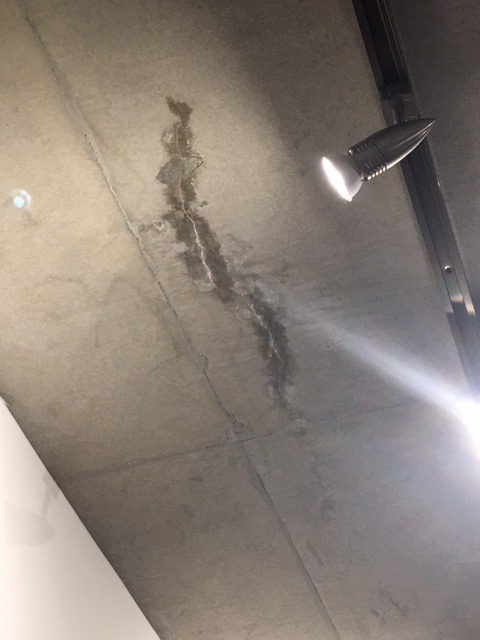
Now John is really smart about a lot of things, but he’s not a finder. I looked up at the ceiling above the puddle and saw what looked like was a probable ceiling leak in our cement ceiling. We’re on the top floor of our complex. Our landlord had told us there had been some issues in the past with leaks and to be aware of it.
Now we had no choice; we had to use the iCondo app to report the ceiling leak, and while we were at it, why not include the hot water issue. We have the iCondo app on our phones, but decided that since we didn’t really understand how the app worked, and it was still in Spanish, we were probably better off trying to submit the repair request from the iCondo website on the computer – bigger display and a keyboard to type. John sat down at his computer and I pulled up a chair beside him, armed with the Google translator app on my phone.
John logged into the app and looked at the hamburger menu. I’d already clicked on “Salir” on my app and that logged me out, so we ruled that menu item out. The closest menu item seemed to be “Tiquetes”.
“What’s that translate to,” John asked.
“Tickets,” I replied.
“Nothing else seems to fit, let’s try that.”
John entered a title, where we tried to helpfully insert both Spanish and English documenting problems for the ceiling leak and the hot water heater adjustment. He then was presented with a category drop-down selection. The only option translated to “community space.” We were reporting a problem with our own apartment, not a community space, so we left it blank. John then entered a lengthy description in English and clicked the “Salvar” (Save) button. An error message appeared that roughly translated to – “Can’t leave the Category blank.” And, it blanked out everything we had previously typed in! This time around John clicked “community space, re-entered everything as before, then clicked “Salvar” again. Success! (Or at least no error message.)
We had no idea what the timeline was for the complex to respond to “tiquetes.” We had dinner and started to do our Spanish homework – John on his computer in the second bedroom, and me on mine in the living room. Yes, we get homework with every lesson – makes it really feel like we are getting our money’s worth from our classes.
In the previous lesson we had learned to ask basic questions using the Spanish equivalents of “who,” “what,” “when,” “where,” “how,” “why” and “which.” Our homework was to come up with three questions for each our fellow classmates.
In class we had used example questions related to buying milk – who needed to buy milk, where do you need to buy milk, why do you need to buy milk, when do you need to buy milk, what milk to you need to buy. When we got to the “what milk do you need to buy” question in class, we spent a lot of time discussing the different types of milk – over ten in all, including cow, 2%, almond, soy, goat, buffalo, rice, to name a few. If you need us to go to Walmart to buy milk for you and you have some kind of crazy ass requirement for the type of milk you need, or you are lactose intolerant, we have you covered!
John and I quickly discovered that although we had the knowledge of question words, we had very little else to work with that would allow us to ask a question about anything we might really care to know about our classmates. We haven’t covered past or future tenses yet, so anything about their past or what they want to do in the future was out of reach. The other challenge was that we are still dreadfully short on noun knowledge. So, armed with what little vocabulary we have, we had settled in to prepare our interrogation of our classmates’ beer (cerveza) and cheese (queso) buying habits.
There was a knock on the door. John was as close to the door as me, but since I was in the room with the door, he said, “Cindy, the door.” I opened it to find a guy with a plaid shirt and jeans. He announced that he was there about the “hot water.” It quickly became apparent that he didn’t speak much English, and I once again apologized for “no hablo español.”
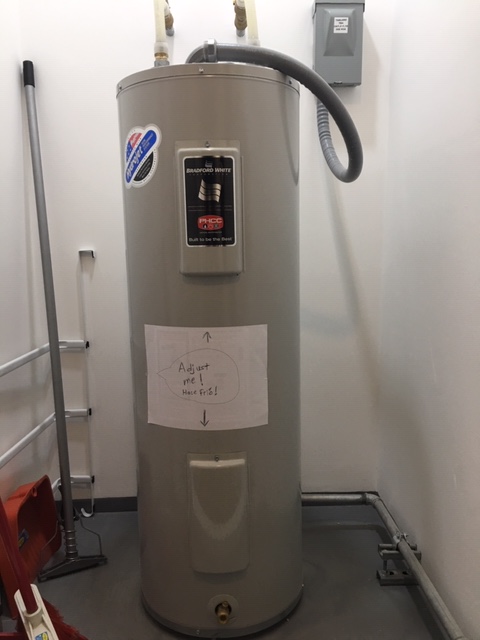
We moved to the closet that housed the hot water heater and opened the door. John emerged from the second bedroom and helpfully pointed to the panel that the Youtube British guy had demonstrated needed to be removed to make adjustments to the hot water heater. I said something about it needing to be adjusted. The guy just shook his head “no.”
John went back to his computer. The guy and I attempted to carry on a conversation with the use of Google translate on his phone. He would speak into Google translate, and look at what it gave back. Often it was just a couple of words, so he would shake his head and then try a couple more times before it must have looked to him like the correct amount of words were included in the translation.
“How many minutes after your shower is it not hot?” was one of his questions.
At this point I summoned a phrase that we had learned years ago when our daughter was in a grade school Spanish skit. Her school had a Spanish teacher that would come in once or twice a week to give the kids what was at best an introduction to Spanish. I was in the school one day for whatever reason, and she made a point to seek me out. She told me that Allison’s line in the skit was “hace frío” and Allison really needed to be more dramatic in her delivery. The Spanish teacher demonstrated for me how she thought Allison was supposed to act out this line, including folding her arms together, shuddering and exclaiming, “hace frío!” I thought the line must be very important to the plot and did try to encourage Allison to be more dramatic. When I actually saw the skit, I didn’t really see what the drama was about. Every kid had one line, and Allison’s was just one of many forgettable lines.
John and I encountered this phrase again when we were in Quito Ecuador. We had taken the funicular up a mountain. We were taking in the scenery, somewhat chilly in our shorts and sweatshirts. A couple came up, touched John’s exposed leg and said to us, “Hace frío!”
“Not after, during!” I replied to the guy in our apartment. Then, in a most dramatic fashion that would have made Allison’s Spanish teacher proud, I folded my arms together, shuddered and exclaimed, “Hace frío!”
“How many minutes when your shower is not hot?” he asked.
“Seven” I answered.
“Siete” John called out from his computer.
The guy went into my shower and turned it on. He waited for a while for the water to warm up. He then went to John’s shower and did the same. He didn’t say anything.
He then went to the kitchen sink and turned on the water full blast to the red dot. He held his hand under it and said “caliente, hot.” I put my hand under the running water. Again, it was barely hot, so I said, “no muy caliente.” He looked at me incredulously. “Es hot,” he protested.
“No, es no muy caliente,” I shook my head.
He spoke into Google translate. I read, “same for all departments.” I sighed. At this point it appeared that we were going to have to agree to disagree on what “hot” was.
He then indicated the water pressure was low and said, “pipes clogged, will have to clean.”
John said from his computer, mostly to me, “if the pipes were clogged, we wouldn’t get any hot water, and then it wouldn’t get cold after it was hot.” John also pointed out, “if they improve our water pressure we will only run out of hot water faster. The water pressure seems fine and far better than the water pressure we had in West Des Moines.”
I replied to John, “I know that. Do you want to come talk to him?”
“Nope,” said John and he returned to his computer.
“Will need to report to Eliza,” plaid shirt guy said.
“OK,” I said. I then added, “what about the ceiling leak?” I pointed to the probable ceiling leak. This seemed to be new information. Immediately he frowned and started looking all around the apartment, every room, to search for other leaks.
“Will need to get crew here. When is good?”
“Any day except Monday and Wednesday mornings. We have Spanish school.”
The fact that we were going to Spanish school seemed to make him happy. He spoke into Google translate and I read, “tomorrow 8:30 to 12”.
“Yes,” I said.
The next day was Saturday. We had hoped to make it to our first Farmer’s Market, but with the service crew coming, we decided that probably wasn’t going to happen. We usually do our run (John)/walk (me) at the same time in the morning, but decided to do them separately so someone would always be at the apartment in case the service guys showed up. John did his run. No one showed up. I did my walk. No one showed up until I was in the bathroom changing out of my sweaty clothes. I heard the knock at the door and voices. Fortunately I had taken all of my clothes to change into with me when I had headed into the bathroom. (This was a lesson I had learned long ago when I was caught in the bathroom on a business trip in only my underwear – long story, and not nearly as interesting as it sounds like it should be…) By the time I emerged from the bathroom, John was the only one in the apartment.
“They took measurements for the leak and left,” John said, and then added, “I was afraid you were going to come out of the bathroom without your clothes on.”
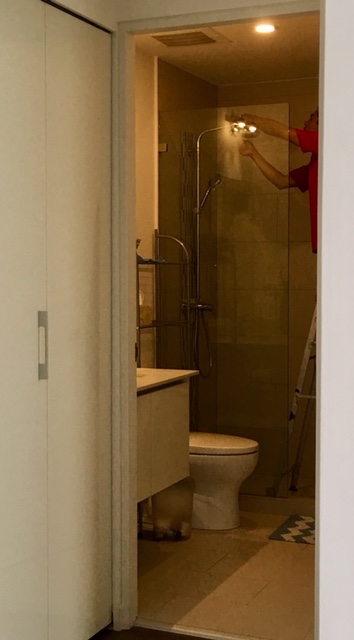
It was time for lunch. As we were eating, there was another knock at the door. John answered it. This time a young guy with a red shirt that said, “Postvende Servicio” came in with a ladder. He nodded to us, then went directly to John’s bathroom, put the ladder in the shower, and removed the shower head. He didn’t even turn on the light. I am bothered by people doing things in the dark, even if what they are doing is ineffective. “Luce?” I called out. I thought that meant “light” but now I see that it doesn’t. No wonder he ignored me. I went to the bathroom and turned on the light. He took the showerhead to the bathroom sink and rinsed it. He then went to my bathroom and did the same thing. I once again followed him and turned on the light. He then went to the kitchen sink and unscrewed the nozzle, ran some water over it, and screwed it back on. John continued to eat his salad. The guy nodded again at us and left. That was unclogging the pipes?
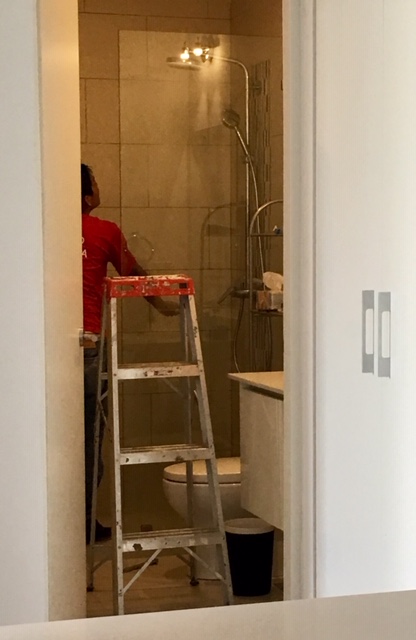
Postvende Servicio removing the shower heads in our bathrooms.
Yesterday afternoon and evening we had a lot of rain. Today we had another small puddle in the same place as before. I am still making it a point to get into the shower first.
 Remember, it's an adventure.
I just took a nice, hot bath. Now I feel un poquito guilty.
LikeLike