Despite applying over two years ago, Costa Rica has yet to process our application for residency. As we have discussed ad nauseam, to be able to drive in this country, we must leave and return every 90 days until we get our residency. In September 2021, when we were living near Playa Flamingo, it was time once again for our required 90-day trip out of the country so we could continue driving. This time we thought we would try something different and less expensive than purchasing plane tickets to the US. Many people in our situation make “border runs” to a neighboring country, driving to either Nicaragua or Panama, crossing the border, and returning the same day. (For a while, this was not an option, as the land borders were closed due to COVID, but the land borders are now reopened.)
Our friends Randi and Bill, who had accompanied us earlier in 2021 on our trip to Miami to meet the 90-day requirement, had heard about a one-day tour to Nicaragua, where we would cross the border, do some sight-seeing, and then return in the evening. Randi found that the tour company would agree to a private tour for the four of us. This trip would allow us to meet the 90-day requirement, cross the border with a guide, with the added bonus of seeing a country we’d never been to before – we were in!
This is the first post about our first trip to Nicaragua.
You must know the COVID requirements when leaving and entering different countries. You can’t just hop in the tour van and get to the border without preparation. The tour company was helpful in providing information on what was required for Nicaragua, and also Costa Rica, although we had experience with Costa Rica. It became a little more confusing since everything was going to happen the same day, and the tour company also wanted copies of documents, etc. Nicaragua requires a negative COVID test administered 72 hours before entering the country. Nicaragua is more of a stickler on the type of test – it has to be a PCR test, rather than an Antigen test. The PCR test is more expensive, and it usually takes more time to receive results. John and I were dreading dealing with Beachside Clinic again for the COVID test.
Fortunately, the tour company told us they could help with the COVID test and gave us the name of a nurse that would actually come to our house to perform the test. We reached out via WhatsApp (the app that most people use here), and were so pleasantly surprised that she was responsive, told us exactly what she needed, how to fill out the required form, and had no problem scheduling the appointment. She even sent a reminder the day before the appointment, and on the day of the appointment, let us know she was on her way, and arrived on time! Results were received in our email in a timely manner, and she sent us a message telling us that they had been sent. Yes, the cost was more than Beachside, but the difference in experience was night and day! We were definitely using her again!
At that time, Costa Rica didn’t require a negative COVID test but did require us to fill out their on-line Health Pass, within 48 hours of our trip. We’d filled out the on-line Health Pass many times previously when we returned from the US via air flights. Two days before the trip, in the evening, we started to fill in the on-line form for the Health Pass, confident that we would easily get through the process. Hah! Different information is required when you come into the country via ground transportation. For example, what time are you arriving? Um, we didn’t know. We had a general itinerary from the tour company, and the return times listed on the website for this trip were 9-10 pm, but that was back to the place of pick-up, which weren’t where we would be picked up, anyway, and accounted for travel time from the border. Not surprisingly, “unknown” wasn’t an option. We had a running WhatsApp chat going with Bill and Randi as we filled out the form. We just made a guess and entered 6:00 pm. Times are very fluid here, so we figured it wasn’t a big deal if it wasn’t exact.
The next question that threw us for a loop was the location of our border crossing. That wasn’t on the itinerary, either, although that would have been helpful. I started doing Internet searches on places to cross the border between Nicaragua and Costa Rica, from the options given in the online form. The place that seemed right, based on our location in the country, was Peñas Blancas. From our limited Spanish, we knew “blancas” means “white.” All of this was making us punchy. How could we not notice that the first word looked an awful lot like “penis”? We selected “Peñas Blancas”, which we childishly referred to as “White Penis” from then on.
We completed our Health Pass successfully and received our QR code that we would need to show when we re-entered the country. John and I took a picture on our phones and also printed them, just in case. We had other documents printed and saved to our phones, as well, like our return trip to the US in another 90 days. Because even though we were leaving Costa Rica to meet the 90-day requirement, every time we return to Costa Rica, we have to prove we’re leaving again. It’s a vicious cycle. We also sent all of the documents that the tour company wanted to them by email.
The tour company had helpfully provided a list of things to bring along for our day trip. The evening before the trip I looked at the list and started stowing items they had suggested, as well as other things we thought might need, into a backpack.
- Comfortable walking shoes. I decided to wear tennis shoes, but also throw in some flipflops to change into after the tour. We wear tennis shoes when we exercise, but other than that we go barefoot around the house. It is surprising to admit, but regular tennis shoes just feel “heavy” on our feet when we have to wear them all day. John wore his “good” sandals, which he can walk in well, but he also thinks feel heavy.
- Passport. Duh – of course. I decided to bring my trusted fanny pack in addition to the backpack so I could have quick access to passports, vaccine cards (if needed), etc. (I had fanny packs over 20 years ago, and never thought that trend was going to return – but here we are.)
- Flight Itinerary (printed or mobile). Because we have to always prove we are leaving Costa Rica again when we enter.
- Rain gear. If it was the dry season, we wouldn’t have bothered. But it was September, the height of the rainy season, so we decided to bring light rain jackets and small umbrellas.
- Sunscreen. It seems counter-intuitive, since I just mentioned that it is the height of the rainy season, but it doesn’t rain all of the time, and likely will be sunny some of the time. The sun is more intense closer to the equator.
- Insect repellent. We’re in a rain forest so we always have insect repellent on hand; I just threw one of our multiple small spray cans into the backpack.
- Camera. This is possibly somewhat outdated information unless you are a true photographer. John has good quality camera equipment. He considered bringing it but decided it would be a pain to lug around, so we just opted to use our phones for pictures, like most everyone else.
- Reusable water container. Interestingly, we were told that water was included in the tour.
- Pocket money in US dollars. We didn’t think that we needed a lot of cash. We weren’t planning on souvenir shopping. Breakfast and lunch were included in the tour. The four of us had decided on tip money ahead of time, so made sure we had that, a little bit of cash, and a credit card, that I put in a small cloth billfold in my fanny pack.
- Masks. Because, well, COVID.
Because this isn’t our first trip, I also threw in a couple of other items:
- Hats. Helpful for the sun.
- Sunglasses. Ditto.
- Small brush and hair tie. Obviously just for me, but we were going to be gone from 4:45 in the morning to 9 or 10 at night, and I don’t have short hair.
- Emery board. Seems silly, but if I get a snagged nail, it would be nice to have, and it doesn’t take up a lot of room.
We fit all of the items in a backpack and a bag.
The morning of the trip arrived very early. Even though breakfast was on the itinerary, we decided to grab a quick bite at home before we were picked up. I am very susceptible to motion sickness and wanted a little something in my stomach. I also took a Dramamine-like pill and stowed the medicine bottle in my backpack. After years of traveling, I am always prepared for motion sickness. I knew it would make me a bit sleepy, but it beats the alternative.
Randi and Bill got picked up first from their condo. They texted us to let us know they were on their way. The van arrived at our house about 4:45 a.m. as scheduled. It was still dark outside when they arrived. As soon as the driver opened the van doors for us, Randi and Bill quickly exited. Bill said the driver put them in the very back seats, and he was feeling a bit claustrophobic. Would we mind changing seats with them and ride in the last row? We agreed. The van was roomy enough, and I had taken my pill to prevent motion sickness, so we were good to go.
The driver didn’t speak much English, and the tour was supposed to be in English, so we figured (hoped?) that we would be picking up our actual guide next. Ours was a confident driver, who sped along the dark roads like a pro. (We later found out that he had driven buses. Bus drivers here have to have mad driving skills.) Randi and Bill told us that on the way to our house, in the dark, the van had turned a corner and encountered some “loose” cattle in the road. That can happen anytime, day or night. It’s a “charming” feature of driving in this country … as long as it doesn’t kill you.
We drove an hour to Liberia, the sun rising as went along. In Liberia we picked up our guide, who, yes, did speak English. He brought a plastic bag, like the kind you get at the supermarket, filled with different, assorted, store-bought baked goods, and we were once again one our way.
The drive from Liberia to “White Penis” is about an hour. Along the way, we learned that our guide, Claudio, had dual-citizenship in both Costa Rica and Nicaragua, where he was born. He tried to use the drive time to inform us about the history of Nicaragua. He talked about the Civil War in the 1850’s (Nicaraguan, not US), a US guy who established a route through Nicaragua to bring gold from California to the eastern coast of the US, some US guy who became the first Nicaraguan president, and the Sandinistas. Normally I would have been all over that – except that it was a little difficult to hear and understand him and my motion sickness medication had started to kick in, so I was getting drowsy riding along in the back of the van. I tried my best to keep my eyelids open and nod at strategic times.
As we neared one town between Liberia and the border, our guide abruptly asked the driver to take a road into the town. He hopped out and got cash from an ATM, and then re-entered the van and we continued on.
Finally we approached the border. It is easy to tell, as there is a long line of large trucks “parked” along the side of the road for miles before you get there. There is a weigh station that they have to pass through before the border, which is the first bottleneck for them. The second bottleneck must be at the border, for whatever happens there, as the line of “parked” trucks continues from the weigh station to the border. It must be terrible being a truck driver – it seems like it could take days to get through!
For us, the first stop at the border was a small green, rather dilapidated looking building, positioned down a small hill from the road. This is where you pay an exit fee. Its sign is suspect, but it does appropriately call itself the “Green Office.” Our guide hopped out, ran inside the building, and paid the fee while we waited in the van.
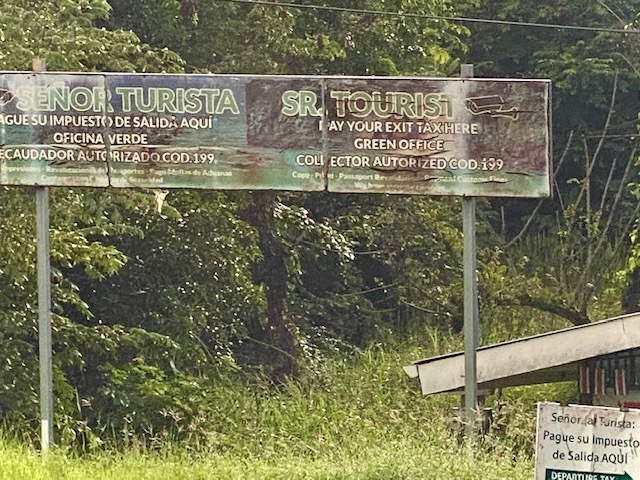
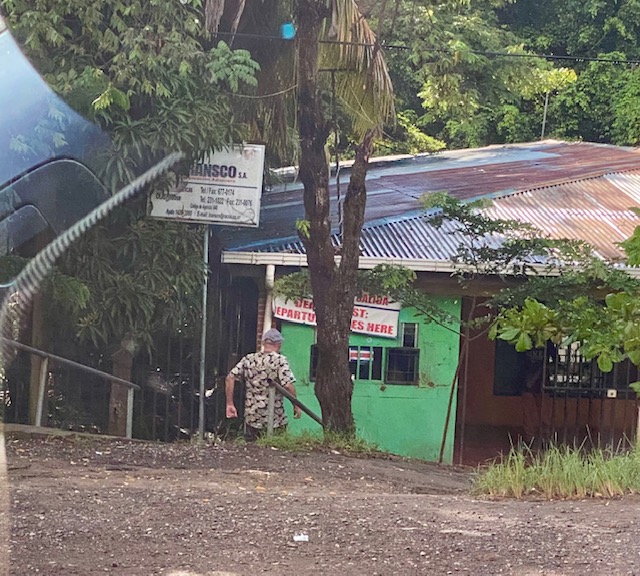
The van drove us a bit further, and the guide told us that we would need to go into the white Costa Rica customs building on the Costa Rica side of the border.
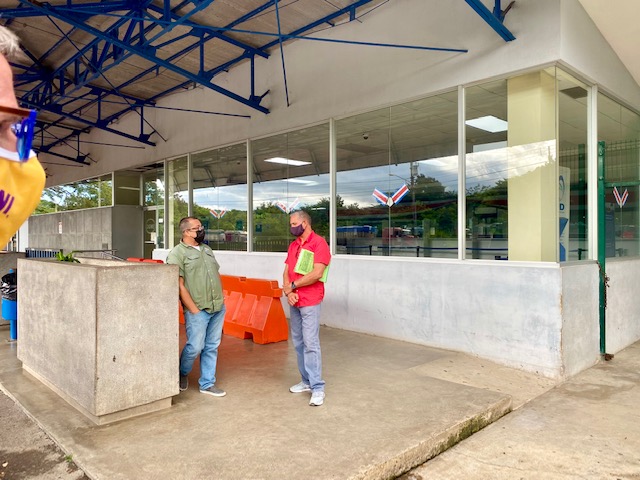
Claudio said that the only things we would need here were our passports and masks and to leave everything else in the van. I made sure I had my fanny pack with the passports, the PCR test for Nicaragua, my phone, and my cloth wallet. John had his billfold and phone. We entered the building – there was no one else ready to leave the country there, so we got right through. The customs official stamped our passport and we left. When we got out, our guide asked us to check that the customs official had stamped our passports twice.
I find it nearly impossible to figure out on what page a customs official in any country stamps my passport. And I always wonder if there is a rhyme or reason for the page they choose. We started flipping through pages, but just weren’t sure exactly what we were looking for. Fortunately, Claudio did, and he was able to confirm that all of the passports had been stamped twice.
Upon reflection, it seemed weird that we had to have our passports stamped to leave the country – not only once, but twice. When you travel out of Costa Rica by air, no one stamps your passport at the airport.
We hopped back in the van and were driven a bit further through trucks now parked on both sides of the road.

We stopped again, and were instructed to get out, and make sure we had our passports and COVID test results as we passed through the Nicaraguan border. As Randi was getting out of the van, Claudio noticed that she had left her water bottle in the door and asked if she needed it. She replied, no, not right now. We all got out with the same items we had carried into the Costa Rican immigration building, padding along behind Claudio, who seemed to know everyone he encountered, fist-bumping and judiciously handing out baked goods from his plastic sack as we went.
The first place we were stopped was a small building located in the center of the road, with people standing outside. Claudio approached a guy who looked like he was in scrubs and told us to show him our PCR COVID test results. He looked at the papers, handed them back to us, and we continued.
The next stop was a woman in a lab coat leaning up against a wall. We also had to show her our PCR test results again. She looked at them, handed them back, and we walked further to the bigger buildings.
It began to sprinkle. I was grateful that we had brought our umbrellas and raincoats. Sure, they were still in the van, but we would be reunited with them shortly. I mentioned the rain to Claudio, who shrugged and said, “It always rains here but after this, we probably won’t have rain again.” I didn’t really believe him. We see locals walk along in the rain all the time, like they just don’t even notice it. It seemed odd to me that it would only rain here at the “White Penis” border (or maybe we’d accidentally aptly named the place), but since we were prepared for rain, we would be OK.
The first building we stopped at had a small window where a couple of people in lab coats were stationed. We pushed our COVID PCR test results through to them. They reviewed them and gave them back with a small white piece of paper. Claudio told us to insert the paper into our passports.
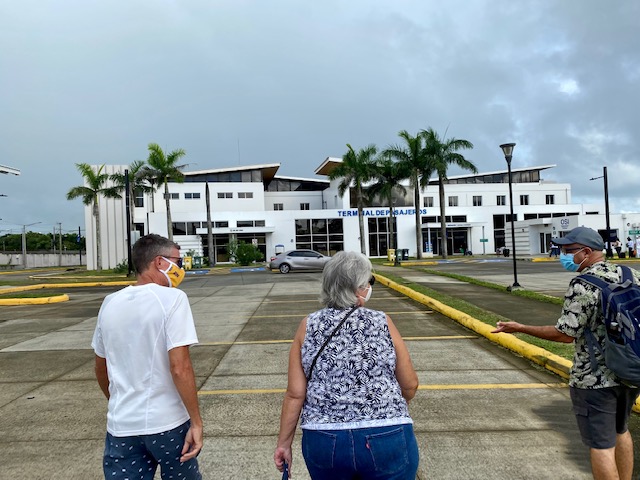
Finally, we entered the large Nicaraguan Customs building. There weren’t a lot of people, but there were a few. Claudio told us to stand aside, as he went took care of things. First, he made a payment to a lady in yellow polo-type shirt who was collecting money, and then he kind of disappeared. When he returned, we stood in line for the customs official and showed our him our passports. More money was collected there, too, but Claudio had taken care of it for us. (It all must have been included in our tour fee.)

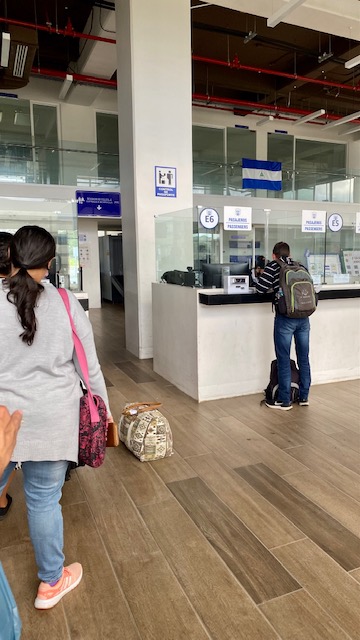
Next, we had to run our items through a luggage scanner. We didn’t have anything really, so that was easy. Then we walked out the door to Nicaragua.
Claudio led us to the van with open doors and instructed us to get in. Wait a minute! This was a different van and a different driver! And the van was empty! Alarmed, we asked, “Where’s our stuff?!”
Claudio explained that the other van couldn’t cross the border and seemed confused as to why we didn’t know that. Well, because no one had told us! Since we picked him up in Liberia, he hadn’t seen us load all our bags and backpacks into the van. Suddenly it made sense that he had asked Randi about her water bottle the last time we exited the van.
John and I did a quick assessment of what we had – John had his billfold and phone and was wearing his good sandals. I had my fanny pack with my phone, small cloth wallet with a little cash, one credit card, both passports, both vaccine cards, and was wearing tennis shoes. We both were wearing masks and our regular glasses, but if we did encounter sun again, at least we had the kind of glasses with lenses that darkened automatically. That was it. That was all we had, after I’d carefully followed the tourist company’s instructions on what to pack, and had even proactively packed some additional items that I thought would be useful.
Randi and Bill were in a similar position. Their biggest initial concern was that they had opted to wear their flip-flops on the drive and were now wondering if there would be walking involved that would be difficult in flip-flops. Claudio assured them that this wasn’t the case.
The four of us sighed and quickly got into the van to avoid the rain. I was already wishing that we had our umbrellas and rain jackets. I looked around the van – it wasn’t nearly as nice nor as roomy as the van that had picked us up that morning.
As we drove off, it started to rain harder.
Stay tuned for the next posts relaying what we saw during our tour of Nicaragua.
 Remember, it's an adventure.