These may seem totally unrelated, but in November 2020, due to the confluence of our need to drive, COVID, and driving restrictions, we found ourselves scrambling to book a trip to Miami. (This is the first of several posts about our trip to Miami.)
Just a background refresher here … If you are not a citizen or resident of Costa Rica, you are required to leave the country 90 days after arrival. When you entered Costa Rica (pre-COVID), the customs official usually just wrote in “90” on your passport entry stamp. There is an exception to the requirement to leave the country within 90 days – if you have applied for residency, you are not required to leave the country within 90 days. You may need to show the official paperwork if asked, but you are not required to leave. Still, unless you are citizen, or obtain official residency, you are considered a tourist, even if you have applied for residency.
There is also a 90-day driving rule for tourists. A tourist is allowed to drive using their foreign driver’s license for 90 days. In theory, these two 90-day periods would coincide for tourists. They can stay in the country for 90 days and they can drive for 90 days using their non-Costa Rican driver’s license. It gets tricky, though for people who have applied for residency. Even though for immigration reasons they are not required to leave the country, they still have to leave the country to retain their driving privileges.
Expats who live here for more than 90 days make what is called “border runs.” These are usually quick trips to a neighboring country, Nicaragua or Panama. They cross the border, get their passport stamped and return to Costa Rica, ready for their next 90 days in Costa Rica.
It got confusing when COVID came into play in 2020. Costa Rica closed its borders, including the land borders to Nicaragua and Panama. Costa Rica started issuing tourist extensions for tourists who had entered from December 17, 2019. The immigration extensions continued to various dates in 2020. As it became clear the COVID situation was not going to rapidly improve, the extensions continued from July 2020, August 2020, and November 2020. The driving dates were then also extended to match the immigration dates. The announcements were never made at the same time, but in the end, matched up. Had we been paying close attention we would have realized that there were two different Costa Rican government departments issuing these extensions – the Directorate of Migration issued tourist extensions and the MOPT (Ministry of Public Works and Transportation) issued the tourist driving extensions. In the fall of 2020, immigration had extended the dates for tourists to March 2, 2021. The driving date was November 18, 2020, so they didn’t match up.
Before we moved to Playa Flamingo in July of this year, we were happily walking in Escazú almost everywhere we needed to go. During that time we didn’t own a vehicle, weren’t driving, and since we had applied for residency, we didn’t have to leave the country every 90 days.
However, when we moved to the Playa Flamingo area, we bought a vehicle out of necessity. No stores are within walking distance, and it even takes about five minutes to drive from our house in the Mar Vista community where we live to the main road on which it is located. Keeping track of driving restrictions related to COVID become important to us.
When Costa Rica closed its borders due to COVID, it resulted in an economic downturn. In the fall of 2020, Costa Rica started the gradual re-opening process to tourists coming in through air travel. Land borders to Nicaragua and Panama remained closed. The months of September and October are the wettest months of the rainy season here, so it was unlikely that many tourists from outside the country would be coming anyway. Still, the country started opening up, which came with periodic updates on rule changes, some we really needed to pay attention to. The US Embassy continued to send out email updates to help us make sense of the situation. Here is a summary of Costa Rica’s tourist re-opening in the last several months of 2020, that led to us booking a trip to Miami.
September 2020
On September 1st, before COVID was raging across all of the US, Costa Rica decided that it would be safe to open its borders to US citizens from 8 states in the north-eastern part of the US. As of September 15th, it opened it up to 3 additional states. (But not Iowa. We have Iowa driver’s licenses.) They did allow for travel through an airport in a non-allowed state, as long as you didn’t leave that airport, and your layover wasn’t more than 18 hours. But there were requirements for entry – US citizens had to complete a digital epidemiological health pass, obtain a negative PCR-RT coronavirus test taken within 72 hours of their departure from the US, and purchase travel insurance that covered accommodation in case of quarantine and medical expenses due to COVID-19. Plus, the US tourists had to prove that they lived in one of the approved states, with a driver’s license or state ID card. (This is why the state of our driver’s license was important.)
We still were contending with driving and business restrictions in designated Yellow and Orange areas of the country, determined by the number of COVID cases. At least the driving restrictions, based on the last digit of the license plate, were now standardized throughout the country. As a reminder, the last digit of the plate on our Toyota Hilux is 0, meaning we couldn’t drive on either Friday or Saturday. Plus, there were driving curfews – until 10 pm on weekdays and until 8 pm on weekends. Beaches were only open from 5 am to 2:30 p.m.
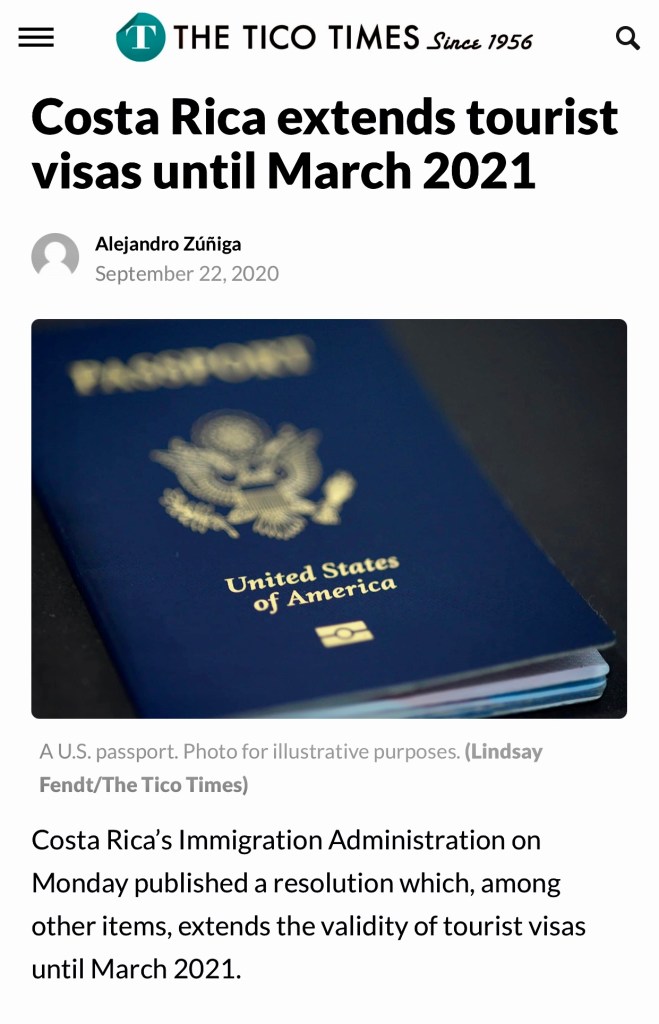
The tourist and driving extensions had been granted for both until November 18, 2020. On September 22, there was an official announcement that the tourist visas had been extended to March 2, 2021. The Directorate of Migration announced that tourists who entered from December 17, 2019, through November 30, 2020, could legally stay in the country until March 2, 2021. We had returned from a Christmas holiday trip to Iowa on January 3, 2020, so were happy that we shouldn’t have to leave again until March. We were confident that although the driving extension hadn’t yet been announced, that it would be.
October 2020
In October, driving curfews were extended – until 10 p.m. on weekdays and until 9 p.m. on weekends. Beaches were open until 10 p.m. on weekdays and until 9 p.m. on weekends. Clearly the government wanted one of its most attractive tourist destinations open.
In October, the list of allowed states to gain entry during the month of October grew to 21 (Iowa not included). Requirements for entry were the same in October as September. US citizens from any of these 21 states would be allowed to enter, providing they followed the requirements, which were the same as in September.
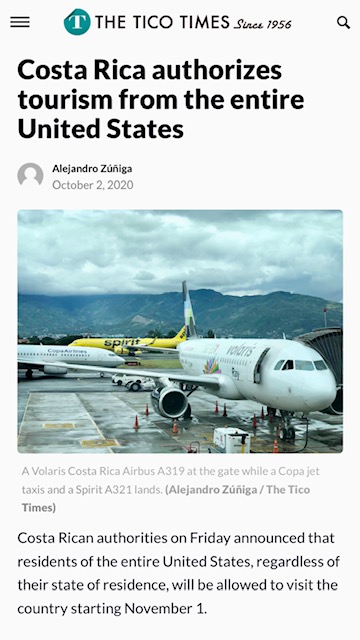
On October 2, the government announced that as of November 1, anyone from any US state, and anyone else in the entire world, were welcome to enter the country.
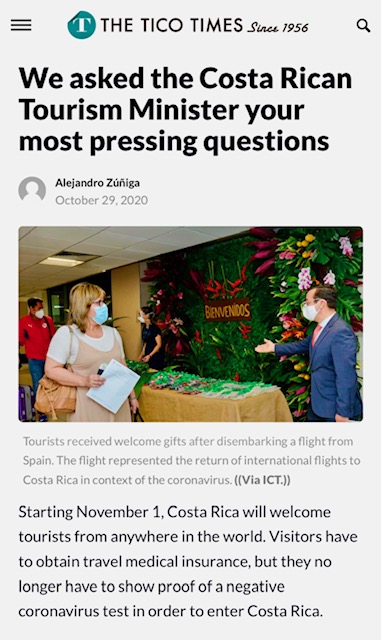
On October 22nd, we received an email from the US Embassy. The Ministry of Tourism announced that as of October 26th, visitors arriving to Costa Rica no longer needed to show proof of a negative COVID-19 test. The tourist extension until March 2, 2021, was still in effect. There was no update on the driving extension past November 18, but that usually came later, anyway.
November 2020
When November rolled around, we continued to wait for the anticipated extension of tourist driving privileges to be extended to match the March 2, 2021, tourist extension. The first week came and went, and nothing happened. We tried to be patient, as things can move slowly here. But we were getting concerned.
We did not hear good news at the start of the second week of November. The government entity in charge of driving had determined the driving extensions would not be extended past November 18. This information came from a couple of reliable sources. There is an organization called Outlier Legal, that is very helpful to the expat community. It publishes information like this, and also tries to work with the government on these kinds of issues. Even the emails from the US Embassy continued to relay the November 18th deadline.
From what we learned, the MOPT reasoned that since air borders were now open for everyone and the Immigration offices were open again on December 1st, there was no need to extend the driving deadline past November 18.
What to Do?
Monday, November 9th, saw us struggling to figure out what to do about the driving situation and running through the options:
Ignore the situation. There was a lot of chatter on the expat forums about this topic. Many people believed that the driving date of November 18th, would be extended, and were content to just wait it out. The pro’s of this option were obvious – it cost nothing to do nothing. If there ended up being an extension after all, you weren’t out anything. But, if there wasn’t an extension, you would be scrambling to get a flight out with everyone else in the country. Plus, you would need to buy the COVID insurance when you re-entered Costa Rica, to cover you for the entire time you would be back in Costa Rica. For us, that would be for 90 days.
Book a flight and do a border run by plane. If no extension was granted, the pro was that you were doing what you would need to do. And, hopefully, by booking a flight before the drop-dead date, you would be avoiding the rush of all the procrastinators. The con’s were that if an extension was granted, and you had already left the country, you would be putting yourself into the 90-day tourist cycle unnecessarily. You needed to purchase an outbound plane ticket for no more than 90 days after your return to Costa Rica, to prove that you were going to leave the country. This also meant that you had to pay for the tourist-required COVID insurance for 90 days, unless you left again before then. At that time, pricing for the insurance was about $11 per day per person, at an estimated cost of almost $2000 for both of us, for 90 days.
Further complicating the decision was that we thought we had an appointment for residency in December. If we were residents and had a Costa Rican driver’s license, we wouldn’t have to leave the country. Was it possible for us to get our residency before 90 days after November 18th?
John and I discussed this quite a bit, debating what to do. I actually sent an email to the US Embassy in Costa Rica, asking about the driving extension and if they were working with the Costa Rican government on this issue. By the next day, I received a short but courteous reply – the date was November 18th, and they didn’t interfere with the workings of the Costa Rican government.
John and I decided it might just be best to be pro-active, bite the bullet, and book our border run flight. We reached out to our friends in Costa Rica, Bill and Randi, that are also building a house where we are, to see if they wanted to do the same. We coordinated flights and booked our refundable trip and hotel rooms for November 16th, waiting until the last minute to purchase insurance.
As November 16th grew closer, we heard that there were internal communications between the Costa Rican Migration and Transportation departments. According to the rumors, the Migration department was not pleased that the Transportation department had not made their date the same as theirs – March 2nd, and that there was an expectation that the dates should be the same. There was a reportedly leaked memo to that effect. Still, there was a rumor on the other side, as well, that transportation policewomen were amassing in the tourist areas, to set up checkpoints to catch people after the November 18th date. That seemed more unlikely – why hassle people who were spending money in Costa Rica when the country desperately needed it, and why only policewomen?
We grew increasingly optimistic that the driving deadline would be extended, and even before there was anything became official, we canceled our trip. On Tuesday, November 17th, the day before the drop-dead date, there was an official announcement by the Transportation department. Tourist driving privileges were extended to the same date as the tourist extension – March 2nd. Outlier Legal provided a link to an official document, in Spanish, declaring the March 2nd date. They encouraged everyone to print off the document and carry it in our cars, just in case we were stopped by transportation police, who (literally) hadn’t received the memo.
We breathed a sigh of relief. March 2nd seemed like a long way away, and maybe things would change by then. Maybe there would be progress on our residency application. Maybe there would be another tourist extension. Maybe…
Our next post talks about what happened next.
 Remember, it's an adventure.