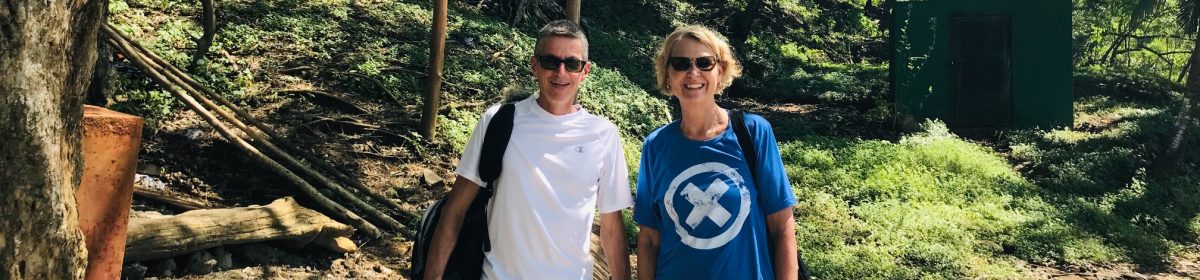
Being from Iowa, we use Iowa as a frame of reference for our experiences here. For example, Iowa is about 2.5 times geographically larger than Costa Rica, but Costa Rica has 1.5 times the population of Iowa. When the coronavirus hit, we started making comparisons to Iowa about that, too. For example, as of this writing, Iowa has had 23,926 cases of the virus, and 652 deaths. Costa Rica has had a total of 1,538 cases of the virus, and only 12 deaths.
It should be noted that Costa Rica has a good health care system that covers all its citizens. (It abolished the army after WWII and devoted resources to education and healthcare.) Costa Rica also took steps to reduce the spread of the coronavirus, closing restaurants, parks, beaches, museums, etc., and instituting driving restrictions. The country is now in the process of a phased reopening plan, with each phase subject to change, depending on the success of the previous phase.
So, what is like living in Costa Rica during the age of COVID-19?
Getting In and Out of Costa Rica
Starting in March, the country put restrictions in place to hopefully reduce the spread of the virus. We receive travel alerts from the US Embassy, and our Spanish teacher has also been helpful in making us aware of restrictions that could affect us. The first travel restrictions were focused on Santa Semana (Holy Week). Costa Rica’s first ban on non-resident foreigners entering the country had an end-date of April 12, 2020, which was Easter Sunday. The US Embassy dutifully alerted those of us in the country, that if we wanted to get out of Costa Rica, we’d better do it immediately, as options to return to the US using commercial carriers, were extremely limited. Commercial flights had already slowed, and many were suspending service as of the end of March. If we didn’t leave, we needed to be prepared to remain in Costa Rica for an indefinite period of time. We were also warned that many hotels had already closed, and others were expected to close soon. (This is when our neighbor decided to return to Florida and left us with Buddy.)
The ban on foreigners entering Costa Rica has been extended several times now and has currently been extended through June 30th.
Although it is true that airlines suspended service, the US Embassy did work with United Airlines to provide “repatriation” flights from San José to Houston, based on requests from US citizens in the country. Apparently not everyone who didn’t leave before the end of March was prepared to stay for an indefinite period of time. We started to receive emails daily stating that there was going to be one United Airlines flight in the upcoming week, along with a lot of information about scheduling directly with United (the US Embassy does not assist in booking), that all documents need to be in order, details about traveling with pets, jurisdiction for health regulations for boarding in Costa Rica and landing in Houston, etc. Then we would receive an email stating that flight was full, and if anyone else was interested in returning to the US, they should contact the embassy. Subsequently we would receive another email stating that there was going to be another flight in the following week. This went on for all of April, with a repatriation flight occurring every week, all seeming to fill up. These repatriation flights continued through the month of May, and now continue into June.
Interestingly, we were also initially informed that non-citizens who left the country would lose their residency status. This was a statement that drew legality arguments in Expat forums. We are not legal residents but have applied for residency. The residency process takes a long time here and requires you to provide background check documents from your country of citizenship. We had to get fingerprinted at the West Des Moines police station and supply background checks from local authorities and the FBI in order to apply for residency in Costa Rica. We also had gone through the application process with our Costa Rican lawyers, including fingerprinting here in Costa Rica. We didn’t want to have to go through all of that again, (how could we?), and we didn’t have anywhere else to go, anyway. We were/are prepared to remain in Costa Rica for an indefinite period of time.
With the latest border closure extension to June 30th, the Costa Rican government has provided a few clarifying updates. They are now saying that if you are a non-citizen and leave the country, you cannot use your residency status to re-enter the country before the border reopens to non-citizens. This makes more sense.
During “normal” times, Costa Rica has a 90-day rule for tourists (non-residents), that can be confusing. When you come into the country, the customs officials ask you what hotel you are staying at. It doesn’t make a difference if you are living there, like we told them when we entered the last several times. If they like your answer, they will stamp your passport and write in 90. The expectation is that tourists will leave in 90 days. What’s confusing is that if you have applied for residency, you don’t technically have to leave in 90 days. When you are in Costa Rica, you may have to prove that you have applied for residency (there’s a piece of paper you can carry around with you), but you don’t have to leave.
Our experience has been that the airlines feel they must enforce the 90-day rule and aren’t interested in sorting through the details of proof of residency applications. When we checked in at the US ticket counter for our flights to Costa Rica in July and January, the fact that we didn’t have a return flight scheduled at those times didn’t go unnoticed. We were required to check in with an agent and provide proof that we were getting out of Costa Rica within 90 days.
Again, legally, since we’ve applied for residency, we don’t have to leave in 90 days. But it would do us no good to try to argue the point with an airline ticket agent. To get around this, some people buy a refundable airline ticket and then cancel it for the refund after they return to Costa Rica. We’ve employed another option, and that is to buy a bus ticket for a trip out of the country. We bought Tico Bus tickets for what we can only imagine would be an arduous 9-hour journey to Nicaragua. We show the bus ticket receipt and confirmation to the airline ticket agent, who is only concerned about checking the 90-day box, and we are good to go. The ticket is really cheap and good for a year. We have changed the trip date several times so we are covered for the 90 days for any trips within that year.
There is another 90-day rule in Costa Rica that a non-resident must abide by, and that relates to driving. Tourists/non-residents are only allowed to drive for 90 days using their foreign driver’s licenses. After 90 days they must leave the country for at least 72 hours, and then when they come back to the country, they can drive for another 90 days. For this requirement it doesn’t matter if you are in the residency application process or not. When you become a resident, you can apply for a Costa Rican driver’s license, which would take care of this leaving every 90 days to drive requirement.
So, all that being said, with the closing of Costa Rican borders, and limited ability to leave, what is the status of these 90-day rules? Fortunately, the Costa Rican government declared that non-residents who entered the country after December 17, 2019, had an extension until August 18, 2020. The driving extension is only until July 17,2020. The July date had been a previous tourist extension, and then the driving extension had been the same. Since the last tourist extension, it is out of synch with the driving extension. Hopefully the government will rectify this situation. As we have mentioned often, we don’t have a car (status changing shortly – more to come on that in a later post), but we could rent a car until July 17th. That would be fine, except due to the virus, the government also instituted driving restrictions.
Driving in Costa Rica during COVID-19
On March 25th, we were informed that in addition to the flights stopping, that Costa Rica had instituted a vehicular traffic restriction (curfew) between 10 pm and 5 am. It did exempt essential services and night shift workers. We don’t have a car, so weren’t worried about fines for drivers not complying with restrictions. As it got closer to Santa Semana (Holy Week before Easter), the government instituted additional restrictions. The driving curfew during the week went from 7 pm to 7 am. On weekends, the curfew went to 5 pm to 5 am. Also, on weekends, you could only go out for essentials – food, medicine, or medical appointments. They did provide an exception for delivery services, which meant that food delivery services could continue for restaurants. They also restricted the traffic based on license plates on the weekend – Saturday was for cars with plates ending in odd numbers and Sunday was for cars with plates ending in even numbers.
When we walked during the weekend, we would check the license plates of any passing car to see if they were adhering to the restrictions. For the most part, they were, and for good reason. We did see the police set up a checkpoint one evening on the road in front of our apartment complex. The next day the police were stopping vehicles on the road in front of the Walmart. Yet another day we saw a vehicle stopped by the police, with one of the policemen kneeling behind the car removing the car’s license plate. They don’t mess around here. The police will immediately remove your license plate if you are not adhering to the law. We also heard stories of the police stopping vehicles on the weekends to ask where people are going, and maybe asking to see receipts.
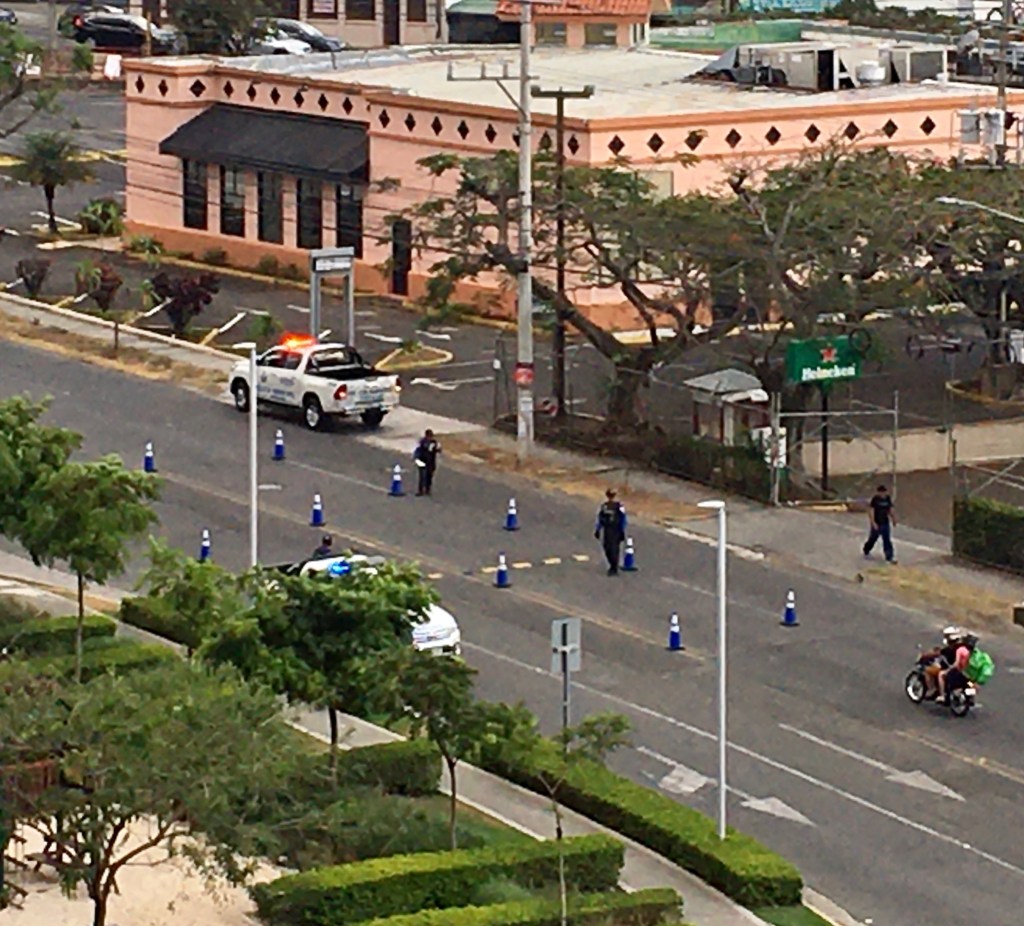
Many offices that could, had already implemented “work from home” for their employees in March. And, during the week of Santa Semana, many businesses traditionally shut down anyway, at least the Wednesday through Friday of the work week before Easter. It was amazing how little traffic there was on the roads the week before Easter. During that time you could have blind-folded us, spun us around and told us to cross the street in front of our apartment complex, and we would have been able to do it with no trouble. So different than the game of “Frogger” we were used to playing to cross the streets! It was almost eerie when we went out for daily exercise, it was so quiet.

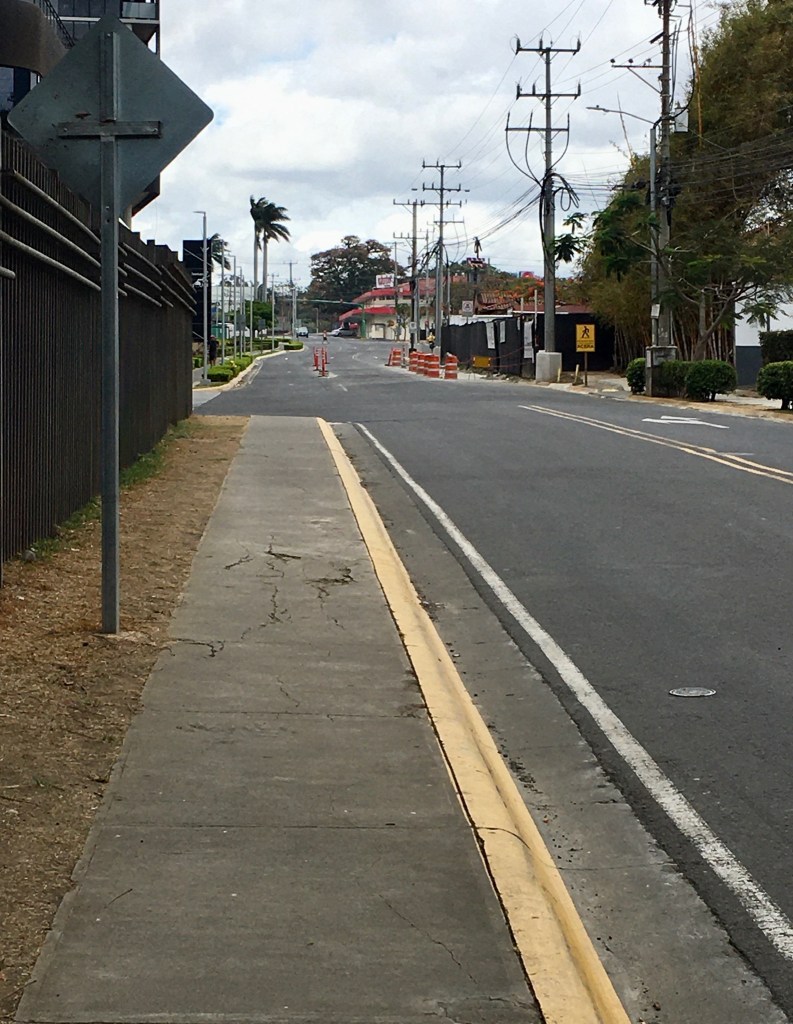
After Easter, the government eased up on restrictions during the week, allowing 80% of the vehicles on the road on a given day, again, according to license plate number. There is still a curfew. And, the weekend restrictions of 50% of cars traveling was still in place.
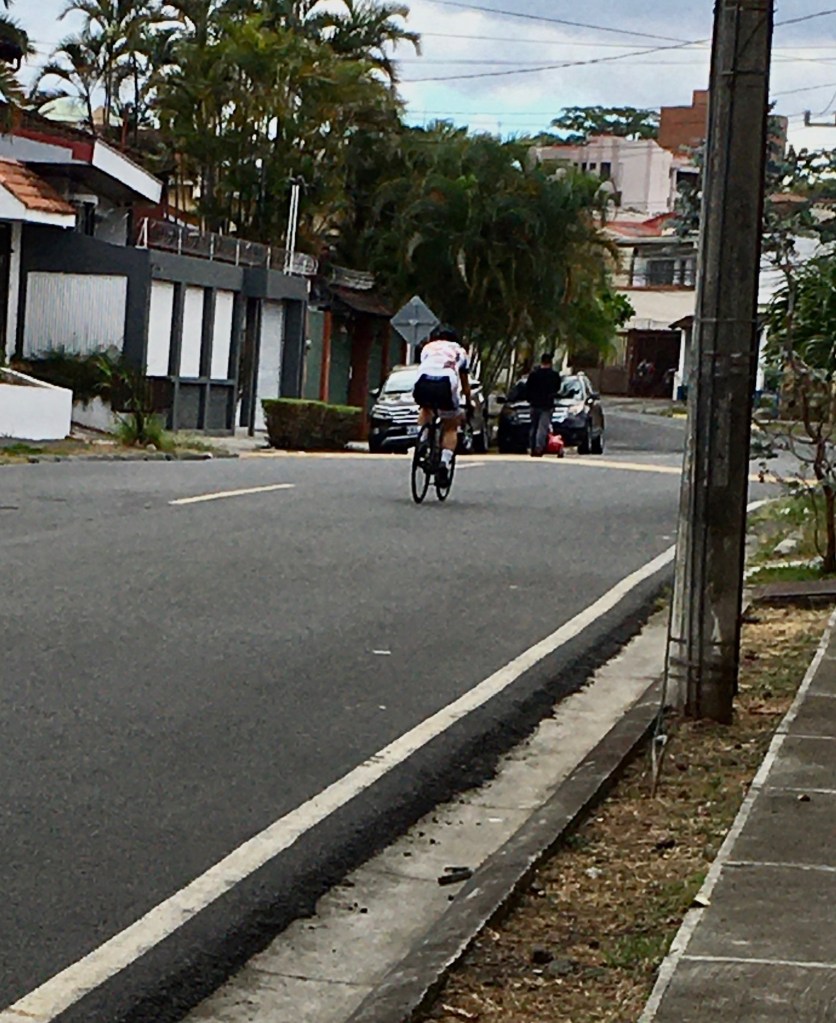
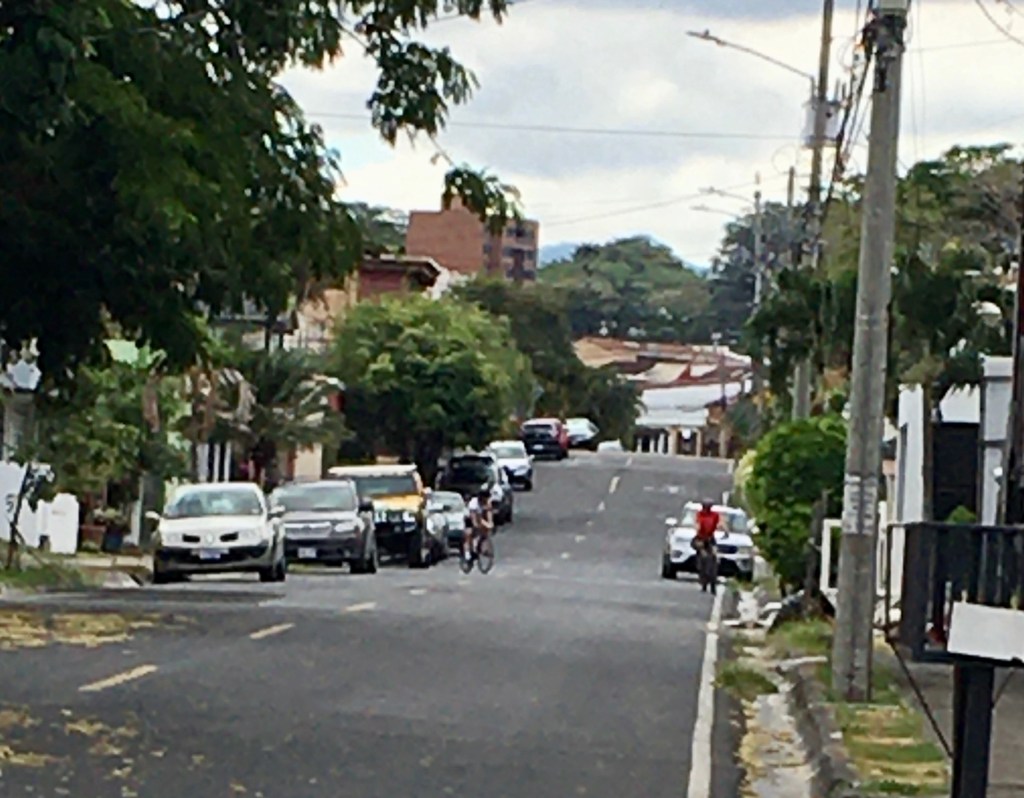
Now that there is less traffic, we’ve noticed more bicycles on the road during the week.
Where Would We Go Anyway?
Our Spanish school went online, using Zoom. So our twice-weekly 1 ½ hour round-trip walk to school was replaced by a three step walk to our couch. This was not the best thing for our exercise routine. We bought a long HDMI cable so that we could hook up our computer to our large living room TV for Zoom. Zoom Spanish class was rocky for a few at first, especially getting the audio to work, but after a few sessions, those having trouble mastered getting their audio to work without requiring help from their spouses. Our teacher also got better at ensuring all students were in attendance, after he forgot to let one of them into the Zoom class for at least a half hour.
Even if we did have access to a car, and could navigate the driving days and curfews, there wouldn’t be much point. The government shut down all schools, pools, public beaches, national parks, public parks, museums, sporting events, church services, hotels, etc.
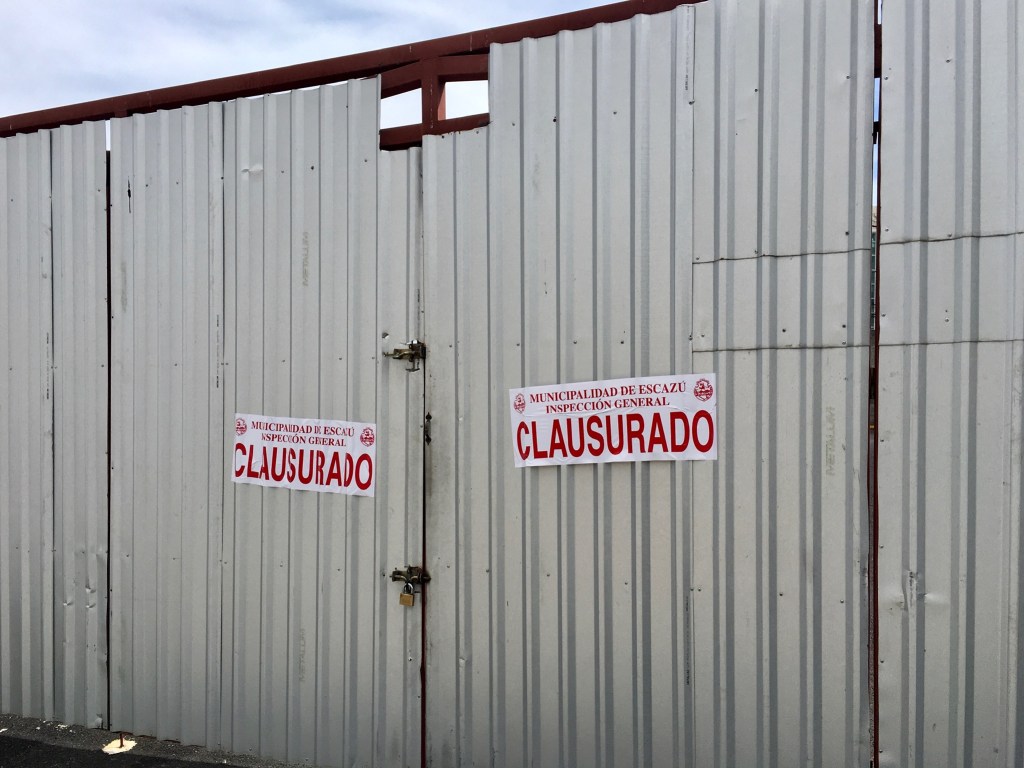
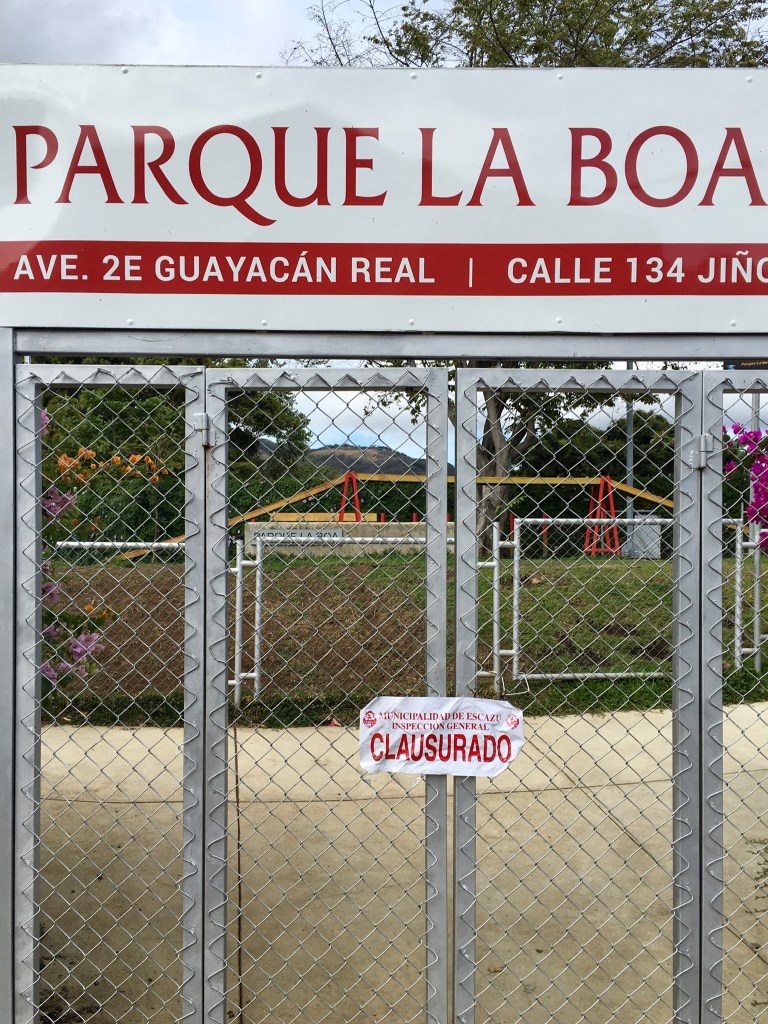
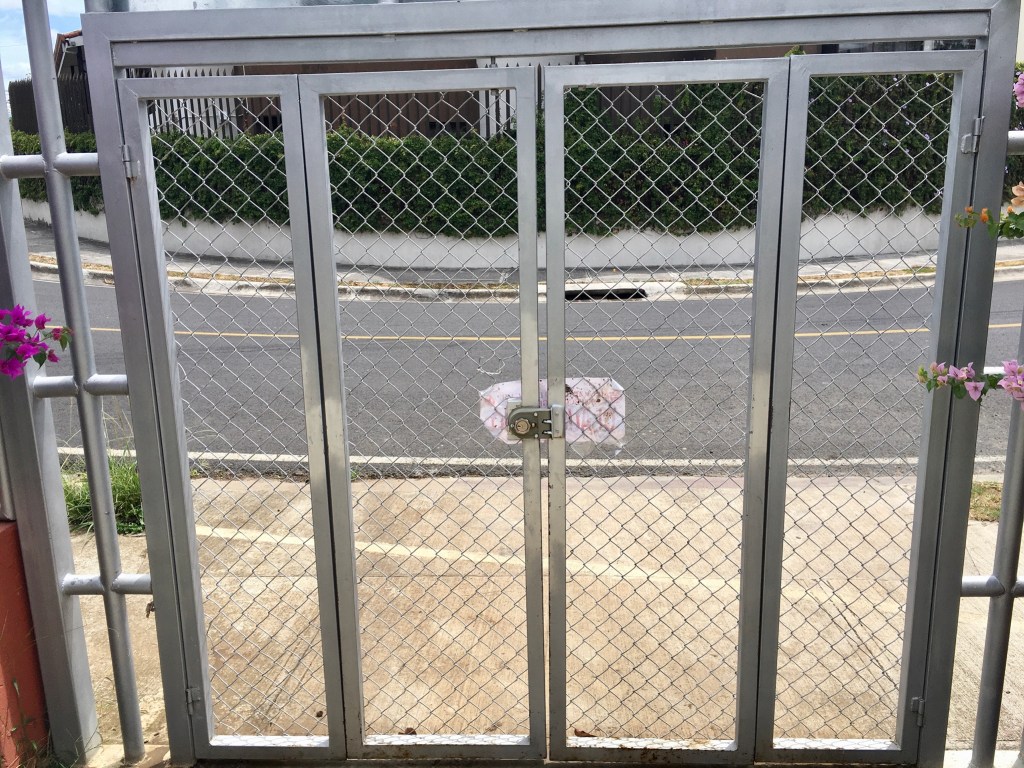
In Escazú, we started seeing “closure” stickers posted on parking areas and public parks. This was somewhat amusing. For example, there is a nearby gated parking area that we go by during our morning walk/run. In the past, we’d seen this area used by not only cars, but shuttle type buses for tourists and students. Presumably with the closure of tourist spots and schools, no vehicle needed to be parked there. The city of Escazú came by after it was already shut and padlocked for several days, and plastered two closure stickers on it. The city also padlocked a public park, Parque Buenaventure (check this), and slapped a closure sticker on it

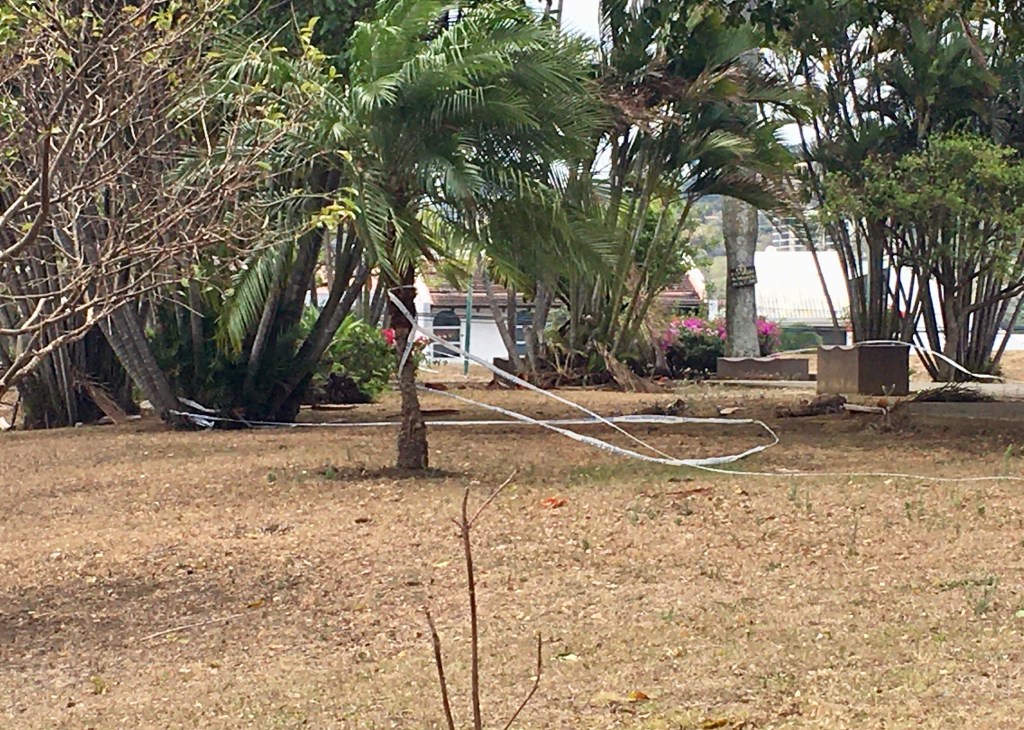
There is another park, Parque Iskatzu, that doesn’t have a fence of any type. The city draped police tape around the center area of the park, where the cement benches were, to indicate that people shouldn’t use the park. There was nowhere to adhere a closure sticker. The police tape was ineffective for two reasons. First, people tended to ignore it. Secondly, the tape wasn’t strung up well, as it was strung around tree trunks, etc. and would end up on the ground after a couple of days, making it even easier to ignore. Then the city would come by again and drape the police tape in the same manner as before, with the same result.
John found this especially frustrating. One day he was running by when they were stringing it up again and confessed that he just wanted to stop and say, “Here, please let me help you do that! You need to wrap the tape around the crotch in the branches of the trees, not just around the trunks!” Eventually the officials planted wooden stakes in the ground around the perimeter of the park and draped the police tape around them. The tape isn’t holding up much better with the stakes. They need to be stapled or tied, or something. Again today the police were out readjusting the police tape to the wooden stakes.

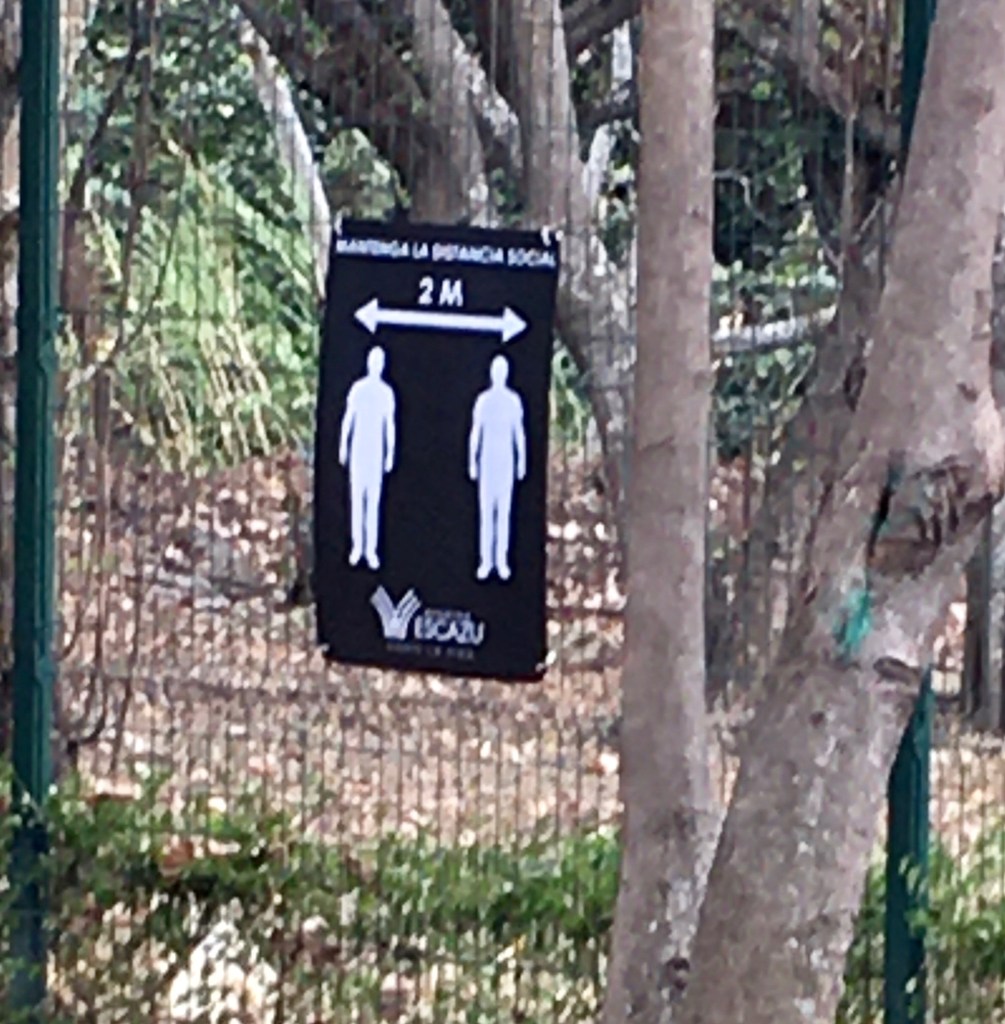
There is another park area near Avenida Escazu. This has a road that runs through it that some people are permitted to drive through. The park officially closed the road to through traffic on the weekends, but people can still go in it. Social distancing signs were posted in the park, but they might be a bit off in their message. They look like the signs you see posted in front of amusement park rides – you must be this tall to ride the ride.
They did tape off the kids’ play equipment in the park.
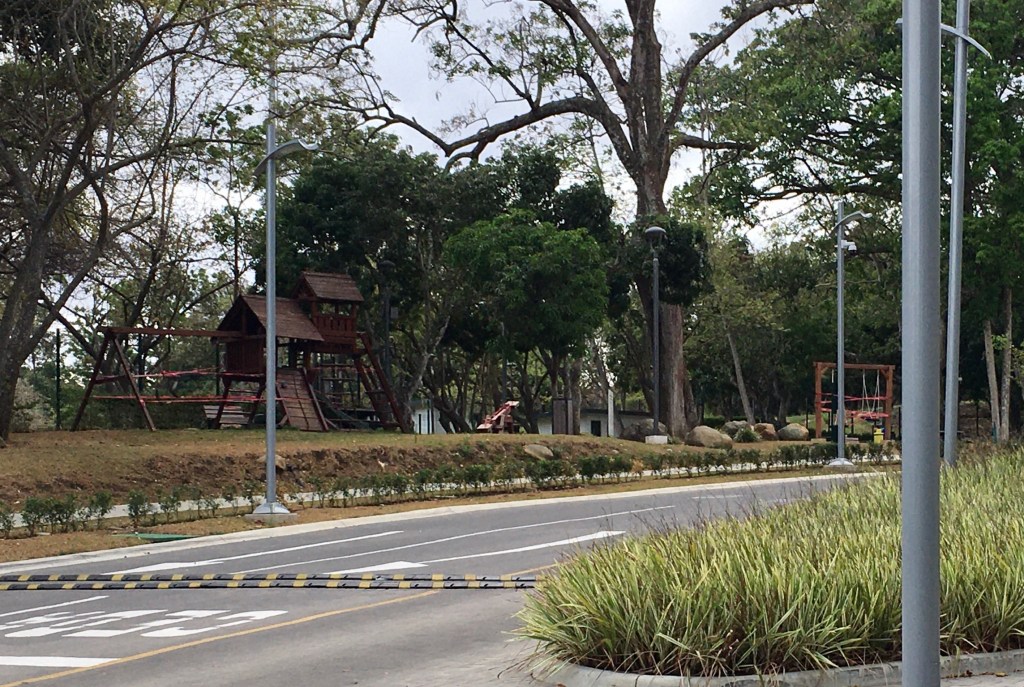
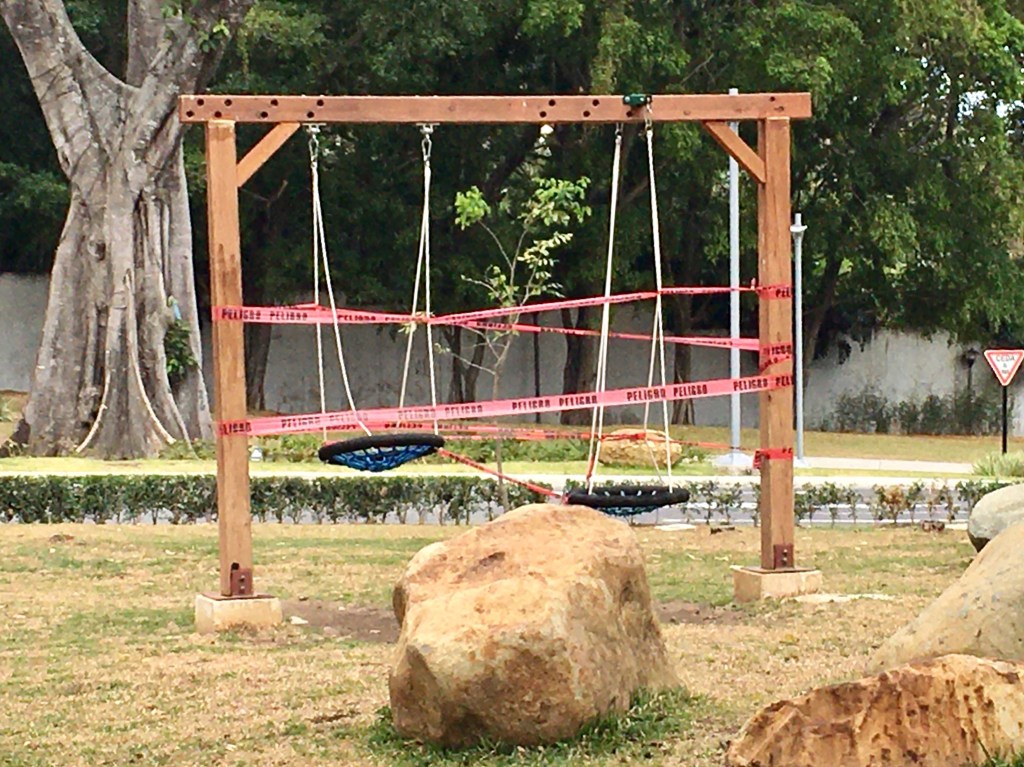
But, the dog park in one end of the park is open. For some reason, the city padlocked the gate to the area of the park near the dog park. But, if you go a few blocks further, you can get into another entrance of the park, and get to the other side of the padlocked gate. I’ve seen kids running up and down the dog park equipment. After all, the kids’ equipment is off limits. As I noted in a previous post, the dogs never seem that enthused about the equipment in their dog park, anyway, so they seem happy to share the equipment with the kids.

The dynamics of dog walking has definitely changed during this time. Before the virus and everyone staying at home, we would see “the help” out walking the dogs, or professional dog walkers. Now that more people are working from home, walking the dogs seems to be an excuse for the actual owners to get out of the house every day. There are definitely more owners walking the dogs daily. And I am wondering if the dogs are getting more than their usual amount of exercise. One day I saw two different dogs lay flat out down on the ground and refuse to go another step.
Store Modifications and Closures
Before Easter, for the most part only “essential” stores were open. In Avenida Escazú, we could see that most of the stores had signs posted explaining that they were temporarily closed. Texas Tech is located in Avenida Escazú, and it also went to on-line classes.
Unfortunately, Avenida Escazú had also arranged to have a temporary “Frida” photo exhibit running from the last weekend in February through the end of May. John and I had looked forward to seeing it. We went to Tamarindo the first weekend it was open so missed seeing it then but did try to find the exhibit the following week. Although there were promotional “Frida” signs plastered everywhere, including a giant billboard, there was nothing specific about where exactly it was located within the buildings in Avenida Escazú. You would think that as often as we traverse that area, we would have figured out where it was, but we never did. After a couple of weeks, it was a moot point anyway, since exhibitions were closed due to the coronavirus.

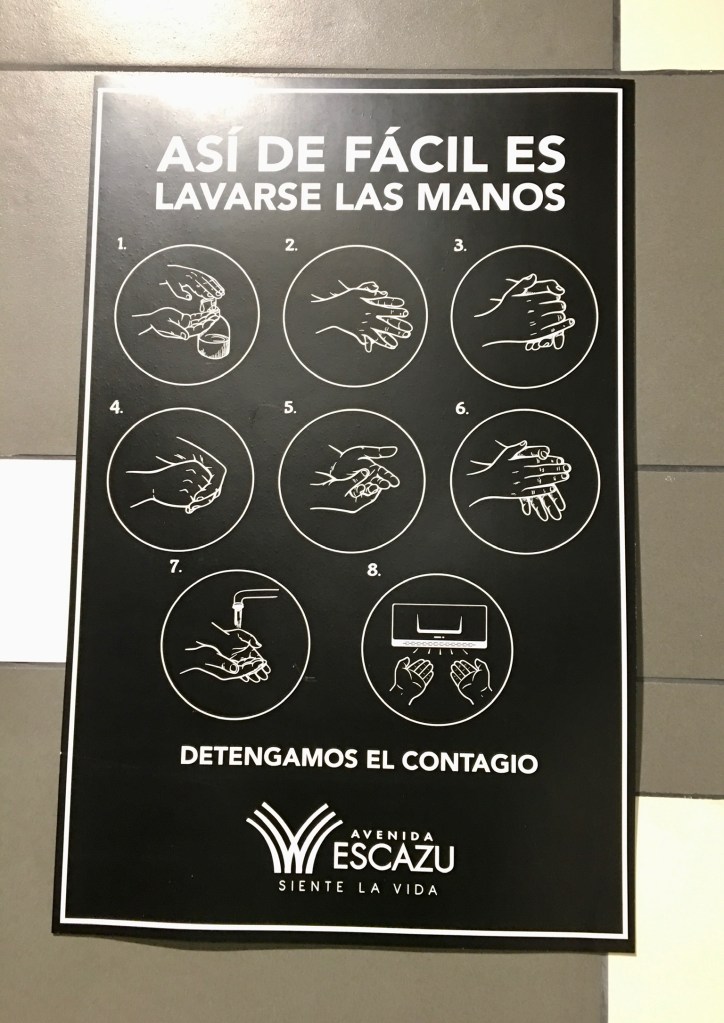
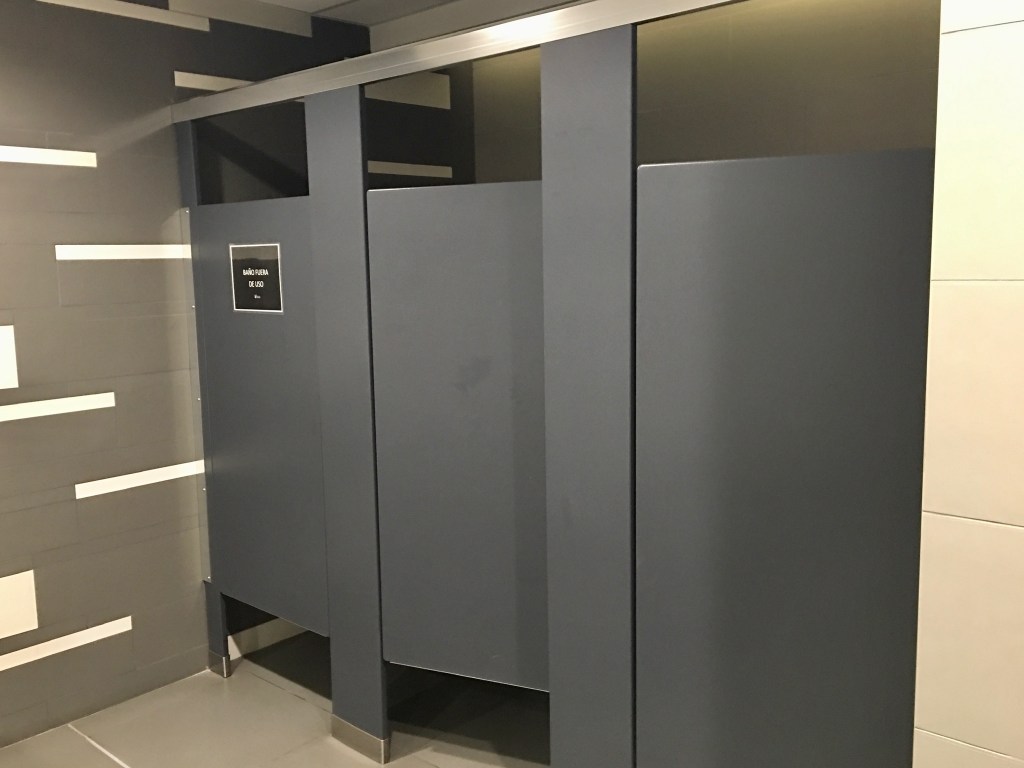
There is a public bathroom in Avenida Escazú that I have to admit, I was somewhat surprised to find remained open. They did make some adjustments. First, they put signs explaining how to properly wash your hands. In the women’s restroom, they also closed off one of the three bathroom stalls. But the one they closed was the one at the far end. If you are going to retain social distancing (or piss-tancing, as I have seen it called), it would seem to make more sense to close the one in the middle. John did say that of the three urinals in the men’s restroom, the middle one was covered in plastic and marked with yellow police tape. However, there are also three stalls in the men’s restroom, and the one on the far end was also closed. Finally, there is a separate, unisex, handicapped restroom next to the women’s restroom. This was closed entirely.
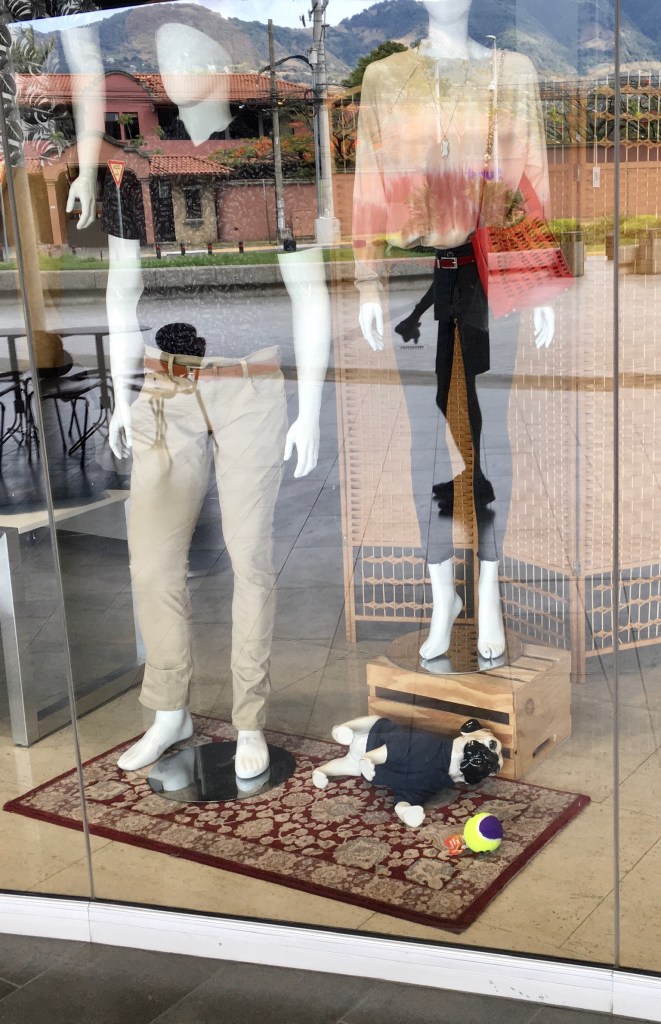
There are two big stores on the first floors of our apartment building. The first is “Yamuni”, which sells items similar to what you would find in a Kohl’s – clothing, jewelry, purses, housewares, etc. When everything was restricted, it just closed up, and didn’t even post a sign on its door. Yamuni also sells a few dog clothing items. You could tell that something was up because the doggie “mannequin” in the window fell over and wasn’t righted until just before the store reopened when restrictions eased.

The second store is “Universal.” This is the store that sells some housewares, upscale cosmetics, some electronics and furniture, a ton of toys, and also craft/school/office items. Universal appears to be nimbler. During the Christmas season it transformed much of its first-floor space to holiday décor. During the Covid season, it transformed some of its first-floor space into grocery items. All of the grocery items were those that could be stocked on shelves and not require refrigeration. Up until that point it had never sold any grocery items. But, because it started selling grocery, it was able to be considered an essential store, and could remain open despite the restrictions.
Grocery stores and of course, our Walmart and PriceSmart (membership store similar to Costco), remained open, as they were considered essential. But social distancing rules were put into place. At Walmart there are two ways to get in and out of the store. Now one of them is a designated entrance only and the other is a designated exit only. A limited number of people are allowed into the store at one time. During the week you can usually get in without a problem, but we found weekends to be so much of a challenge that we have stopped going to these stores on weekends all together. In order to accommodate everyone during busy times, stores like Walmart only allow one family member to shop. Walmart did set up some chairs with appropriate social distancing along the outside of the store so that family members who weren’t let in would have a place to sit. They also marked spots on the floor outside the store so that those waiting would be appropriately spaced.
One day John and I had to wait in a line to get into Walmart, and we were waiting together, appropriately spaced from other people also waiting. A security guard came up to us and asked us something in Spanish. We didn’t understand what he was saying, admitting our Spanish is not good. He continued to try a couple more times, seeming to grow increasingly frustrated, when he finally turned and walked away. We thought maybe he was trying to let us know that only one person from a family group would be allowed to shop, so we spread out, so we looked like we were not together. However, soon a woman walked up to us, who did speak some English. Turns out that they were trying to be nice and allow us “old people” to go to the front of the line to get into the store! We were both disappointed and somewhat grateful. Disappointed that we looked that old and grateful that we didn’t have to continue to stand in that line. We’re still unsure how old that makes us, what age qualifies you for preferential treatment? We continue to delude ourselves into believing that Ticos can’t judge Gringo’s ages that well.
You have to bring a cart from outside the store into the Walmart. Someone is stationed near the entrance to wipe off the cart with a paper towel sprayed with disinfectant, and also to squeeze an unnecessarily large amount of hand sanitizer onto our waiting hands. Despite vigorous hand-rubbing, your hands aren’t dry until half-way through your shopping excursion.
For a while, due to government recommendations, Walmart started taking our temperatures before we were allowed to enter. Sometimes the person taking our temperature would show us – we usually run about 36.2 or 36.3, which at first meant nothing to us, since we never took our temperature in Celsius before this. We are now used to either being sprayed with disinfectant and/or having our temperature checked when we enter most places, like the home improvement store – EPA, Office Depot, and even the bank.
All employees wear masks and/or plastic face shields, and checkout counters have installed plastic shields. Masks were never mandatory for patrons. When all of this started, we couldn’t even find masks, gloves or hand sanitizer. We first found gloves and hand sanitizer at Universal in their newly created grocery section. A classmate told us we could find masks, albeit a flimsier one-use type, at EPA. Walmart finally started selling masks that could be washed, and Universal also started carrying the plastic face shields. We are now stocked up on these items.
As we go about our limited excursions, we can see that some people wear masks and some people don’t. We don’t think that wearing a mask is political, like we’ve heard it is in the US.
Restaurants
I have to admit that understanding restaurants during this time has been perplexing. Costa Rica has been following a phased reopening plan, and as of June 1st, all restaurants can be open at 50% capacity. But, it seemed like some restaurants never really closed their dining areas, except for maybe a couple of weeks around Easter. They did block off tables for social distancing, which they are still doing. The hours vary. The best way to figure out if a restaurant’s dining area may be open is to look at the driving restrictions. If people can’t drive to the restaurant due to curfews, the restaurant dining area isn’t going to be open.
Food delivery seemed to be very popular here even before the virus. We always saw food delivery guys from Uber Eats, Rappi, and Glovo, tooling around on their motorcycles with food delivery boxes strapped to their backs. Delivery services were exempted from driving restrictions, so restaurants were able to stay open on weekends for delivery only.
John and I don’t eat out often, usually only once a week on the weekend. When the virus shut down the restaurant dining experience, we decided we would try delivery, with mixed results. One Saturday night we ordered from our local Italian restaurant in Avenida Escazú via Uber Eats and were so looking forward to eating a couple of our favorite dishes. Uber Eats confirmed that Pablo had picked up our order and would be coming on … bicycle? Why weren’t we getting a guy on a fast motorcycle like we saw all of the time? We’d seen a few delivery guys on bicycles before, and they usually had motors attached to them, the annoying kind that sounds like a chainsaw. Still, we can walk to Avenida Escazú in about 15 or 20 minutes, so we figured that a bicycle delivery would be OK.
Pablo had a tracker on his bicycle so we could monitor his progress via the app. This was both good and bad because we could track where he was as he made his way to our apartment complex. John and I went to the 2nd floor area in our complex, that houses restaurants and retail. From there we would be able to meet him when he arrived. We could see all of the delivery guys with their fast, shiny motorcycles driving into our complex, dashing up the escalator to retrieve their delivery orders from the restaurants here, like Johnny Rockets, and then dash back to their motorcycles and speed away to make their deliveries.
Meanwhile, we were monitoring Pablo’s turtle-like progress on the UberEats app. About half-way from the restaurant to our complex his progress completely and inexplicably stopped for about 5 minutes. We were about ready to message him when he started back up again. Finally we saw a bicycle delivery guy slowly ride up, and then pass by our Escazú Village complex. He pedaled through the next intersection and continued up the street. According to the app, this was our guy. We frantically entered “You’ve gone too far” into Google Translate and messaged him in Spanish. On the app we could see the bicycle icon slowly turn around and head back in our direction. Yes, here he came again. This time we were elated to see him turn into the circle drive of our complex, and then deflated to see him not stop, ride through it and continue past in the opposite direction, despite the fact that we were waving to him the whole time. Again, we quickly messaged him. We saw the bicycle icon turn around again, and this time, stop in the circle drive. In all, it had been 45 minutes for the delivery, the amount of time in which we could have walked the distance at least a couple of times. It was no consolation that the UberEats app sent a message stating that there seemed to be some sort of problem with the delivery and they would look into it. It should be no surprise that by the time we were able to eat the food, it did not live up to our expectations.
And wouldn’t it be easy to just order take-out from Johnny Rockets? The restaurant is in our apartment complex, so literally, all we had to do was step outside our lobby door, walk a few steps and pick up the food. You’d think so, but we couldn’t. When the restaurant’s dining area was closed, the only way to get food ordered was through a food delivery service. Despite our inability to speak Spanish well, I nevertheless tried to call Johnny Rockets to place an order for take-out. No one picked up the phone. We resorted to ordering through UberEats. We watched the food delivery guy pick up our order and then walk towards our lobby door. Those five steps were the quickest delivery we experienced and probably the easiest money that guy made that night.
Our Apartment Complex
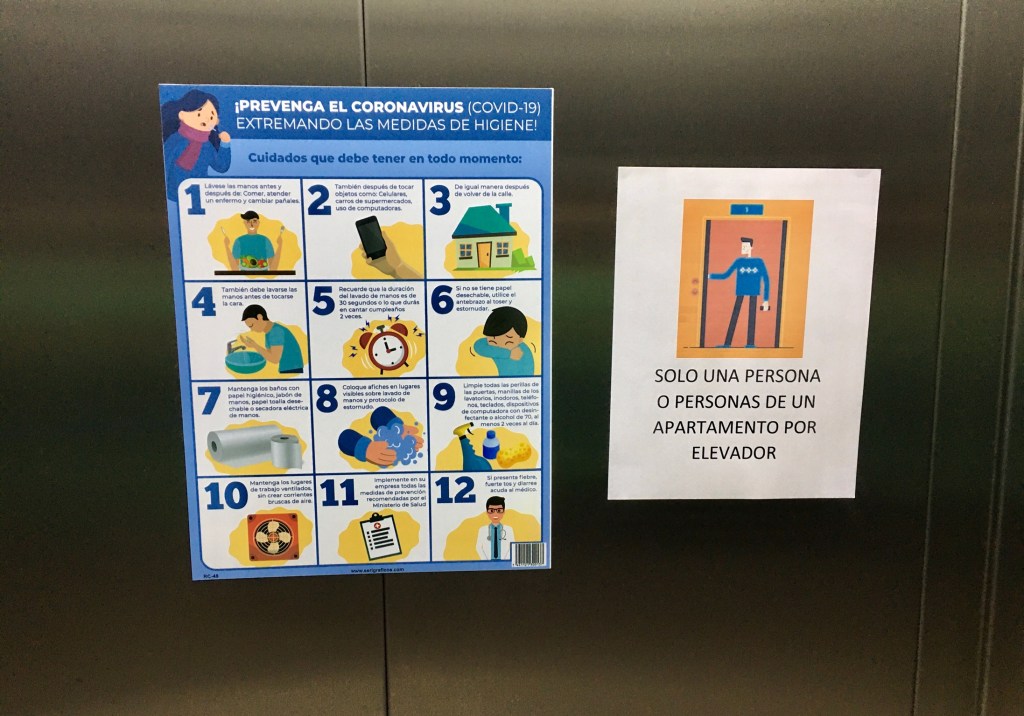
As the government announced restrictions, our apartment complex put up signs in the elevator. One sign provided “helpful” information hygiene. The second stated that only one person, or persons all living in the same apartment could ride in an elevator at the same time. It is a little frustrating to have the elevator doors open and see that there is someone in the elevator already, and not getting out. You just have to wait until the door closes again, the elevator departs, and then push the button again, to summon it.
The apartment management also sent emails stating a few policy changes. The emails are always in Spanish, so Google Translate is essential for understanding. The first email we received in March said that we could use the common areas, like the pool area or ping pong room, but we couldn’t have guests over. Within a week, we received another email stating that all common areas were off limits. They put up yellow police tape in the pool area. The first day after the email we saw a couple of people swim in the pool, apparently undeterred by the newly strung police tape. (How would you not question using it?) They must have been talked to because after that, no one swam in the pool.
It was obvious that more people were at home more often in our complex, or maybe we just noticed more things. For example, we found out that there was a couple with three large fluffy cats living three floors below us in an apartment on the same floor as the pool. The apartments on that floor have fenced patios that open to the pool area. Multiple times a day, every day, this couple let their large cats out onto the common pool area. We had never seen the cats before. The cats walked around the area and also seemed to enjoy hiding in the plants.

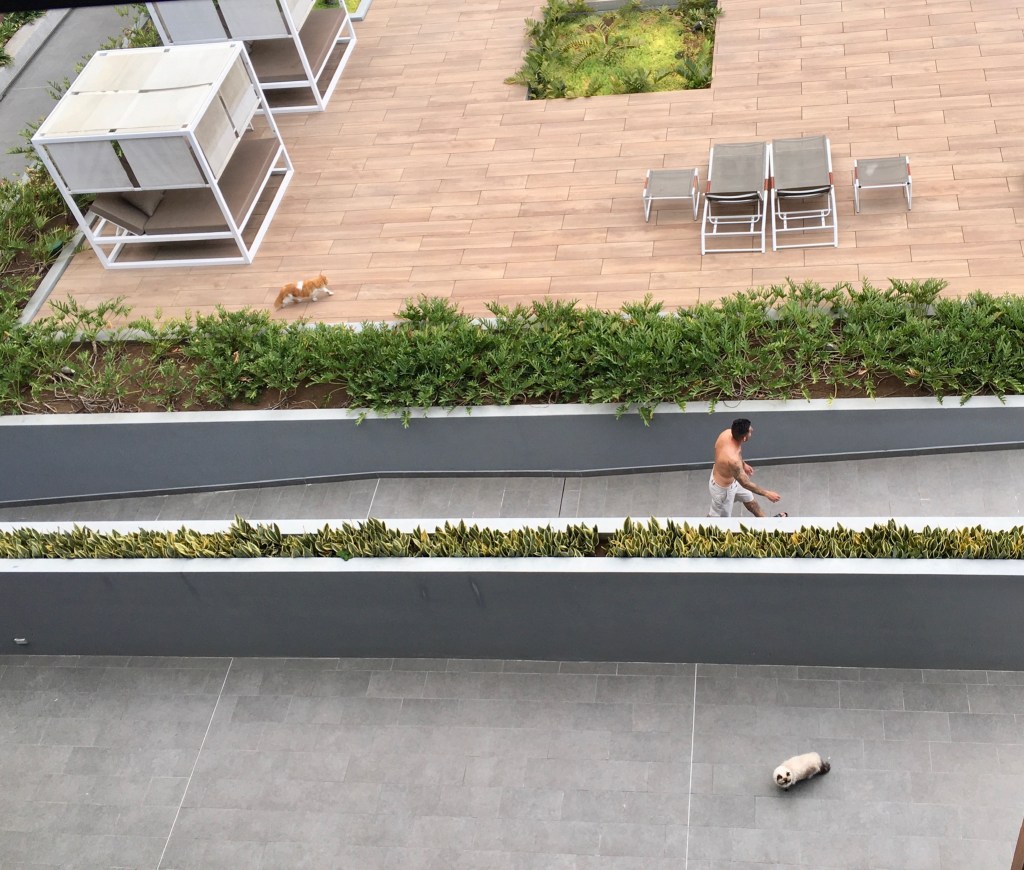
This went on for several weeks, it seemed (time during COVID is hard to judge), until we received an email from the apartment manager, stating that cats weren’t allowed in the common area. This email also addressed another concern that apparently some people had raised, being conscientious about dog barking. It made us think that more people must be working from their apartments and were getting annoyed with dog barking and cat meandering.
When restrictions eased a bit, the pool was available by reservation only. Restrictions eased a bit further, and multiple people were allowed to be poolside at the same time, as long as they maintained social distancing within their social bubbles. Are social bubbles a thing in the US? They are here. It means that you can choose a few other people to be included in your bubble and don’t have to maintain social distancing between yourselves.
A few weeks ago the apartment complex did provide a free concert, touted as a reward for the residents’ patience and cooperation during these times. The musician played guitar poolside, allowing many of us to enjoy the concert from our balconies.
At this time, we are still not allowed to use the other common areas. John and I look longingly at the ping pong room, just a few doors down from us, as we walk to the elevators.
And Finally?
As of this writing, Costa Rica’s Minister of Health has announced a “second wave” of coronavirus. They have indicated that it is due to migration along the border with Nicaragua, and some northern areas of the country are under stricter restrictions, even as the country is attempting to reopen. The repatriation flights continue, allowing people to leave the country. The borders are currently closed to non-citizens through June 30th, but these dates have been pushed back every couple of weeks since April. We are doubtful that the borders will reopen then, so are prepared to stay here for an indefinite period of time. But “here” doesn’t necessarily mean in Escazú – more on that in a future post.
 Remember, it's an adventure.