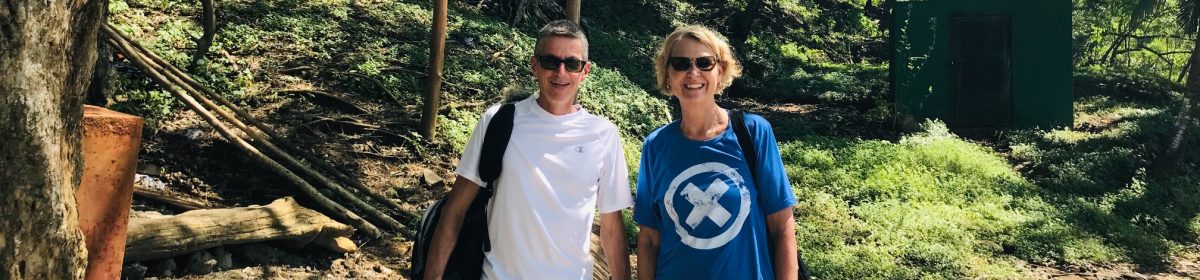
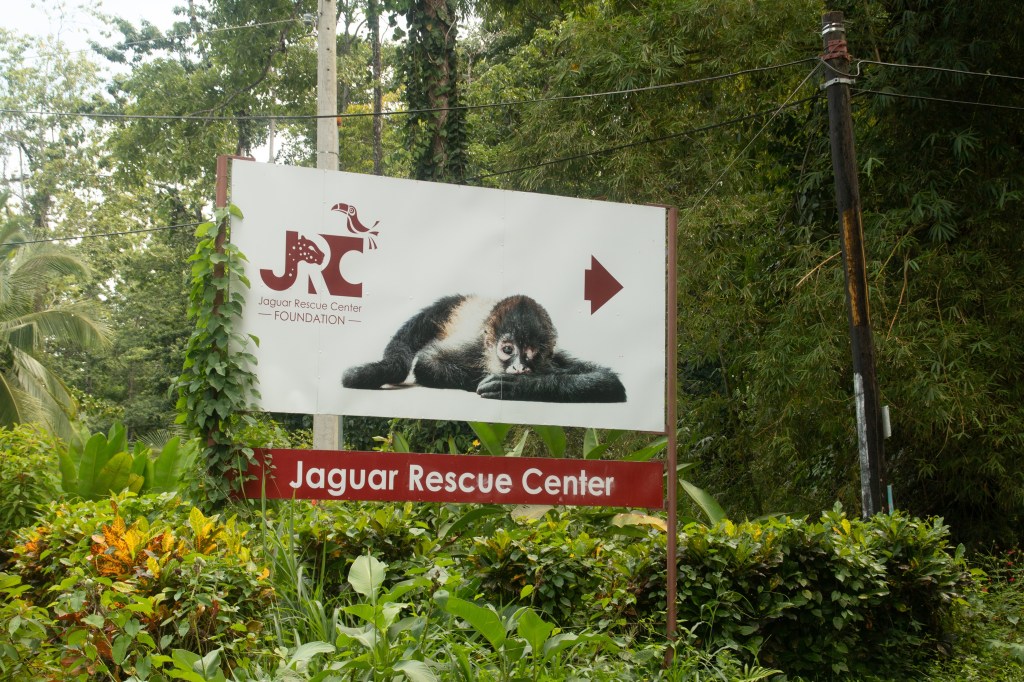
We were delighted to find that the Jaguar Rescue Center was within walking distance of our hotel, Le Cameleon, in Playa Cocles. We signed up for a public tour, offered twice a day, and thought it was one of the highlights of our trip.
This is the last post about our trip to Playa Cocles where we relay our experience at the Jaguar Rescue Center.
The Jaguar Rescue Center offers two public tours a day, at 9:30 and 11:30. We hadn’t checked before we walked to the center, so arrived after the 9:30 tour but well before 11:30. We signed up for the 11:30 tour, and walked back to the hotel and then back again for our tour. It was a beautiful, sunny day. As we were walking to the center, I remembered that I hadn’t put on any bug spray. John assured me that we were taking the tour in the middle of a sunny day, so that shouldn’t be a problem. He was right in that it wasn’t a problem … for him. For me, it was another story. I counted more than 20 bug bites the next day (when my bug bites show up), and even John admitted that he had noticed the mosquitoes. Word of caution, if mosquitoes love you like they do me, you need to use bug spray on the tour, even if it is in the middle of a beautiful, sunny day.
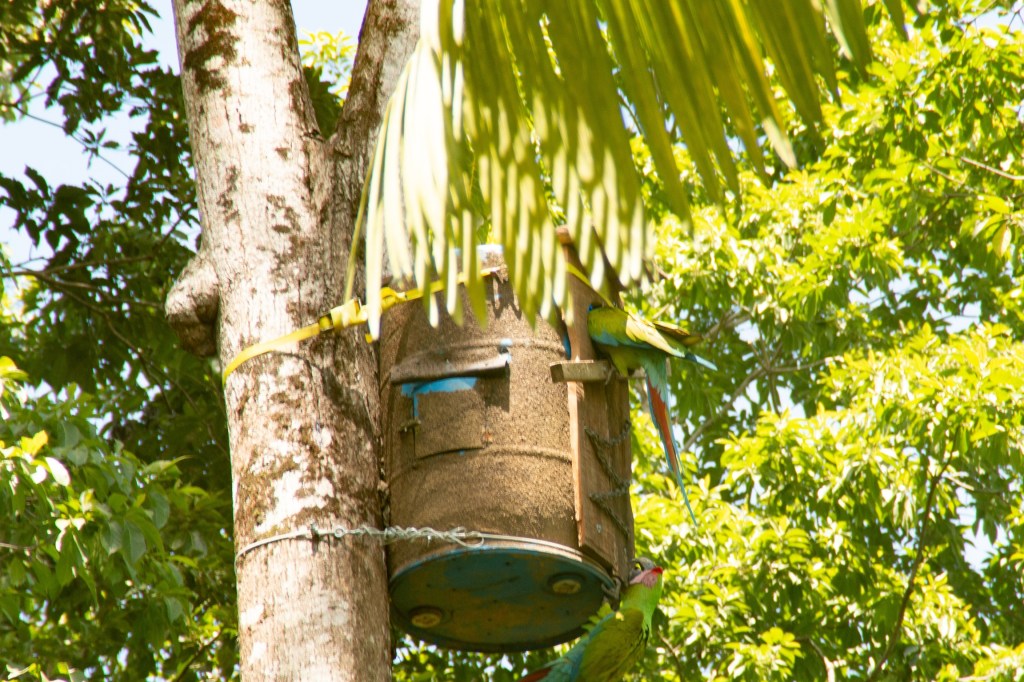
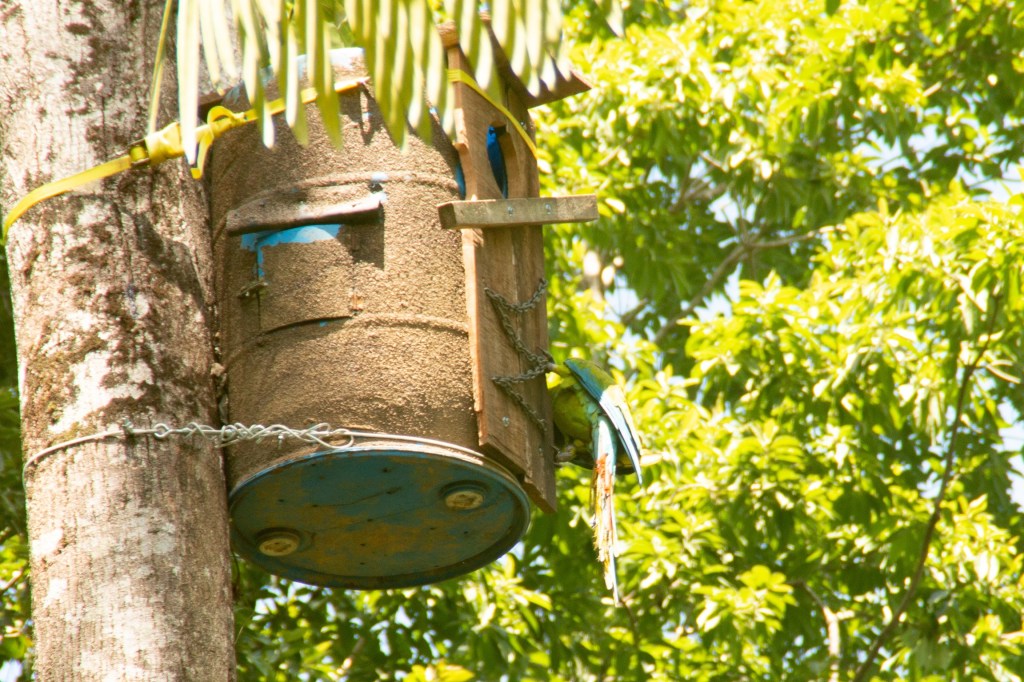
As we were waiting for the tour to begin, we saw a macaw flying to a large container of sorts, obviously constructed by humans, high in a tree. Later we found out that the return of the macaws has been facilitated by the construction of these “nests.”
When it was time for the tour to begin, we were herded into a waiting area, where there were several cages with large snakes. The snakes were never discussed in the tour, by the way.

Two guides came in, and we were divided into two groups, an English-speaking group, and a Spanish-speaking group. Our English-speaking guide was from England, and she was fabulous! She is in the country doing research. She lamented the fact that she moved to one of the only other countries that had more rain than England.
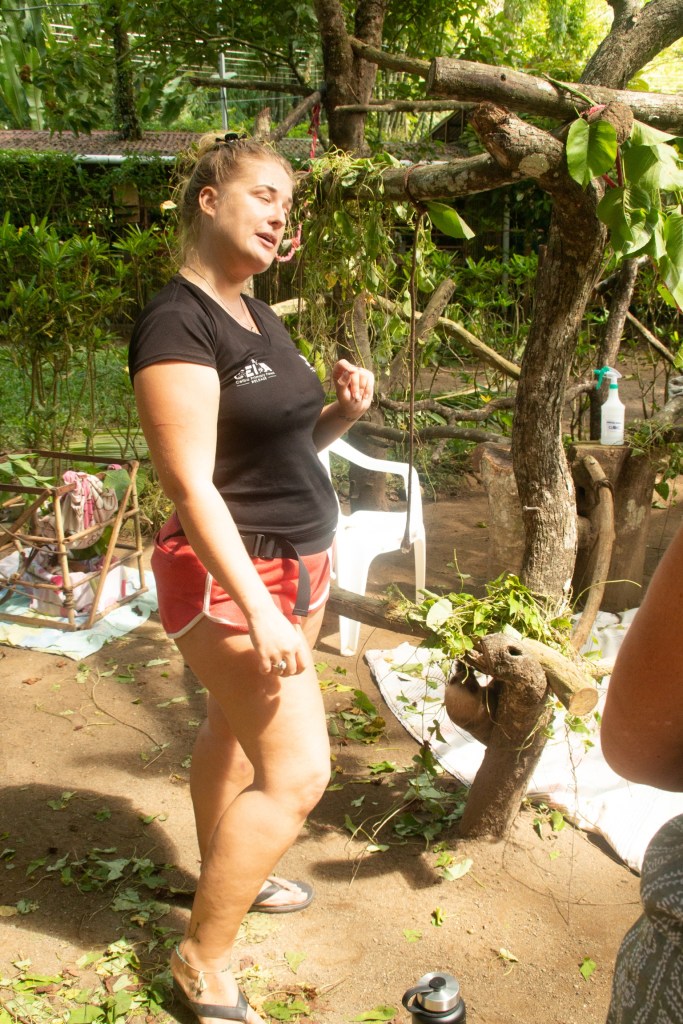
What made the tour so great was not only seeing the animals, but also the guide’s stories, some of which we’ll relay here. There was so much information, it was hard to remember it all.
First, a little about the Jaguar Rescue Center (JRC). This is a rescue center for monkeys, sloths, other mammals, birds and reptiles. The JRC doesn’t receive funding from the government. People, including those working for the government, who find wild animals in need of help, bring them to the rescue center. The JRC provides veterinary services and attempts to release the animals back to the wild, if possible. Although we saw a lot of animals on our tour, our guide told us that we wouldn’t see most of the animals that were being cared for to return to the wild. They want to limit human contact with those animals.
The first large compound contained several types of monkeys. It had multiple cages and one large area where there were several volunteers sitting with the monkeys. Or, perhaps a better description would be that there were monkeys crawling on the volunteers. Not sure what exactly they were doing, but our guide told us that you weren’t a “real” volunteer at the JRC until you had monkeys pee and poop on you. Can’t imagine they mention that in their recruitment ads!
Our guide told us that they have a squirrel monkey that is very smart. Squirrel monkeys do not have opposable thumbs. This monkey is housed in a cage in the compound with other monkeys in their cages, also in the same compound. The JRC staff has locks on each of the animals’ cages. But this squirrel monkey figured out how to unlock the cages. At night, he would unlock his cage, and then go and unlock the cages of the other monkeys in this compound so they could “have a monkey party,” according to our guide. The JRC staff amped up security by installing carabiner clips on the cages. They figured that since the squirrel monkey didn’t have opposable thumbs, that he wouldn’t be able to open the cages. Well, somehow, he figured out how to open up the carabiner clips, too, and continued opening the cages for his nightly “monkey parties.” The JRC staff have now installed combination locks on the cages. So far, that’s stopped the monkey parties, but it felt that the JRC staff was holding their collective breath.

We also saw a compound that housed white-faced capuchin monkeys. These monkeys are all together and have formed their own tribe. The JRC will be returning these monkeys to the wild together when they think they are ready. Interestingly, the JRC takes animals into the wild for “practice” trips. Unfortunately, at the time, we didn’t think to ask how exactly that worked. How free are the animals when they go to practice, and how does the staff corral them to go back to the JRC? How do they know when the animals are ready? Questions left unanswered, sorry.
We did learn to be extremely wary of the capuchin monkeys, though. Our guide just came out and told us they are thieves, and they work as a team. When they are around people, they will send one or two monkeys out in front of the people as a distraction. When the people coo over how cute they are and start taking pictures, the rest of the monkeys sneak up from behind and pick their pockets, unzip their backpacks, and take whatever they can get. Our guide told us that two years ago one of the monkeys stole a cell phone from one of their volunteers, and they have not found it yet – and they go into their cage! By the way, our guide’s caution about the monkeys was helpful in a subsequent trip we took.
Our guide showed us an opossum they had. She acknowledged that most people do not find opossums overly endearing. (This is true for us – John had an interaction with an opossum in the middle of the night in a window well at my parent’s house many years ago. Admittedly he was the only one brave enough to venture to the window well and see what was making the noise that had awakened everyone. When he came running back to the rest of us saying it had hissed and bared its teeth at him, we let it figure out how to get out on its own.) Our guide went on and on about how wonderful opossums are, even including a note about curing breast cancer. She then swore us in as part of the opossum army. At this point, since I can’t remember their wonderful qualities, but do remember that they hiss and bare their teeth, I would probably be considered an army deserter.
The JRC had many sloths in an open area containing multiple tree limbs. This area did not have a cage, so we were able get close enough to actually see what a sloth looks like. Remember that up until now, we’d seen sloths, but only up in trees, where they looked like nothing more than balls of fur. There are two types of sloths, two-toed and three-toed sloths. These are not really “toes” as they are located on their forelimbs. The English language is the only language that misrepresents this. The two types of sloths are separated by million of years of evolution and are closer evolutionarily to other animals than they are to each other.

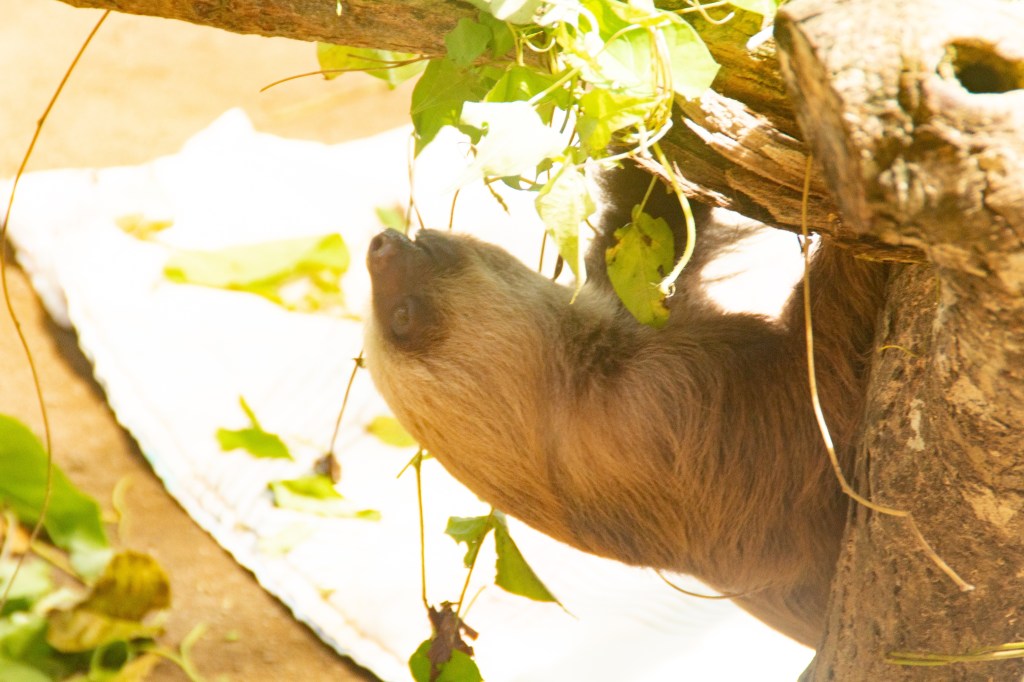
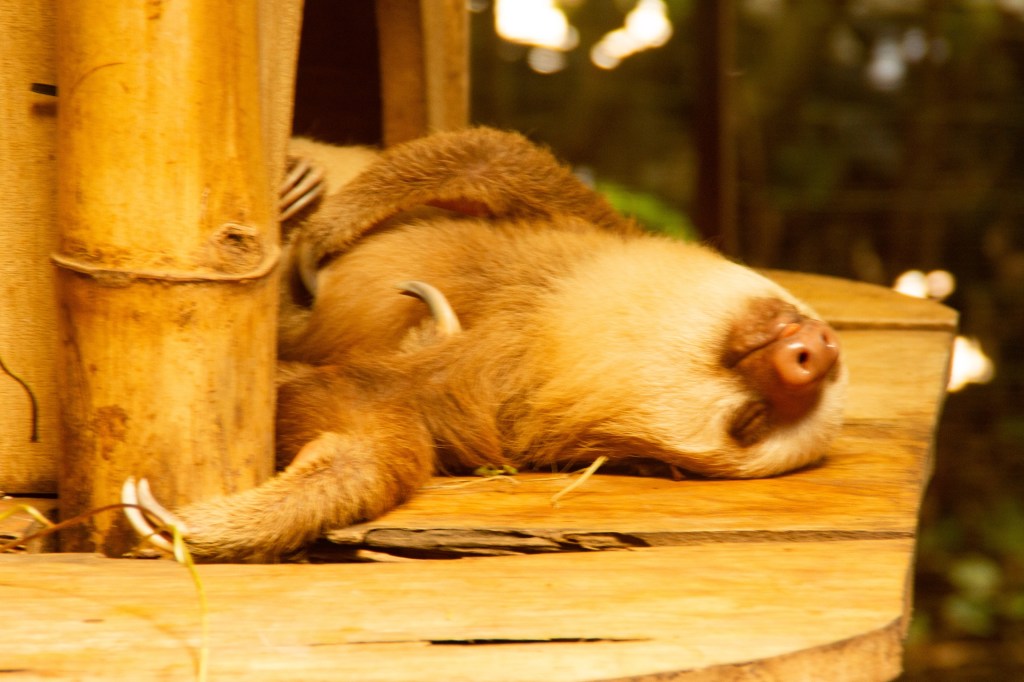
Sloths conserve energy and eat leaves for food and water. It takes one month for a sloth to digest one leaf, that’s real conservation! They have more vertebrae in their necks than other animals, which allows them to turn their necks more than other animals. Baby sloths cling to their mothers, but can get separated if they fall or the mother is attacked by a predator, etc. The mother will try to protect the baby by curling herself around it. If baby sloths are brought to the JRC, they will record the baby’s cries and take the recording to the area where the baby was found. A mother sloth can recognize the cry of her own baby and will come to it if able. The JRC has had success in reuniting mother and baby sloths using the recordings.
There are no longer continuous tree lines in many areas of Costa Rica due to human development, so monkeys and sloths will go from tree to tree using electrical wires. Electrical wires are not buried here. Our guide told us that Costa Rica uses less expensive electrical wires, so the insulation will wear out in spots. When animals hit a spot where the insulation has worn out, they become injured. The JRC raises money for the replacement of the cheaper electrical wires with better ones, using a GoFundMe page, and have an arrangement with the Costa Rican government. The JRC raises the money for the new wires and the government will supply the labor to replace them.
Our guide brought us to a large parrot who was once owned by a person. This parrot can speak a lot of words and can mimic sounds very well. Our guide says that the parrot has even mimicked her laugh so that it sounds just like her. The JRC can’t release this parrot into the wild, because of how well it speaks. If they do, then other parrots will mimic the words and sounds from this parrot, and this will continue to spread to other parrots. The problem is that this will make all of these parrots very attractive to poachers, which will put them in danger.
Near the end of our tour, we came to an enclosure that housed a crocodile that was blind in one eye. The JRC believes this crocodile is fully capable of living on its own in the wild, but the Costa Rican government has denied its release. Crocodiles can live to the ripe old age of 75 years, and they think this one is only in its 20’s, so they will be housing this animal for another 50 years.
Our guide relayed an experience she had on one of her tours. Her tour group had come to the crocodile’s area, when a lizard fell from a tree into the enclosure. The crocodile didn’t move. The lizard then walked directly to the nose of the crocodile. The crocodile still didn’t move. Then the “stupid lizard” (her words), crawled up onto the back of the crocodile. Apparently, that was the last straw for the crocodile. All of a sudden there was a “Whap” as the crocodile used its tail to propel the lizard from its back and into its mouth, where he happily ate it in front of the group. The tourists were horrified, and children began to cry. (I guess it’s all well and good when Elton John sings about “The Circle of Life” in the Lion King, but nobody wants to see it in real life.) Our guide did say that negatively impacted her tips from the tour, which is what she relies on for her income.
The obvious question would be, with the name “Jaguar Rescue Center” – Did we see jaguars? No, we did not. They are somewhat rare in Costa Rica. We did see several other members of the cat family. One of them, we think it was the margay, tries to attack any person who enters its cage.
We really enjoyed our tour of the Jaguar Rescue Center, and highly recommend it. There was so much more to it than I’ve been able to capture here. If you are able to go, remember your bug spray!
 Remember, it's an adventure.