It’s said that turtle watching in Tortuguero (Place of Turtles) is all about timing. We visited during September, which is one of the peak nesting months for green sea turtles, so felt there was a good chance we’d be able to see a green sea turtle nesting. It seemed extra special since green sea turtles are listed as an endangered species.
But you don’t just wander down to the beach to see a turtle nesting. Sea turtles come on shore at night to nest. Access to nesting sites on the beach are strictly controlled at night, and you are not allowed to wander the beaches at night on your own. So, we signed up for the (optional) night sea turtle tour on Thursday night, and paid the $40 per person fee. It was worth every penny!
For the tour, we were told to wear shoes (not sandals), and dark clothing – long pants, long sleeves. We could NOT bring cell phones or lights of any kind. (For this reason, we don’t have any photos of this excursion.) Lights disturb the turtles. If there are lights on the beach, a mother turtle may not come ashore to lay her eggs. We were told that she will just return to the sea and dump them!
Costa Rica is near the equator and has an equal amount of day and night practically all year round. Sunrise and sunset only vary by about an hour the entire year. Obviously, there is no need for “daylight savings time” here. This time of year, sunrise is around 5:30 a.m. and sunset is around 5:30 p.m. But again, it isn’t going to vary much anytime of the year. We were to meet for the tour at 7:30 p.m., so it had been dark for 2 hours before we started out.
The beach on the Caribbean Sea is on the eastern side of Tortuguero Village. Aninga Lodge, where we were staying, is located west of Tortuguero Village, across the Lagunas de Tortuguero. This meant that we needed to take a small boat to get to a dock near Tortuguero Village. The usual suspects from our lodge had signed up for the tour – the nice young people from the US we’d had breakfast with, the Spanish-speaking couple that rode with us in the morning van, and us. We boarded the small boat and rode the short distance to meet up with others who had signed up for the tour that night.
Everyone on the tour was assigned a tour guide, in groups of about 10. The tour guides were the only ones with a flashlight, and it emitted red, not white, light. We were assigned to a guide but couldn’t immediately start our tour. Apparently, our guide was told that there wouldn’t be a full number of participants for her to lead, so she had brought along her granddaughter. When she realized that she had the maximum number for her to lead, she had to send her granddaughter back to the boat to wait. You can tell that they take this very seriously.
When that was all settled, we walked from the dock to the Caribbean side and stumbled onto the beach. And I do mean stumbled. The tour guide did not use her red flashlight to light our way. She only employed it when it was necessary to show us something of interest. Most of the time we were completely in the dark. We couldn’t see the moon that night, so there was no moonlight to light our way. Plus, the area of the beach that we were traversing wasn’t the smooth sand down near the water. It was the area above the high-water mark, near the vegetation, so the footing was uneven and there were dead limbs, etc., strewn about. I did fall once, but at least the sand was soft. We could barely make out each other as we bumbled along. John and I felt the need to hold hands. Not because we were having a romantic stroll along the beach at night (you’ve met us, right?), but because we felt that at least we wouldn’t get lost from each other. I think the usual suspects were assigned to our group, but really, who could tell?
We haven’t mentioned it before, but all of our guides on this entire trip were very accommodating to both English and Spanish speakers. The main guide on the bus to Tortuguero, Bernardo (our assigned guide for the lodge tours), and our turtle tour guide always gave information in both Spanish and English. I did notice that I was picking up a few Spanish words when the guide was speaking in Spanish, but that was it, a few words. We still have a ways to go before we are “functional” in our español. (I will say that we are getting pretty good at inserting the much-needed tildes and accent marks when we write in Word.)
There was a tour monitor of some sort that would appear and tell the guides where to go to show the groups things. He (?) appeared from the darkness and would speak something softly to our tour guide before disappearing again. Our guide would then lead us forward.
The first thing our tour guide led us to was a pit where a mother green sea turtle was in the process of laying her eggs. Green sea turtles mate every two to four years, and often choose to lay their eggs on the same beach used by their mothers. They lay between 75 – 200 eggs at a time. Our tour guide shone her red light so we could see. It was amazing! The turtle was probably about 4 feet long, and about three feet down in the pit she’d made. We could see eggs around her. When the mother is finished, she will cover the nest and return to the sea. They nest between three to five times per season. We were told that sometimes female turtles dig a fake nest next to their real nest to deceive predators that want to eat the eggs.
Green sea turtle eggs hatch after about two months. The next thing our guide led us to was a baby turtle trying to make its way to the sea. The nesting season had been going on for several months so baby turtles were hatching from previous egg laying events. The tour guide stood in front of the baby turtle with her red flashlight and provided a lighted path to the sea. It was so cute as it scampered over the sand with its little flippers! It successfully made its way into the waves, and we all felt a sense of accomplishment and relief. With so many people around, the turtle was protected from the predators that usually make this the most dangerous journey for the turtle. Natural predators include crabs and sea gulls. Jaguars also eat baby turtles. We were told that there are only about 200 jaguars in Costa Rica, and some are found here, due to the availability of baby turtles. We did not see a jaguar.
Finally, the last thing we saw on the tour was another mother turtle that was returning to the sea, her job finished.
At the end of the tour, the guide gave us each a sticker to commemorate the event. A portion of the tour fee is used for sea turtle conservation purposes.

As we had been stumbling along on the beach, my feet became increasingly heavy. I suspected my shoes had taken on sand. When we got back to our cabin, I sat on one of the rocking chairs on the front porch, took off my shoes, and dumped out a cartoonish amount of sand from each one. When I went inside and took off my socks in the bathroom, more sand poured out! I used my hand to create an impressive pile of sand near the shower wall. I didn’t have a broom or anything to sweep it up with, so hoped that the housekeeper would notice it the next day. I have no idea how that much sand got into my socks and shoes! John didn’t have the same problem.
On Friday afternoon, we went on the Tortuguero Village tour included with our package deal. The tour was led by Bernardo, and included the Spanish-speaking couple and ourselves. The other two from the usual suspects had left that morning to meet up with their friends in Limón. (We’ll have more about the town tour in our next post.) Because it was a town tour, I wore tennis shoes. Little did I know that Bernardo’s first stop on the town tour was the beach.
The beach was beautiful, but as noted in a previous post, it is not exactly an attractive beach for people to swim. There are dangerous riptides and sharks.
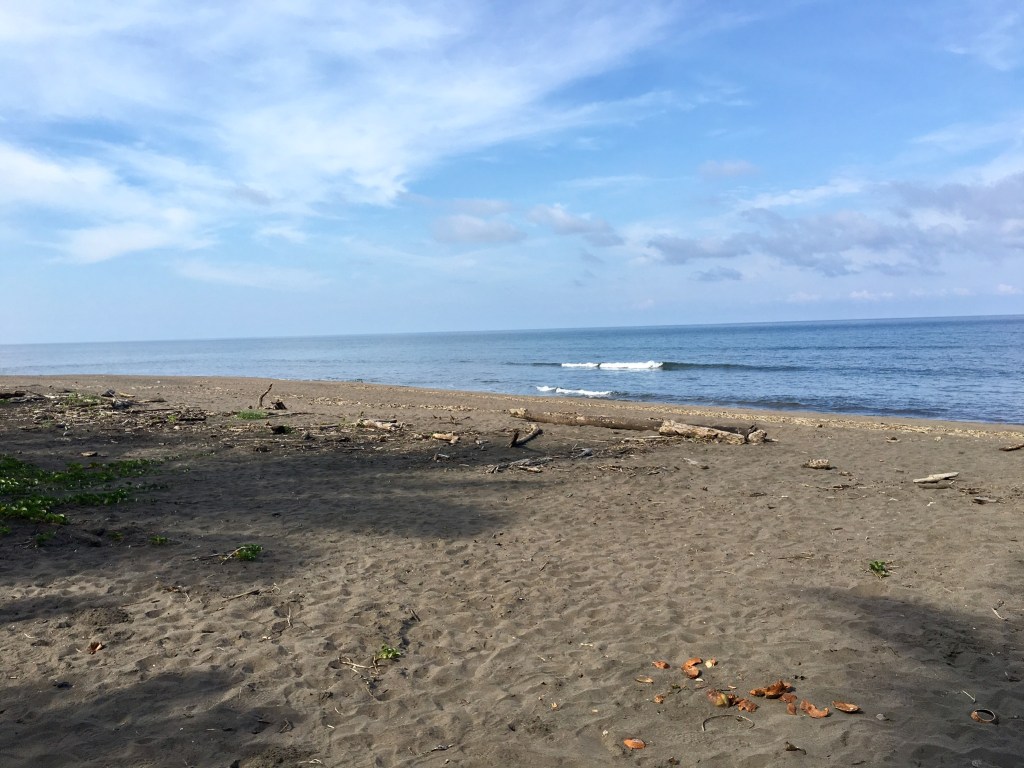
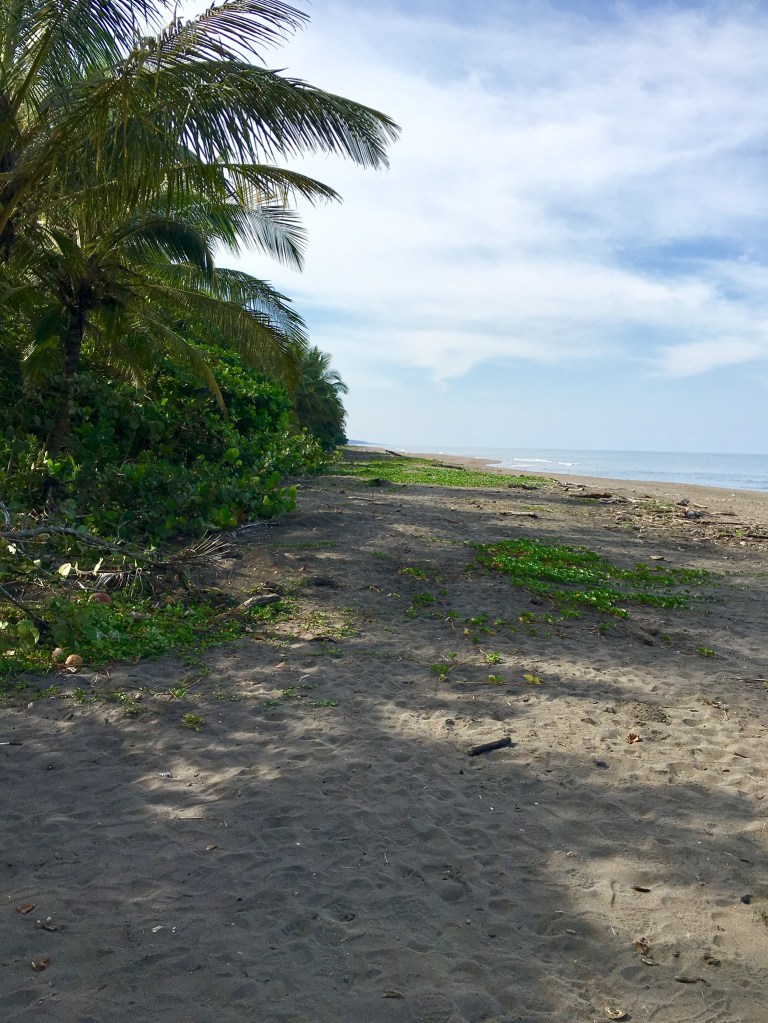
Bernardo showed us the turtle nests in the sand. We also saw some strange markings in the sand that Bernardo told us were turtle tracks from a female turtle going to and from the sea.
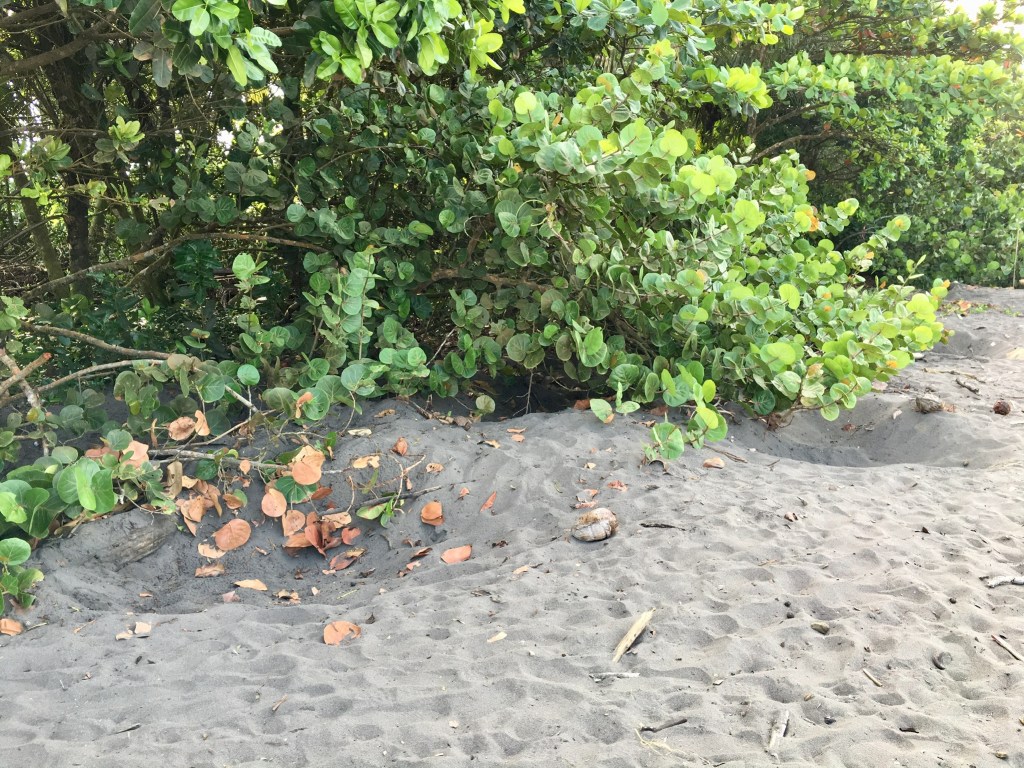
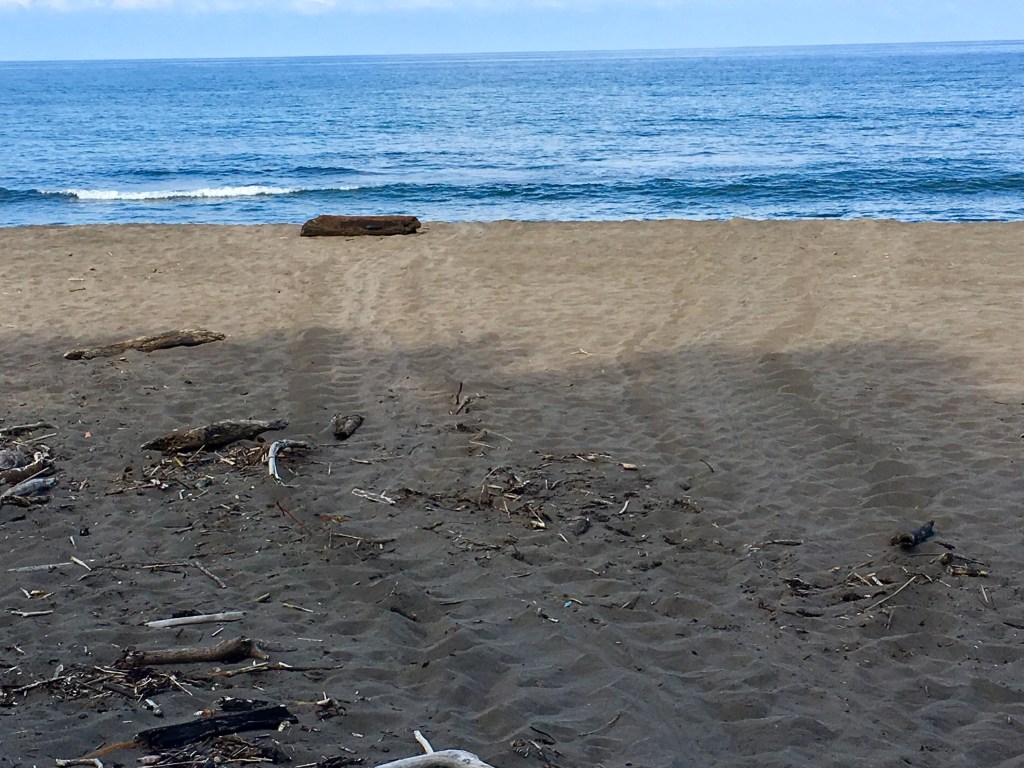
We could see from the posted sign on the beach that it is illegal to dig nests or touch turtles.

We moved from the beach to Tortuguero Village. My shoes were heavy again, so my first stop was to find a place to dump the sand from my shoes. So glad that John got a picture of that! A week later, I still have some sand stuck to my feet after wearing those shoes, even with socks!
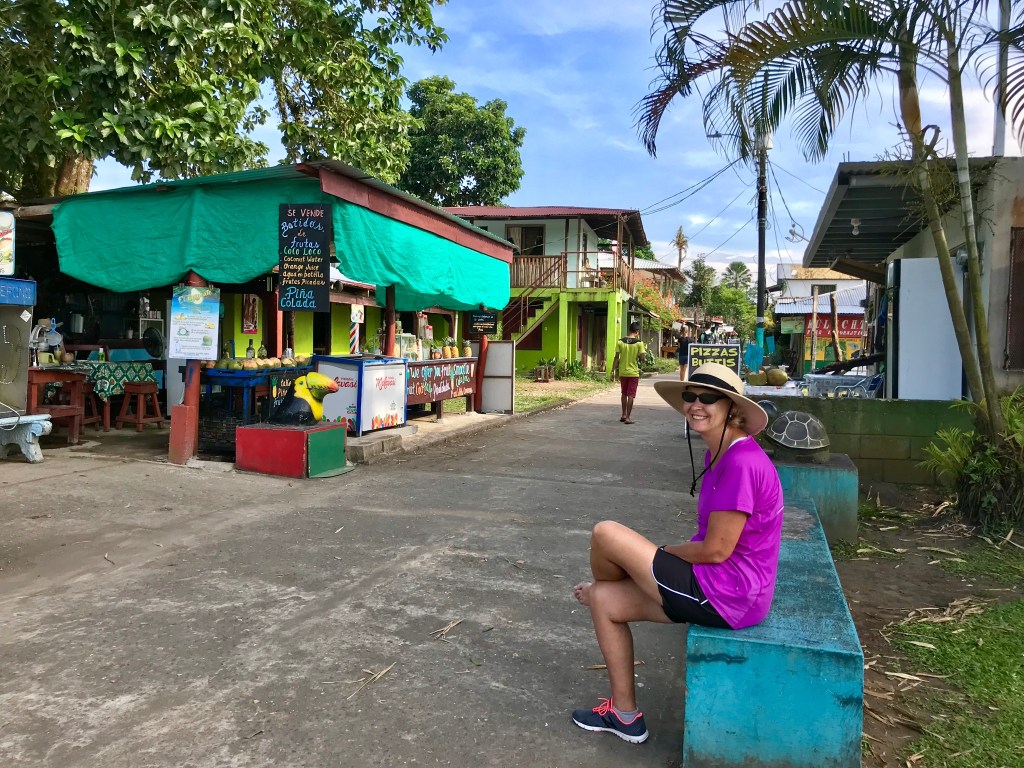
More about the village tour and our adventure that morning in our next post – stay tuned!
 Remember, it's an adventure.